
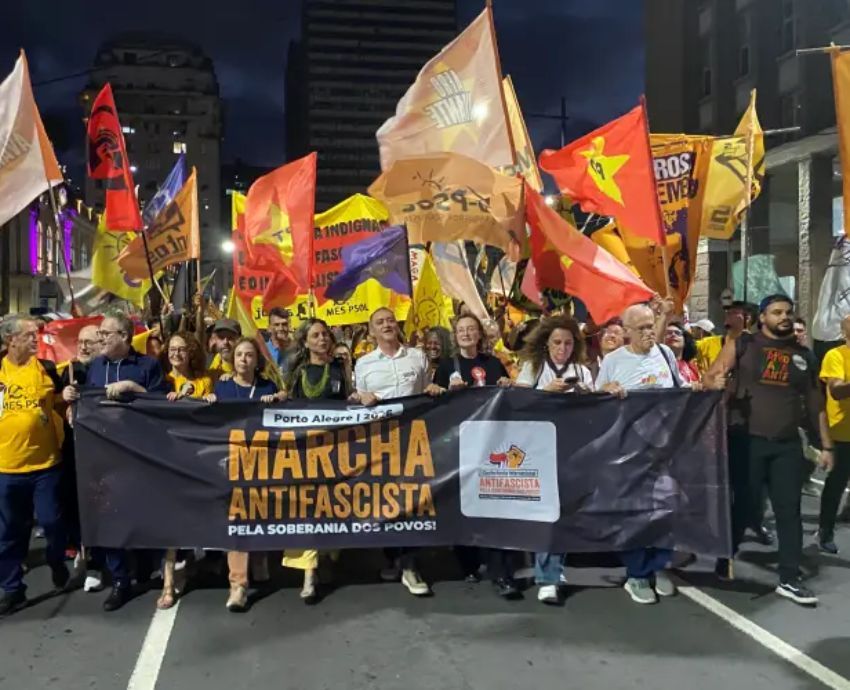
The first International Anti-Fascist Conference for the Sovereignty of Peoples, held in the Brazilian city of Porto Alegre on March 26–29, was an important step forward in organising the struggle against the far right across the Americas and internationally.
Four thousand activists from more than 40 countries across five continents took part. They sought to strengthen organisation against the various forms of fascism, the far right and the increasingly aggressive imperialist turn under capitalism.
The conference took place amid a week of significant international developments: the Nuestra América convoy to Cuba, which challenged United States President Donald Trump’s intensified blockade; street actions by more than 1 million people in Argentina against the far-right Javier Milei regime; and a large anti-fascist mobilisation in Britain. Perhaps most significant were the latest “No Kings” demonstrations in the US, involving up to 9 million people across hundreds of cities.
Valter Pomar, from Brazil’s Workers Party’ (PT), set the tone in the opening plenary. He said Trump is a product of a period of capitalist degeneration, in which the system increasingly turns to war. Capitalism and imperialism are intertwined, he said, and only socialism and a class-based agenda can provide an effective fightback.
Pomar emphasised that sovereignty spans from food to digital — from our oldest to newest needs — and must be realised as popular sovereignty through the defeat of the dominant classes.
Plenaries and key workshops actively opposed racism and women’s oppression and supported gender diversity.
Palestinian liberation was the most prominent international struggle raised. Several participants had been part of the recent Global Sumud Flotilla, including the chair of the Palestine plenary, who called the struggle “the cause of our times”.
The ambassadors for Palestine and the Arab League gave greetings. However, the spokesperson for Palestinian cultural groups — which danced before the plenary — characterised the fight best: “No one dances alone; no one fights alone.”
Opposition to the war on Iran was another recurring discussion.
A Cuban speaker received a standing ovation before they even started speaking, reflecting the conference’s universal solidarity with Cuba in the face of the US blockade.
The fight against the far right in Brazil and Argentina was the focus of two plenaries. In the opening session, Brazilian federal deputy Sâmia Bomfim — a Socialist Left Movement (MES) member elected through the Socialism and Liberty Party (PSOL) ticket — discussed how Brazil, led by PT President Luiz Inácio Lula da Silva, could present an alternative to Trump’s attempts to reassert US power through war and intervention.
She warned that the Bolsonaro clan — with jailed former president Jair being succeeded politically by his sons — continues to lead the far right and is meeting with Trump officials ahead of the next presidential election. Bomfim called for a street action plan to resist the Bolsonaro family.
There was also discussion about the “critical” upcoming election and the Brazilian left uniting to support Lula at the ballot box.
International collaboration enriched the discussion. Ukrainian and Russian activists, for example, found common ground in workshops addressing repression under Russian President Vladimir Putin and opposition to the invasion of Ukraine.
Sushovan Dhar, from the Indian branch of the Committee for the Abolition of Illegitimate Debt (CADTM), argued that several BRICS countries — including Russia, India and China — combine authoritarianism with neoliberalism, meaning “multipolarity is only for the elites”.
Rafael Bernabe, a former Puerto Rican senator, followed by invoking Vladimir Lenin’s warning against reducing popular struggles to “imperialist manipulation” and urging support for the rights of all peoples.
Young socialist activists from the US shared perspectives on fighting Trump within the imperialist core. In a panel of political representatives, Abdul Osmanu, a local councillor in Hamden, Connecticut, echoed Black Panther Bobby Seale’s call to “seize the time” in response to the right’s offensive.
Young Democratic Socialists of America (YDSA) ran a workshop highlighting Palestine solidarity encampments, unionisation drives, resistance to Immigration and Customs Enforcement in Minneapolis and socialist electoral victories, such as Zohran Mamdani’s win in New York City. These developments, they argued, are raising workers’ expectations and could help build a large-scale internationalist movement against Trump’s “neofascism”.
Jana Silverman, from the DSA, said that the US has a long history of interference in Brazil, dating back to the 1964 military coup. More recently, Silverman noted, the Barack Obama administration was found to have phone tapped and spied on the Brazilian president and top officials.
Silverman argued that Trump marks a shift from US “soft power” to “hard power”. While tariff threats against Brazil failed, Silverman said, Trump may look for a military response.
Parties in resistance
Porto Alegre, a state capital, has particular historical significance as the host of the early World Social Forums (WSF) beginning in 2001. That legacy was in the back of many people’s minds as they gathered for the anti-fascist conference, which also expressed support for the upcoming WSF in Benin in August.
CADTM, which has played an important role in the WSF, helped organise the conference and facilitated participation from Africa, South Asia and Europe.
Unlike the movement-oriented WSF, however, this conference was more party-oriented. Key organisers included MES, PSOL, Brazil’s Communist Party, the governing PT and Argentina’s Workers’ Socialist Movement.
International delegations included parties from across Latin America, YDSA members (particularly those aligned with the Bread and Roses caucus), La France Insoumise and sections of the reunified Fourth International. Three Socialist Alliance members from Australia attended.
A 7000-strong march opened the conference on March 26, with big party contingents from Brazil and Argentina.
Workshops were often used by parties — particularly MES — to present concrete action plans, while plenaries allowed for broader political perspectives on agreed topics.
Unions
Trade unions had a strong presence, with representatives from Latin America and Europe discussing how to confront neoliberalism and the far right. Hugo Godoy, from the Argentina’s Workers’ Central Union, highlighted Milei’s attacks on unions and the role of organised labour in any effective resistance.
Speakers from Brazil, Uruguay, Colombia, Mexico and Europe converged on a common conclusion: a strong, united workers’ movement is essential to resisting neofascism.
The message was clear — workers must fight on two fronts: the workplace and the political arena. Danilo Serafim, from the Rio de Janeiro teachers’ union, and Quintino Severo, from Brazil’s biggest union federation Unified Workers’ Central, emphasised that unions will play a decisive role in the struggles ahead.
Socialist Alliance member Clive Tillman ran a workshop on building worker power through global unions, where participants discussed how to harness international union networks and industrial connections to strengthen resistance to neoliberalism and the right.
Declaration
The conference adopted a declaration highlighting that imperialist capitalism is in deep crisis. It stated that imperialist powers’ response to this “has been the promotion of fascism everywhere, the imposition of neoliberal policies, military aggression against weaker nations, and their recolonisation”.
The declaration recognised the diversity of forces opposing the far right and the different approaches and conditions they face. However, it identified common features of the far-right threat: attacks on democratic freedoms and labour rights; the explosion of structural unemployment; privatisation and austerity; scientific and climate denialism; support for agribusiness and extractivism; ultra-restrictive migration policies; and a massive increase in military spending.
It highlighted how the far right seeks to redirect discontent with the disastrous consequences of neoliberalism towards oppressed groups: migrants, women, LGBTIQ people, racialised communities and national or religious minorities.
The declaration asserted that “imperialism is becoming increasingly unrestrained, aggressive, and militaristic”, pointing to the “explicit genocide in Gaza”.
While recognising political differences, it called for unified action across movements, centred on defending and deepening democratic rights, strengthening workers’ power, coordinating resistance to fascist violence and neoliberal precarisation, confronting ecological destruction and advancing agrarian reform for food sovereignty.
Finally, it emphasised the need for international coordination. Commitments were made to organise a future international conference involving new organisations and to create an international coordinating space, which would encourage regional and national anti-fascist and anti-imperialist conferences, beginning in Argentina and North America.
In Australia, we should consider how to contribute to this process, particularly as East and South-East Asia and Oceania were relatively underrepresented at the conference.