
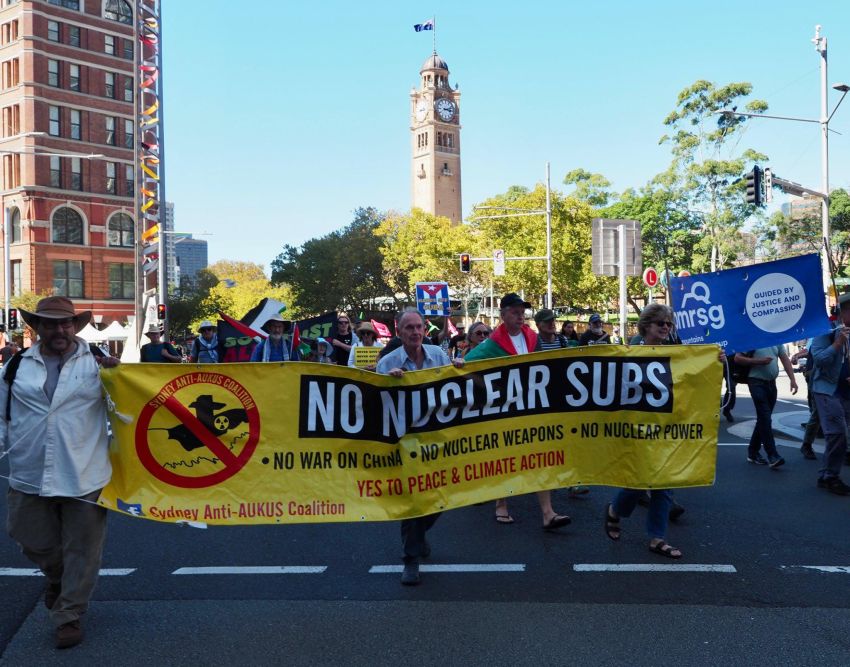
Australia’s minister for war Richard Marles came back from the annual “Shangri-La dialogue” in Singapore selling AUKUS like never before.
This is despite his United States war minister counterpart Pete Hegseth telling him what everyone else has known for years — the US cannot deliver the promised new Virginia-class nuclear-powered attack submarines.
Australia will instead now receive up to three second-hand ones at some point — despite having already given millions in down payments.
But Marles’ media statement kept shtum on this.
“AUKUS Pillar I remains on track to support Australia’s acquisition of a conventionally armed, nuclear-powered submarine capability,” it said.
When a journalist at the meeting of defence ministers from Asia-Pacific, North America, Europe and the Middle East asked Marles about the change, he batted it away saying: “All the submarines come to us after a mid-life sustainment [sic], so a refresh, if you like.”
The US Congressional Research Service had already strongly hinted last year and again this year that the US didn’t have capacity to build extra nuclear-powered submarines, as they are behind on their own.
Marles continues to talk up the expensive defence pact, telling the ABC somewhat incomprehensibly on June 1: “They have the life to take them where we are now to the future, where we will be operating the submarines we’re building in Adelaide.”
The submarines being built in Adelaide are only expected to be delivered sometime in the early 2040s. For a minister hell bent on talking up “threats” to Australia, Marles’ arguments about the need to spend so much on offensive war-fighting capacity against a supposed threat — China — that the US has just said is not a threat, do not stack up.
Given that AUKUS is bipartisan policy, parliament has blocked all calls to hold an inquiry.
However, a people’s public inquiry into AUKUS, announced on June 2, will attempt to shed light on some of the many questions related to the decision-making behind spending upwards of $368 billion on weapons for wars.
The AUKUS public inquiry, coordinated by the Australian Peace and Security Forum (APSF), announced it will hear and take submissions and report back in October.
Its terms of reference include: Where and how will the high-level nuclear waste be stored? How many jobs will be created and at what opportunity cost? Why is Australia joining the US to potentially go to war on China, our largest trading partner? Will AUKUS make Australia safer or turn us into a nuclear target?
A group of former MPs, retired military and naval officers, strategists and academics, human rights lawyers and union leaders are a part of the inquiry.
They include retired general Michael G Smith, former Labor MPs Doug Cameron, Carmen Lawrence and Peter Garrett. Karina Lester, a Yankunytjatjara woman from the Anangu Pitjantjatjara Yankunytjatjara Lands, is another commissioner, alongside The Australia Institute co-CEO Leanne Minshull.
The APSF said the inquiry will ask if the nuclear-powered submarines will keep Australians “more secure” and explore the implications for Australia’s nuclear non-proliferation commitments.
It also wants to assess the economic, technological and employment effects of AUKUS-related initiatives, as well as the environmental, health and safety consequences of nuclear technology and waste management, particularly for First Nations peoples.
Finally, it aims to “generate broad public awareness” of AUKUS.
Smith said that AUKUS lacked “legitimacy” and its impact would be “felt by generations to come”. He said it did not suit a “changed strategic environment”, adding that the US “has basically walked away” from the “rules-based order”.
“We need to rethink our national interests and AUKUS is very questionable,” Smith said. “Make no mistake on the US submarines; we’ll have very little say.”
Lester, who has spent decades campaigning against nuclear waste being dumped on sovereign land, said: “For First Nations peoples, AUKUS is not an abstract policy debate. It is a question about land, country, and waterways. It is a question about where nuclear waste will be transported, where it will be stored, and how it will be managed, on and across Country that has already borne the costs of Australia’s nuclear history.”
Smith said parliament needs to “reconsider this mammoth decision” and he hopes this inquiry will help push that along.
APSF spokesperson Peter Garrett said: “A commitment of at least $368 billion to one particular form of defence, made with very little public debate, and with significant questions still unanswered, is not good enough for a democracy.”
He encouraged people to make submissions and hinted that there would be public hearings.
Lawrence, former Labor premier of Western Australia and former federal MP, is one of the five commissioners. She said the inquiry would ask questions that should have had answers years ago, including what contingency plans exist for a nuclear accident near Fremantle, Rockingham or Perth. Another question is if aligning Australia so closely with the US war posture is making us safer or exposing us to greater risk.
“They are the questions citizens in a democracy have a right to ask and to have answered,” Lawrence said.
[The AUKUS public inquiry meeting dates can be found here.]