
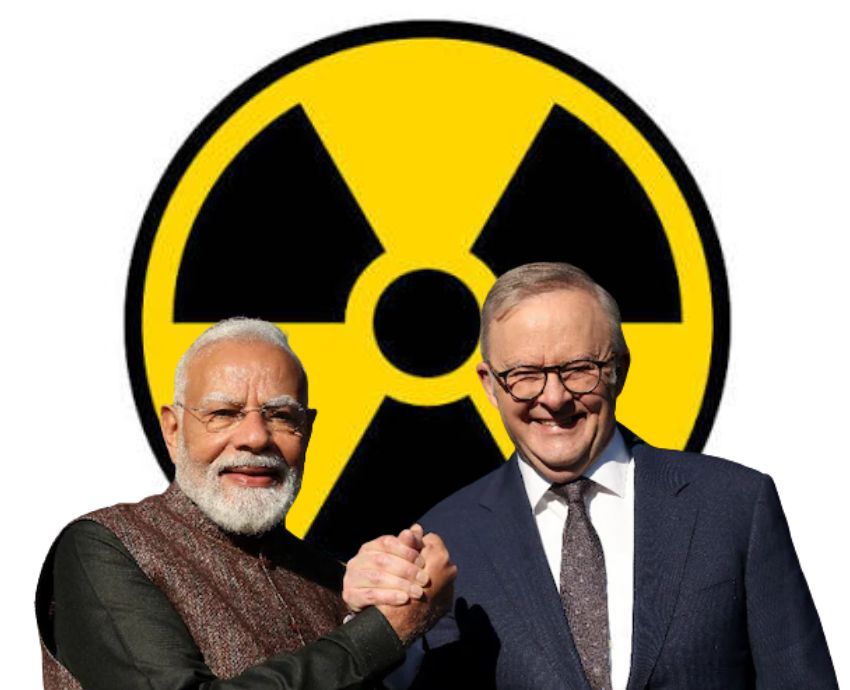
Australian politicians have become accustomed to toadying. On his visit to Naarm/Melbourne last week, Indian Prime Minister Narendra Modi was greeted by an evangelical atmosphere unseen and — it should be said — needless for other political leaders.
Indian Australians mean votes for Australian Labor MPs. A growing Indian economy means returns: Education, services and, as became so clear on this Modi trip, uranium.
The Australian and Indian governments on July 9 minted an administrative arrangement permitting the sale of uranium to an ever energy hungry India. The Australia-India Joint Statement on Energy Security confirmed arrangements “necessary to enable the export of Australian uranium to India for exclusively peaceful purposes and under International Atomic Energy Agency (IAEA) safeguards, as provided for under the Australia-Indian Nuclear Cooperation Agreement (2015)”.
In Modi’s words, this will “give our clean energy objectives [sic] fresh momentum”.
Australian uranium, which accounts for almost 28% of global sources, is seen as essential for India to reach its goal of 100 gigawatts of nuclear energy capacity by 2047.
There was much in the way of ignominious foot washing by Anthony Albanese’s government and the largely starry-eyed media corps. The Australian Financial Review celebrated the “landmark agreement that will pave the way for a flood of exports to India, finally making good on a nuclear co-operation pact between the nations signed more than a decade ago”.
Mining corporation publicists also featured the deal. “The uranium industry is just one of the things that can help make sure we continue to enjoy the world’s highest standards of living in Western Australia,” stated Jonathan Fisher, chief executive officer of Cauldron Energy.
The Minerals Council of Australia (MCA) reiterated its call to overturn the uranium mining bans, which exist in all jurisdictions with the exception of South Australia and the Northern Territory. Fisher said such prohibitions were a product of “ideology” rather than “practicality”.
MCA chief executive Tania Constable said: “It puts us in the box seat to meet India’s ambitious goals on nuclear power … [and it] sends a strong, clear message that Australian uranium and Australian mining is of great strategic importance to India.”
The uranium deal, however, ignores the enormous problems that arise from supplying New Delhi.
International law academic Donald Rothwell advised the International Campaign to Abolish Nuclear Weapons (ICAN) in November 2011 that this would violate Article 4 of the South Pacific Nuclear Free Zone Treaty (Treaty of Rarotonga), unless India subjected its entire nuclear infrastructure to comprehensive safeguards and invigilation by the IAEA.
Article 4 bars parties from providing “source or special fissionable material, or equipment or material especially designed or prepared for the processing, use of production of special fissionable material for peaceful purposes to (i) any non-nuclear-weapon State unless subject to the safeguards required by Article III.1 of the NPT, or (ii) any nuclear-weapon State unless subject to the applicable safeguards agreements with [the IAEA)”.
“rticle III.1 of the Nuclear Non-Proliferation Treaty (NPT) place obligations on non-nuclear-weapon state parties to accept safeguards to be negotiated with and concluded with the IAEA “with a view to preventing diversion of nuclear energy from peaceful uses to nuclear weapons or other explosive devices”.
Former Coalition Prime Minister Malcolm Fraser was also sceptical, opining that “selling uranium to India would breach our international obligations”. In January 2012, Fraser warned the then Julia Gillard Labor government that permitting exports of uranium to India would nourish a global spread of nuclear weapons.
India, along with Pakistan, Israel and North Korea, are not members of the NPT. (North Korea announced its withdrawal from the treaty in 2003.) For that reason, New Delhi was, for decades, prevented from securing uranium purchases and various associated nuclear products from members of the Nuclear Suppliers Group (NSG). Its refusal to accept full-scope safeguards, allowing the IAEA freedom to inspect all nuclear facilities, also compounded matters.
Despite this, India secured an exception in 2008 when the NSG, of which Australia is a member, voted to permit uranium exports to India. Then Indian Prime Minister Manmohan Singh lauded the dispensation, saying it marked “the end of India’s decades-long isolation from the nuclear mainstream and of the technology denial regime”.
Despite the 2015 bilateral agreement between Australia and India on the supply of uranium, the Parliamentary Joint Standing Committee on Treaties (JSCT) recommended that sales could only start after India had met various conditions regarding nuclear regulation, routine inspections and decommissioning plans.
ICAN’s 2014 submission to the JSCT included arguments for Australia not to ratify the treaty for a number of reasons that remain the case. India is a member of the NPT, which means it is not obligated to pursue negotiations in good faith for nuclear disarmament. It has not made other legally binding undertakings to disarm. ICAN said that to supply India with uranium questions Australia’s own commitment to the NPT and jeopardises the crucial understanding that parties signing up to the NPT would be able to access nuclear materials and technology for non-military purposes as long as they renounce the acquisition of nuclear weapons.
ICAN’s submission further dispenses with the image of India as an “impeccable” international citizen on the question of nuclear non-proliferation.
Its first nuclear test in 1974 was conducted using material and technology provided by the US and Canada intended for non-military purposes. The “development of nuclear weapons sparked a nuclear arms race with Pakistan, which led to a series of nuclear tests in the late 1990s, and is still ongoing”, ICAN said. Australian uranium would also benefit the Indian nuclear weapons program by permitting New Delhi to use domestic reserves, as imported uranium is preferred to power civilian reactors.
New Delhi has also shown itself to be unreliable, even dangerous, in another respect.
In his 2021 annual threat assessment, Australian Security Intelligence Organisation director-general Mike Burgess announced that a foreign spy ring had been operating in the country. It was subsequently revealed that the Indian foreign intelligence agency, known as the Research and Analysis Wing, had furnished the spies in question.
Not only was it responsible for gathering information on Australian defence projects, the country’s state of airport security and classified material on trade relationships, it was also gathering information on members of the diaspora. Sikhs, suspected of fostering secessionist tendencies in India, figure prominently on that list.
Despite this, successive Australian governments have fallen for Modi, despite his sectarianism and bad record on human rights. Modi knows that money does not so much talk as bellow, drowning out human rights advocates and those who wish to see a world free of nuclear weapons.
[Binoy Kampmark lectures at RMIT University.]