
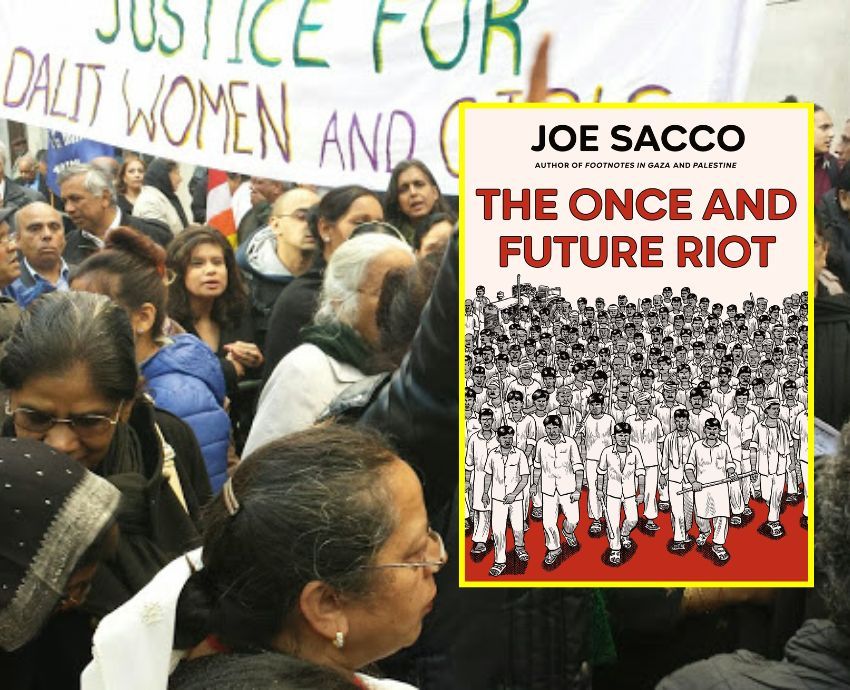
The Once and Future Riot
By Joe Sacco
Jonathan Cape, 2025
The Once and Future Riot, about the communal violence between Hindus and Muslims in India’s Uttar Pradesh state, is a superb work of comics journalism from the genre’s master and founder Joe Sacco.
Best known for Palestine, Safe Area Goražde and Footnotes in Gaza, Sacco combines interviews and historical research with detailed black-and-white drawings to depict the experiences of people caught up in war, occupation and political upheaval.
This new book centres on the Muzaffarnagar riots of 2013, in which dozens were killed and many more displaced.
Sacco interviewed victims, witnesses and local leaders from Muslim and Hindu communities, assembling a layered account of how tensions were inflamed and violence unleashed. As in his earlier books, he is less interested in moral simplification than in the difficult work of listening, reconstructing and placing testimony in context.
Sacco traces that context back through the partition of India and Pakistan in 1947, the 1992 destruction of the Babri Mosque in Ayodhya and the 2002 anti-Muslim violence in Gujarat, when Narendra Modi was chief minister of the state. The Muzaffarnagar riots helped propel Modi to the prime ministership and the Hindu nationalist Bharatiya Janata Party to victory over the Congress Party, which had dominated Indian politics since independence.
Sacco’s interviews make clear that while neither side is entirely without blame, the greater share of violence has come from the Hindu side, while Muslim communities — many of them poorer agricultural workers and labourers — have borne the brunt of the suffering.
The Once and Future Riot’s pages are crowded with the textures of everyday life, but also with crowds of angry faces and rioters wielding sticks, swords and other weapons.
Although its focus is on one relatively contained incident, it becomes an entry point into contemporary Indian politics and the dangerous nationalist turn of the world’s largest democracy. It leaves the troubling impression that future waves of violence are not only possible, but likely.