
NSW Premier Chris Minns continues to defend his NSW Labor government’s anti-protest laws, despite the NSW Court of Appeal striking them down in April as unconstitutional.
The Public Assembly Restriction Declaration (PARD) laws, amendments to three acts, were rushed through parliament after last December’s Bondi terror attack. They included giving the police commissioner the right to stop public assemblies in “restricted” areas after a terrorist event and the power to renew the restrictions for 90 days.
Since then, Minns said he “absolutely” stood by the laws, despite the justices finding that they were “was not compatible with the maintenance of the constitutionally prescribed system of representative and responsible government”.
NSW Police Commissioner Mal Lanyon, NSW Assistant Commissioner Peter McKenna and NSW Police Minister Yasmin Catley have also defended the laws.
The judges found that the laws was were unconstitutional because they sought to shut down all protests — rather than those that may be deemed to provoke another terror-related incident. They said there was a “lack of proportionality between the notionally legitimate objective and the means chosen to pursue that objective”.
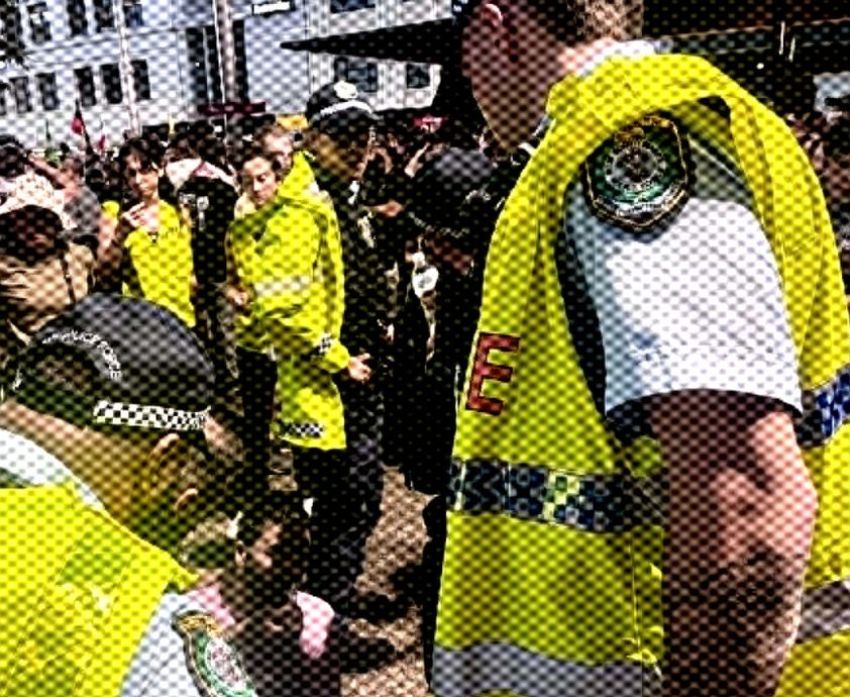
Meanwhile, it’s week 14 of the Law Enforcement Conduct Commission’s (LECC) investigation into more than 800 complaints about police conduct at the Gadigal Country/Sydney protest in February against visiting Israeli President Isaac Herzog.
The LECC said on May 24 that 556 of these complaints were made directly to the commission and 267 to police. Commissioners are said to be reviewing 450 items submitted through its portal and more than 1000 hours of CCTV footage. It will also consider video footage from police body cameras.
Senior police officials were quick to defend the force’s behaviour in February. Lanyon said the police did “what they needed to do” at the Herzog protest and showed “remarkable restraint”.
The video footage and thousands of witnesses say otherwise.
Questions have been raised about the LECC investigation, as police do not have to provide information that they deem to be “contrary to the public interest”.
Under section 179 of the Law Enforcement Conduct Commission Act 2016, the police commissioner may “at any time” notify the LECC that it will not provide certain information, known as “police information” or “critical police information”.
The LECC said in March it expected to conduct “some public hearings” in the second half of this year. It said this month that these would not start earlier than September, possibly because of the amount of evidence against the police it has to review.
Meanwhile, NSW Police announced on May 13 it had dropped charges of resisting arrest and failure to comply with a police direction against a 25-year-old Palestinian Australian man who was arrested as he tried to protect a group of people praying at the Herzog rally.
Lanyon told ABC radio on May 13 that, pending a review, charges would be dropped against others charged under the PARD laws. However, another 29 people were charged with offences that fall outside the PARD laws, making it unclear how, or if, the LECC investigation will affect those charges.
He also said there was another investigation into whether police directions under a “major events” declaration law, which gave police expanded move on and search powers, were lawful. Minns has previously said those charges should still apply.
Fourteen protesters had their matters adjourned on May 13, to allow for a review of the charges. But the police prosecutor told the Downing Centre local court that there were “further reasons”, including “considerations to other challenges in relation to other acts”.
Nick Hanna, who is representing some of those who have been charged, told the Guardian that while he hoped charges would be dropped against all 30 people, it remains unclear what police will do about the charges that did not come under the PARD. He said attempts to “untangle” who was charged under the PARD was an “artificial exercise”.
“The simple reality is that the police crackdown [at the Herzog protest] was, in no small part, due to the police refusing to facilitate the peaceful march from Town Hall to Parliament House, and that refusal was based almost entirely, if not entirely, on the existence of that PARD,” Hanna said.
Meanwhile, Timothy Roberts, NSW Civil Liberties Council (NSWCCL) president, said on May 25 that there is significant opposition inside NSW Labor to the anti-protest laws. He said they were among the harshest in the country, are “undermining democratic freedoms and community trust” and he urged Labor party members and union leaders “to show leadership” and “help turn a new page”.
Roberts said that maintaining the right to protest is the “single most submitted issue by Labor branches and affiliated unions” ahead of the annual NSW Labor Conference over July 4–5.
The NSWCCL said Labor branches and trade unions have passed 56 motions calling for the repeal of anti-protest laws, specifically the Roads and Crimes Legislation Amendment Act 2022, which criminalises environmental protesters who undertake unauthorised protests that obstruct or disrupt major roads, bridges or industrial facilities.
They also want the Crimes Amendment (Places of Worship) Bill 2025 amendment to the Crimes Act 1900 to be rescinded.
Anastasia Radievska, spokesperson for the Australian Democracy Network (ADN), said: “It’s time for Labor to realise that Australians expect to be able to peacefully assemble, demonstrate and speak out without facing disproportionate legal restrictions or aggressive policing response.”
Asrah Sobh, a teacher and member of the Parramatta Labor branch, said the government should not be trying to criminalise peaceful protests. “Seeing peaceful demonstrators met with aggressive policing [at the Herzog protest] reinforced for me why the right to protest matters so much. No one should fear police violence or political repression for peacefully standing up for what they believe in.”
NSWCCL said concerns about Minns’ anti-protest laws are broadly shared across Labor, with Anthony D’Adam MLC, Cameron Murphy MLC, Stephen Lawrence MLC, Jihad Dib MP and Sarah Kaine MLC all raising concerns about police violence at protests.
Sixty-nine faith groups, unions and legal organisations signed an open letter in February calling for an independent inquiry into the use of excessive police force during the Herzog protest.
NSWCCL and the ADN are calling on Labor party members, unions and conference delegates to support motions to protect the fundamental right to peacefully assemble and march.