
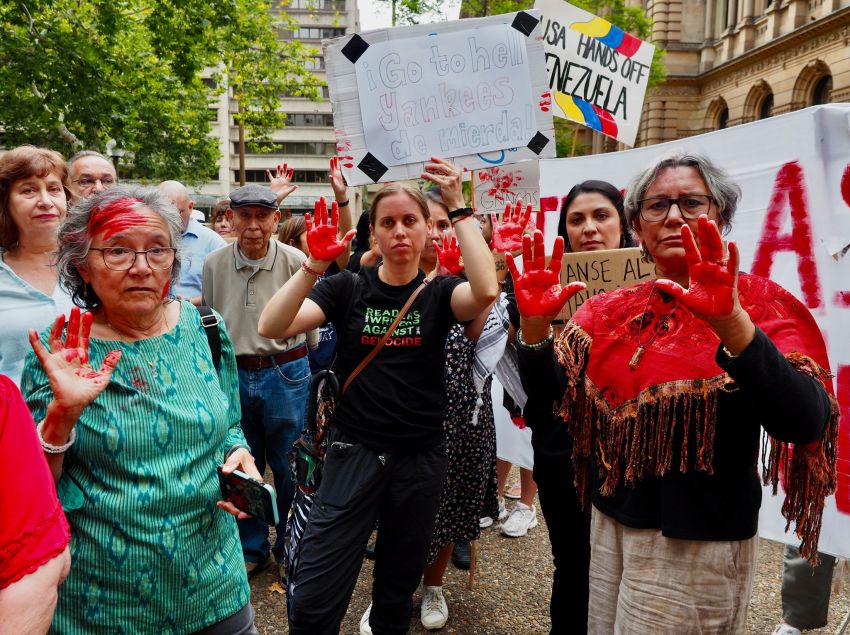
On January 4, my fellow anti-imperialist comrades and I defied the recent prohibition on protests in Sydney’s CBD, imposed through the Public Assembly Restriction Declaration.
As I shouted “Hands off Venezuela!” and held a sign that read “Go to hell, Yankees de mierda!”, I kept thinking about two stories from my homeland, Uruguay. Both occurred during so-called democracy. Both involved activists who resisted newly enacted authoritarian laws. And both unfolded in the years immediately preceding a civic-military dictatorship.
Now, as the Combatting Antisemitism, Hate and Extremism Bill 2026 has just passed, and with the Greens having labelled it “dangerous”, warning it could have a “draconian effect” on political debate and peaceful protest, these stories feel uncomfortably close.
Not because so-called “Australia” is Uruguay, but because Uruguay, too, was once told that extraordinary laws were necessary, temporary and meant to protect democracy.
I think about these stories because I know I will not stop my activism until we are all free.
The first is the story of Líber Arce, a name that, remarkably, means to liberate oneself.
He was martyred for his activism. For context, this murder by the state happened in 1968, four years and 10 months before Uruguay’s civic-military dictatorship of 1973–85. Arce was 29 years old. He was a street vendor, a dentistry student and a member of the Communist Youth Union.
On August 12, 1968, he joined hundreds of university students in a peaceful demonstration in downtown Montevideo to protest the implementation of the Prompt Security Measures — laws introduced by President Jorge Pacheco Areco, which granted the government sweeping powers to detain, censor and silence opposition.
The language was familiar: Security, order and extremism. The promise was familiar too — that these powers would be used responsibly.
The police response was brutal.
A Section 9 police vehicle arrived at the protest. Among those inside was officer Enrique Tegiachi. Without warning, he opened fire on the crowd. Arce was shot. Fellow students carried him to hospital, but despite emergency surgery, the injuries were too severe. He died from haemorrhage.
On August 14, a massive crowd attended his funeral. That day has since been commemorated as Student Martyrs’ Day, honouring those who lost their lives resisting repression that arrived dressed as democracy.
A few years later, still during so-called democracy, in 1971, my uncle, folklore singer and activist José Barroso Benavides was just 16 years old, when he marched peacefully with his friend Lilian Rosado, who would later be detained by the state. Along with other students, they walked from their high school towards General Flores Street, four or five blocks away, to join protests against the Prompt Security Measures. They sang. They chanted. They called out against fascism.
Once again, the state responded with violence.
On the corner of their school stood a boliche — a small tavern where people gathered to drink, dream, drown and escape. As my uncle and Rosado approached, chaos erupted ahead. Screams cut through the air. Students scattered. Gunshots rang out. Whizz. Whizz. Whizz.
A police officer had opened fire on the group.
They ran back towards the school. The cleaner on duty opened the door to let them in. As they entered, the officer followed and grabbed one of the female students by the arm. The cleaner immediately seized her other arm and shouted “This is my daughter — let her go!”
It was a lie. The girl was not her daughter, not even of her blood. But in moments like this, we are all familia. Miraculously, the officer let go.
They locked themselves inside the school while the officer waited outside, knowing reinforcements would soon arrive. Inside, the students huddled together, whispering in fear.
¿Qué hacemos? ¿A dónde vamos? ¿Qué pasa si nos quedamos? [What do we do? Where do we go? What happens if we stay?]
Then a fellow student, Daniel Maciel, who was pro-National Liberation Movement, cried out: “Ouch, they hit me with a stone!”
They gathered around him. When they lifted his jumper, they saw blood soaking through his shirt. It wasn’t a stone. He had been shot.
The cleaner called a teacher she trusted, someone who stayed back late and had a car, and together they devised a plan. There had to be another way out. They escaped through the back door, climbed the fence and rushed Maciel to the nearest clinic. He survived.
Uruguay did not fall into dictatorship overnight. It happened step by step — through laws that restricted assembly, criminalised dissent, expanded police powers and reframed political opposition as a threat to public order.
Many believed the institutions would hold. Many believed it could not happen there.
When I see protest bans normalised in Australia, when I hear peaceful activism discussed as “extremism”, when new laws promise protection while narrowing the space to dissent, I recognise the pattern.
History does not repeat itself exactly — but it teaches, if we are willing to listen.
That is why I protest. That is why I shout. That is why I remember. Because nunca más is not just a slogan, it is a responsibility.
[Natalia Figueroa Barroso is a writer of Uruguayan descent with Charrúa, Yoruba and Iberian origins. She is a member of Sweatshop Literacy Movement and has degrees in communications, screenwriting and media production from UTS. This article was first published on her Substack and is reprinted with permission.]