
Nine women have been killed by domestic and family violence in Australia so far this year. According to the Counting Dead Women campaign, some of the deaths are the result of femicide — intentional killing with a gender-related motivation. It’s the most extreme form of misogyny, a deeply ingrained prejudice that Australia has still not eradicated.
Discrimination against women and girls, gender stereotypes and harmful social norms still shape behaviours at home, in workplaces and schools and, increasingly, in public and online spaces.
We know from the latest statistics that despite efforts to stop intimate partner violence, it continues. Last year, 51 women died violent deaths. Even in rich Australia, with its equal opportunity and anti-discrimination laws, a culture of misogyny remains embedded in almost all spheres.
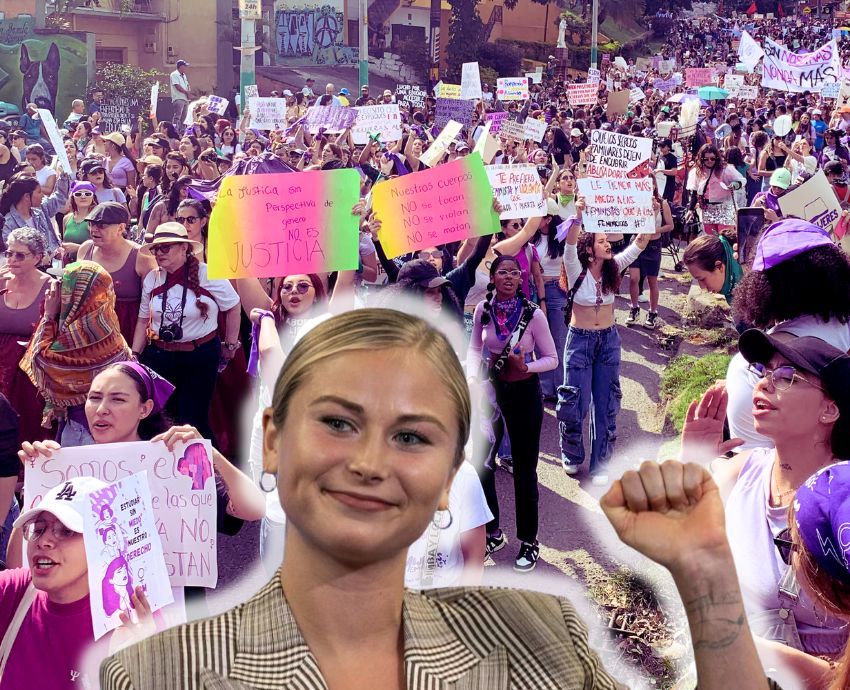
Prime Minister Anthony Albanese’s astoundingly patronising descriptor of Grace Tame as “difficult” is the latest high-profile example of just how embedded these prejudices are.
Tame, herself a survivor of sexual violence, has done the country a huge service in educating about misogyny and how to eradicate sexual violence in institutional settings. Tame was feted for her work in 2021, ironically by then-PM Scott Morrison. But when she started to look at the systemic nature of violence, pointing out how misogyny is part of present wars, including the Israeli state’s war on women and children in Gaza, she suddenly became “difficult”.
Albanese has form. In 2024, he demanded to speak at an anti-sexual violence rally outside Parliament House. Sarah Williams, an organiser from What Were You Wearing, had asked MPs to come and show solidarity, but said victim survivors needed to have the platform. However, Albanese marched up and took the microphone and was heard saying “I’m the prime minister … to be clear we did ask to speak … and were told that wasn’t possible.”
Williams was pushed aside, humiliated by a PM with the national cameras rolling. The irony was lost on Albanese, who could have simply listened to the rally’s list of demands, including for specialist courts to deal with sexual assault and alternative ways of reporting violence, instead of to the police.
After grabbing the microphone from Williams, Albanese said Australia must “do better”, adding, “we need to change the culture, we need to change attitudes”.
Two years later and Albanese’s comments about Tame — and his attempts to brush it off as being nothing of consequence — show that this Labor PM’s attitudes have not changed for the better.
We’re told that nine in 10 say gender equality is “important”. However, according to the Status of Women Report Card 2026, the national gender pay gap is still at a high of 11.5%. It rises to 21.1% for total remuneration within medium and large employers. For Aboriginal and Torres Strait Islander women, they earn 35.3% less than all Australian men.
These statistics tell a story of systemic gender inequality. The federal government’s report card advises that “progress” has been made, with workforce participation reaching a record yearly average of 63.1% last year, with more women in leadership roles. However, it admits that “women still shoulder most unpaid care, face high rates of intimate partner violence, and continue to earn less than men”.
Unpaid domestic work is essential work. It’s a given under capitalism that this essential work will remain unpaid labour, because otherwise it would cost billions.
If women were remunerated for their unpaid work of raising the next generation and looking after older people, the Australian state would be forking out about $700 billion, or about $40,000 each year, on average, per woman.
Women are still largely employed in female-dominated occupations, such as nursing, early childhood education and teaching, where pay rates typically lag behind inflation and housing costs.
These material factors affecting systemic discrimination against women are the basis for sexist and misogynistic attitudes. This is reflected in the glaring statistic that nearly a quarter of the population (22%, according to the Australian Bureau of Statistics) experience sexual violence.
Without a nationwide effort to change the material realities underpinning society and economy, women will continue to bear the brunt of misogynistic attitudes and their inherent potential for violence and death.
We can only hope that Albanese’s lame apology for his Freudian slip about Tame continues to infuriate and spur more women into becoming “difficult” and continuing to challenge misogyny, colonialist wars and racism.