
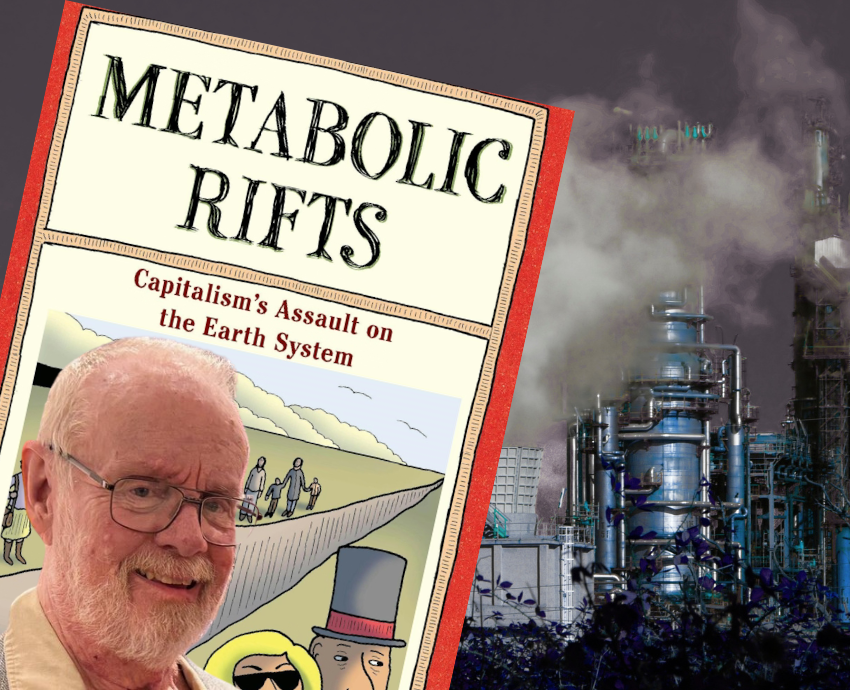
Ian Angus (pictured above) is the editor of the online ecosocialist journal Climate and Capitalism, a founding member of the Global Ecosocialist Network and author of Facing the Anthropocene: Fossil Capitalism and the Crisis of the Earth System.
Marxist economist Michael Roberts recently spoke to Angus about his new book, Metabolic Rifts: Capitalism’s Assault on the Earth System, which has been published by Monthly Review Press. The following is an edited version of the interview transcript.
Angus will be a featured speaker at the Ecosocialism 2026 Conference in Magan-djin/Brisbane, Australia, from September 11–13.
* * *
What’s the main message of your new book?
It’s hard to believe it now but, until roughly 25 years ago, it was pretty much assumed by Marxists and non-Marxists that [Karl] Marx had not much to say about nature and didn’t really care very much about what happened in the natural world.
[Marx’s collaborator, Frederick] Engels seemed a little odd in the fact that he was doing all sorts of reading and research on nature, whereas Marx wasn’t. Around the turn of the century, two authors — John Bellamy Foster and Paul Burkett — went back to what Marx actually had to say, as opposed to repeating a few sentences out of context.
They showed that Marx in fact was deeply concerned about the natural world and how humanity related to it. In particular — related to my book — Foster showed the development in Marxist thought of the concept of the universal metabolism of nature — that human beings are not just in nature but part of it and that we exist by constantly interacting with it.
You can think of this at the simplest level: we breathe in oxygen and breathe out carbon dioxide and plants do the opposite. That metabolic relationship makes our lives possible.
If plants, people and animals didn’t work the way they do, there would be no life on this Earth, or very little. Extending beyond simply those concepts, Marx studied the work of Justus von Liebig, a German chemist, probably the leading agricultural chemist of his time.
Liebig studied why production in English farms had been going down. Why was it they were having to add more fertiliser every year to get the same crops? He showed that another part of our metabolic relationship with Earth is that we grow our food and it takes nutrients out of the soil.
Traditionally, within cultures where people almost all lived on the land, those nutrients went back either in our excrement or when we died. But once capitalism came along with an economy that involved substantial market operations, in which people grew food not for their own consumption or their neighbourhood but for it to be shipped off to cities or distant locations, the nutrients were being taken out of the soil and not put back. That was one of Liebig’s great discoveries and what Marx described as a “metabolic rift”.
What did he mean by a metabolic rift exactly?
He means that the metabolic relationship with the soil in that case was broken. The nutrients that had to come out of the soil and go back in simply for us to continue to get food, instead were being taken out and ending up as waste. Ending up, as Marx says [in Volume 1 of Capital, that] they can see no better use for human waste in the cities than to dump it into the river.
The Thames [River, in London] got so clogged with pollution that parliament had to shut down because it smelled so bad in the 1850s. That was the beginning of the concept — in order for us to survive as a species and to maintain what Marx calls a constant interchange, or constant dialogue, with nature. Here was a point at which we had broken it. He considered this very important.
You mention two cycles in the book: carbon and nitrogen cycles. Can you explain that a bit more?
The carbon one I’ve already described to some degree. Carbon is the fourth-most common element in the universe and it’s the second-most common in our bodies. We need it.
In fact, all living things require carbon to exist.
We know that plants take in carbon dioxide, release oxygen, but also the carbon in their physical bodies, in the plants themselves, ends up going back to the soil when plants die. There is a cycle of carbon constantly being circulated.
Similarly, we are part of that because we breathe in oxygen and our bodies combine it with carbon for our bodies to function, and we breathe out carbon dioxide.
The other thing that scientists discovered in the 1800s was that carbon dioxide, in addition to its function in building our bodies, was actually maintaining the Earth’s temperature at a steady rate.
For millions of years, the amount of carbon dioxide that living things took in was roughly matched by the amount we put out again. There was a steady cycle and the Earth’s temperature varied up and down — because nothing’s absolutely stable — but it was fairly stable until very recently.
What we started to do in the beginning of the 1800s and taking off in the 20th century, was to dig up buried carbon. Carbon that for millions of years had been buried in the ground and was having no effect on us or the climate, because it was so deep. We dug it up in the forms of coal and oil. I’m saying “we”, but we’re talking basically about industry and corporations doing this.
When you burn carbon, it combines with oxygen. Carbon plus oxygen is carbon dioxide.
When it gets into the atmosphere, it stays there. There are other things that go into the atmosphere and come back down in a few years, but the typical life of a molecule of carbon dioxide in the atmosphere is anywhere from 2000 to 10,000 years before it comes out by natural processes.
That means if you’re burning an awful lot of carbon, which we’re doing, the amount of carbon in the atmosphere just keeps going up.
How does the nitrogen cycle fit into this?
The nitrogen cycle is another element that is essential to life. Almost every molecule in your body has got nitrogen in it.
Nitrogen is essential for living things. But the nitrogen supply on a natural basis is remarkably limited. Now, that’s weird because the atmosphere is about 78% nitrogen — it’s an incredibly abundant gas. But it’s in a form that living things can’t use. It’s in molecules that are so tightly bound that nothing else will interfere with them. It’s inert.
Through evolution, a few types of bacteria developed the ability to take nitrogen from the atmosphere, break it up and turn it into a form of nitrogen that living things could use.
Virtually all life is because these few bacteria developed that ability. They mostly live in the roots of legumes, of things like beans, clover and other plants like that.
They work in there, animals eat those plants, the nitrogen gets spread around. Again, we end up with considerable limits on things because there’s only the relatively small number of bacteria that can produce what I would call reactive nitrogen — nitrogen we can use.
Would you say that global warming is a result of the capitalist mode of production, rather than just humanity in general?
Very much so. We can see the same thing with nitrogen. Once industrial methods of taking nitrogen out of the air and making it into a useful form were developed, just before World War I, capitalism’s drive for war increased [and] nitrogen became a major factor in making explosives.
Also, [capitalism’s] drive to expand agricultural production became the basis for massive increases in fertiliser [use], to the point where now artificial nitrogen — industrially produced nitrogen — is substantially more than half of the reactive nitrogen around. That’s causing massive pollution because plants and animals didn’t evolve to have that much nitrogen in the world.
In the case of carbon, we’ve used masses of oil and coal to drive industry. About 2% of that is used to produce artificial nitrogen to drive agriculture — both of which are massively polluting the world, but in different ways.
In my book, I particularly focused on [carbon and nitrogen] because they have such an immediate and intense effect.
Scientists talk about Earth’s energy imbalance. That’s a result of all the extra carbon dioxide — more heat comes into the planet than goes out.
Similarly, nitrogen production is way out of balance ... and in the book I talk about this, the massive extra amounts of carbon and nitrogen hitting our oceans and creating huge amount of additional heat, of increasing the acidity of the oceans [and] killing fish.
We have a combination of those two broken cycles affecting the oceans, which cover two-thirds to three-quarters of the Earth and are the source of food for about 3 billion people.
I’ve noticed a contradiction in some of the writing of ecosocialists, in particular Kohei Saito, who has presented a view of metabolic rift. He seems to say that the environmental climate crisis is a bigger contradiction than capitalism and the class struggle.
I am a great admirer of Saito’s work. His first work, Karl Marx’s Ecosocialism: Capital, Nature, and the Unfinished Critique of Political Economy, in particular, is an extraordinary work showing how Marx’s views in this area evolved. But that doesn’t mean he got it all right.
In particular, there’s sometimes a tendency among almost everybody who studies a new field to conclude that their specific field must be the most important one in the world. I think that to say, “Economics was not the big issue anymore, it’s all environment”, is an incredibly false dichotomy.
You’re trying to break the world up into how we consume, how we produce, etc, and say, “Okay, there’s the part about how it affects nature, and there’s the other part about how it affects industry, and they’re separate." To say that the environment is the issue is to narrow the subject down too much.
Part of what I’ve tried to do in my book is not to say Marx thought the environment was the most important thing. Unfortunately, I think in Saito’s latest book, he really has gone overboard in that direction of claiming, “Oh, Marx actually gave up historical materialism in order to be an environmentalist.” He describes Marx as a degrowth communist, which I think is simply anachronistic.
I think he’s got a vision of what he wants the world to be like and wants Marx to be like him, and that shows up there. I think it’s unfortunate because I think he’s done wonderful work in general. But to separate them that way is false.
The environmental crisis would not exist without capitalism’s drive for permanent accumulation, for constant growth. The drive for constant growth would not exist without all the other aspects of capitalism.
They are all part of a much bigger question of humanity’s relationship to each other and to the Earth that Marx addressed throughout his life, and we face in a multifaceted form.
One of capitalism’s results is war — we’re seeing that with the Iran war and the impact on energy availability. Does this situation demonstrate the need to move out of fossil fuels faster?
I think that anybody reasonable — which is a difficult word when you’re talking to people who would wage war on the basis that the United States and Israel are doing against Iran — would have certainly seen in the past month how destructive our society’s dependence on fossil fuels is and how fragile it ultimately is.
Unfortunately, what we’re seeing in certainly in many of the world’s governments, the US, Canada, I assume Britain is one, is the assumption that fossil fuels are the only way to go.
We are certainly seeing in the Global South, some countries having to now increase their use of coal because of the lack of oil. Instead of seeing this as a lesson to be learned about how we have to get off fossil fuels, what we see is capitalist governments and capitalist corporations doubling down. That’s been quite terrifying.
Look back at 2015, when the world’s governments signed the Paris Accord. That agreement, presumably a mandatory treaty, said they would try to get the level of carbon dioxide in the atmosphere or keep the temperature below 2°C and ideally down to 1.5°C. In fact, we hit 1.5°C several times last year.
Nobody expected it this early. The scientists didn’t expect it. One of the reasons for that is that if you want to lower the temperature, you’ve got to lower oil production.
Instead, what we had was massive investment in new production over the past decade. The petrostates and the oil companies appear to view this as: “Let’s get as much as we can and burn as much as we can just in case somebody tries to stop us.”
Production has increased. In the past 20 years, carbon dioxide in the atmosphere has increased by as much as in all previous industrial periods.
There is certainly no sense in which capitalism is learning the lessons of warming and metabolic rift.
What can we do about this? Can this be reversed?
There’s a book by Terry Eagleton called Hope Without Optimism. It’s a philosophical approach to those questions. I tend to feel that way. I am not optimistic that within a capitalist framework any of this can be resolved.
It’s become very clear from all the articles and endless books about how just a few changes in investment structure would solve all of this and everybody should just be reasonable and invest more in green. I'm obviously not opposed to green energy developing, but the need to radically reduce fossil fuel use in very short order is going to require mass movements that turn things around.
I was thrilled by some of the biggest demonstrations in modern history, with half a million people in London and demonstrations in 3300 cities in the US. All of them opposed to the loss of democracy in our period, but also with considerable voices on the environment coming out of that.
We can’t do anything unless we take control of the fossil fuel industry and the banks and the financial institutions that finance and subsidise them…
Absolutely. That requires what we would have at one time called “nationalis[ing] the commanding heights”. Certainly, the fossil fuel industry needs to be taken over and shut down as rapidly as possible, and we need massive investment in replacements for the things that they have provided.
Some of them will take a long time. This is a difficult thing, technically, that even if we stop putting carbon dioxide in the atmosphere right now, the temperature isn’t going to go down. If we reach the point where it’s 2°C or 3°C before we start cutting fossil fuel use, the heating will continue for a long time.
The glaciers, Antarctica and Greenland are going to melt because the temperature has risen, unless we reduce the amount of carbon dioxide in the atmosphere.
We must get to zero to stop it from increasing. Even if we cut fossil fuel use in half, the other half is still adding carbon dioxide to the atmosphere. We have to stop polluting our atmosphere.
The frightening thing is that we could even reach a point of irreversible process…
There is a substantial body of scientific research that looks at tipping points. About 25 have been identified — areas in how the world functions in terms of specific ocean currents and, obviously, carbon dioxide in the atmosphere.
Once you pass those, there is collapse. Imagine if the Gulf Stream stopped working, which is a possibility. Northern Europe and England’s climate suddenly gets very cold.
It tends to cascade. There’s a strong body of scientific research on what would happen if a particular metabolic system fails. What happens to the other ones? I’ve talked mainly about two of them in my book, but there are dozens.
There’s a whole area of research called planetary boundaries, in which scientists look at what features of the Earth system have maintained us with a steady climate for the 10,000 years since civilisation has been around. It’s the only climate that we know supports complex civilisations.
[The research investigates] what were the conditions that made that possible and how we could return to within those limits. The answer, so far, is that of the nine boundaries they’ve identified, eight of them have now been passed.
[Watch the full interview on Michael Roberts’ YouTube channel here.]