
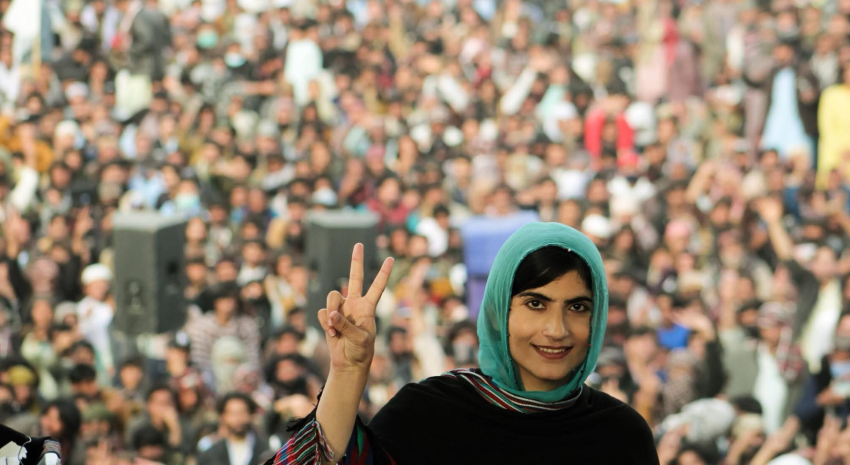
For 17 years, Sammi Deen Baloch, a young Baloch woman activist, has directly experienced severe repression by the Pakistani state. However, she remains committed to peacefully campaigning against human rights violations in Balochistan, Pakistan’s largest province, which has long struggled for self-determination.
Baloch told Green Left that her father, a political leader, was forcibly disappeared by intelligence agencies. Since then, she has campaigned for his safe return and for thousands of others who have been disappeared.
Because of this work, she has faced intimidation, arrest and even her own enforced disappearance.
Baloch is a journalism student and affiliated with the Baloch Yakjehti Committee (BYC), a political movement that stands with the families of victims of enforced disappearances and extrajudicial killings and helps organise resistance to state repression.
In October 2013, Baloch joined other family members of victims of enforced disappearances in organising a 3000-kilometre walk from Quetta to Karachi to Islamabad, Pakistan’s capital.
Since then, she has organised many marches, protests and sit-ins. The BYC has documented violations and cases of enforced disappearance and assisted families with registering cases with the authorities.
Enforced disappearances
Two recent cases taken up by the BYC highlight the extreme repression imposed on the people of Balochistan.
Shahram Baloch, a 38-year-old shepherd and resident of Gishtagan, was forcibly disappeared by Pakistani forces on February 21 from Nehing Zamuran.
For weeks, his family remained in anguish and wasn’t aware of his whereabouts. Nearly two months later, he was killed and his death was presented as having taken place in “an encounter” in Paroom — a narrative the BYC points out is frequently used to cover up unlawful killings and custodial violence.
Zulfaqar, a 47-year-old shepherd from the same area, was taken on the same day without a legal warrant or explanation. He earned his livelihood through livestock and was a civilian with no involvement in armed activity.
Despite repeated attempts by his family to find him, authorities provided no information. On April 16, his dead body was found in Paroom, again officially described as the result of “an encounter”.
The BYC publicly condemns the extrajudicial and demands immediate accountability for those responsible. It reaches out to international human rights organisations and other global institutions to take urgent notice of the situation in Balochistan and ensure justice for the victims and their families.
In some cases, those disappeared are later released. Rahim Baksh, for example, was abducted on March 2 and released on April 6.
However, new forced disappearances continue to happen.
Baloch herself was forcibly disappeared by Pakistani intelligence in 2016 when she was just 17 years old. She was detained in Quetta, the capital of Balochistan, for seven days, during which she was abused and threatened.
She was warned to stop her work and advocacy on human rights and against enforced disappearances, before being released.
Other leading activists — including Dr Mahrang Baloch, Shajee Baloch, Bebarg Zehri and Gulzadi Baloch — remain in detention following a crackdown on protests against enforced disappearances last year.
New generation
Baloch is a vocal advocate for women’s and girl’s rights, including access to education, and is one of several younger women leaders stepping up in the Baloch struggle.
“The emergence of younger Baloch women leaders is not sudden,” Baloch said. “It is the result of decades of continuous state repression in Balochistan.
“For years, Baloch men — particularly political activists, students and community leaders — have faced arrests, enforced disappearances, extrajudicial killings and military operations. This systematic targeting created a vacuum within families and movements.
“When fathers, brothers and sons were taken away or silenced, and when remaining men lived under constant threat, Baloch women were left with no choice but to step forward.
What began as an act of necessity transformed into a “powerful political presence”, Baloch said. “Women came out of their homes not only to demand the safe return of their loved ones, but also to raise their voices for dignity, justice and basic human rights.”
Baloch notes that women have long been involved in political life, but following the intensification of crackdowns, they moved from participation to leadership.
“Today, Baloch women are at the forefront of the struggle,” Baloch said. “They are organising and leading protests, marches and some of the largest gatherings the region has witnessed. This shift is both a continuation of their historical role and a response to extraordinary circumstances.”
This expanded role has made them targets, Baloch said. Women are now facing the same forms of repression once primarily directed at men — including arrests, enforced disappearances, intimidation and fabricated charges.
“Despite this, they continue to stand firm. Their resistance reflects not only courage and resilience, but also a refusal to compromise on their fundamental rights and collective dignity.”
Women, Life, Freedom
Asked about the influence of the struggles in Iran and the Kurdish “Women, Life, Freedom” movement, Baloch said they have had a “moral and symbolic” impact on oppressed peoples across the region. “These movements have shown that women are not just participants, but can stand at the very centre of resistance, challenging state oppression and patriarchy at the same time.”
The slogan itself — rooted in Kurdish women’s movements — represents a vision where women’s liberation is inseparable from collective freedom and dignity. This idea also resonates deeply in societies like Balochistan, where women have also experienced layered political and social oppression.
However, Baloch emphasised that the emergence of women in the struggle is not a result of external influence. “It is rooted in our own lived realities, enforced disappearances, loss and continuous resistance.”
“Our women-led movements serve as a reminder that courage can take many forms — not only armed, but also political, social and intellectual resistance.
“Even under the most brutal repression, voices can rise and reshape the narrative,” Baloch said. “Our movements represent that women can be part of decision making, leadership structures and institutions — not as exceptions, but as equals.
“Their role will be central in building a society based on justice, dignity and inclusivity, where future generations do not inherit the same cycles of violence and marginalisation.”