
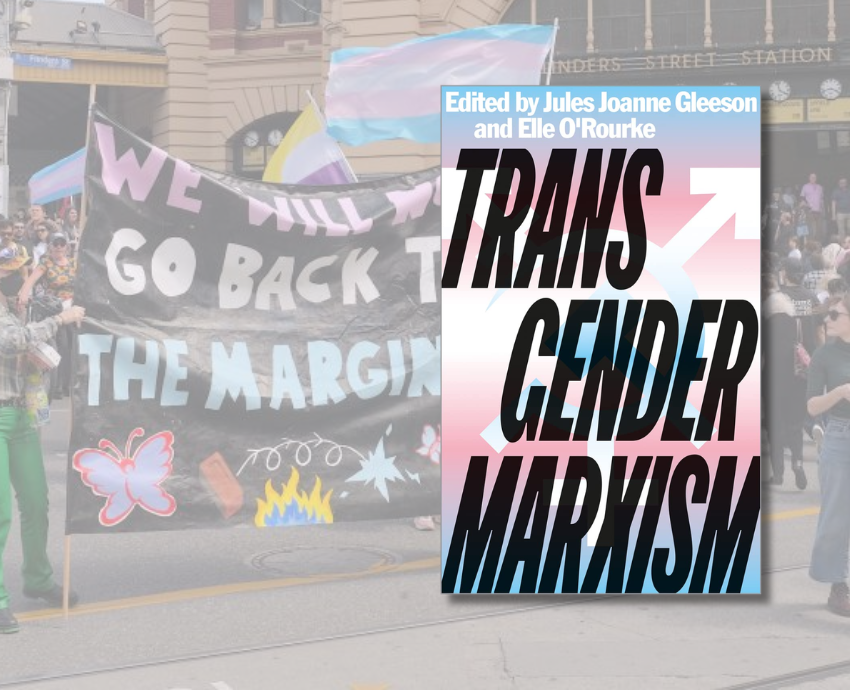
Transgender Marxism
Edited by Jules Joanne Gleeson and Elle O’Rourke
Pluto Press, 2021
Available in hard copy or as an epub
Transgender Marxism is a series of short essays written by 15 trans activists and scholars. In a time of rising transphobia and fascism, it is an important work. More and more trans people are becoming Marxists, and trans-ness is developing Marxism, adding to its theoretical evolution.
Trans, or non-binary people, transition from one sex to another, or refuse to adopt one sex. We sit between or within, one sex/gender or another.
This is a threat to the integrity of sex and gender, which Nathaniel Dickson explains in their essay “Seizing the Means: Towards a Trans Epistemology”, is vital to reproducing the conditions capitalism requires to operate.
Capitalism, as Brazilian trans writer Virginia Guitzel explains in “Notes from Brazil”, “inflicts brutal sexual repression on the whole of the working class … with … control over others’ bodies, the imposition of binary genders pre-defined by genitalia, hetronormative sexuality, and cisgender conformity”.
Under class society, women are considered to be the subordinate sex and expected to reproduce the next generation of exploited toilers. The caring work that women carry out in the home and in raising the next generation, under capitalism, is largely unpaid and unrecognised as labour.
Herein lies the importance under capitalism for sex and gender binaries. Women and men need to stay in their gender boxes, if women are to carry out the unpaid labour to raise the next generation of workers.
This analysis of “social reproduction theory in the cycle of colonisation and capitalism”, is critical for understanding transgender oppression, argues Anja Heisler Weiser Flower in their essay “Cosmos Against Nature in the Class Struggle of Proletarian Trans Women”.
However, late-stage capitalism, where women are compelled to work long hours to secure themselves and their families, has seen a “collapse” of the hetero-normative family unit, reports Kate Griffith in “Queer Workerism Against Work: Strategising Transgender Labourers, Social Reproduction & Class Formation”.
“Among proles there has been a rise in alternative family forms,” she writes.
Nevertheless, social reproduction of gender norms continues. Flower points to lesbian socialist feminist Monique Wittig, who notes “gender manipulates sex into being, smoothing a social order into appearing ‘natural’”.
The rigid gender binaries imposed under capitalism as “natural,” are the main ideological bedrocks of trans oppression, in particular for trans women. They result in “trans proletarian women (being) frequently expelled from her biological family … locked out of legal employment … leav(ing) her to survive via sex work,” Flower argues.
In class societies, the medical world has worked hard to advance the gender duopoly. For what is sex and gender? Is it just “girls are XX and boys are XY”, as year 10 biology teaches? Are fixed sexual definitions of what a man and a woman are an accurate reflection of a scientific reality?
As Dickson cautions, scientific and legal discourses and practices have long been used to justify and perpetuate oppression on the basis of race, gender, disability and class. So, is sex and gender capitalist constructed to bolster the social reproduction of the worker, middle and ruling classes?
Jordy Rosenberg writes in “Afterword: One Utopia, One Dystopia” that dominant medical models at the mid 20th century did not conceive sex to be fixed, but rather “unnervingly capricious”. In response, physicians and researchers began to construct ‘gender’ as a way to stabilise the instability of sex. The ongoing intersex-trans dialogues led, in the 1950s, to the invention of gender.
Rosenberg summarises key findings in Jules Gill Peterson’s pivotal 2018 book Histories of the Transgender Child. Namely, that researchers and doctors found themselves forced to conclude that biological sex is far less stable and fixed than first thought. Biology was plastic, whereas gender was fixed. So “gender” then became the concept that could make binary sex coherent.
But there is a high price trans people pay for disrupting rigid gender binaries, and making “what is widely believed to be obvious look absurd”, says Dickson. Hiding from abuse, stigma and oppression, trans people can be “trapped in their homes for extended periods of time”, explains Jules Gleeson in “How Do Gender Transitions Happen?”.
Dickson contextualises the present-day trans rights discussions and organising in a time of existential questions, where we face “Fascism or communism? Capitalism or life on Earth?”.
The authors of Transgender Marxism advocate liberation. Flower argues that “the flightpath to transgender liberation can only be the path to communism”.
Transgender Marxism is an important contribution towards a scientific, historical materialist and empirical understanding of trans oppression and liberation. The exploration of social reproduction theory is welcome. But what of Engels’s key findings about the three institutions that oppress women, spelt out in The Origins of the Family, Private Property and the State?
Perhaps erring too much on the theoretical side, the work could have been strengthened by proving that classless societies, such as First Nations and pre-colonised communities, did not suffer gender binaries and were not transphobic.
It could have touched on the state of the global trans rights movement and how left electoral victories in New York, England and Wales have bolstered community organising.
It could have explored revolutionary movements in Bolshevik-led Russia, Cuba, Latin America and Rojava in North-East Syria. How did these movements assist sex and gender liberation?
Limitations aside, Transgender Marxism is a seminal work. Strap in for an eye-opening, sometimes unsettling, study of sex and gender oppression and liberation.