
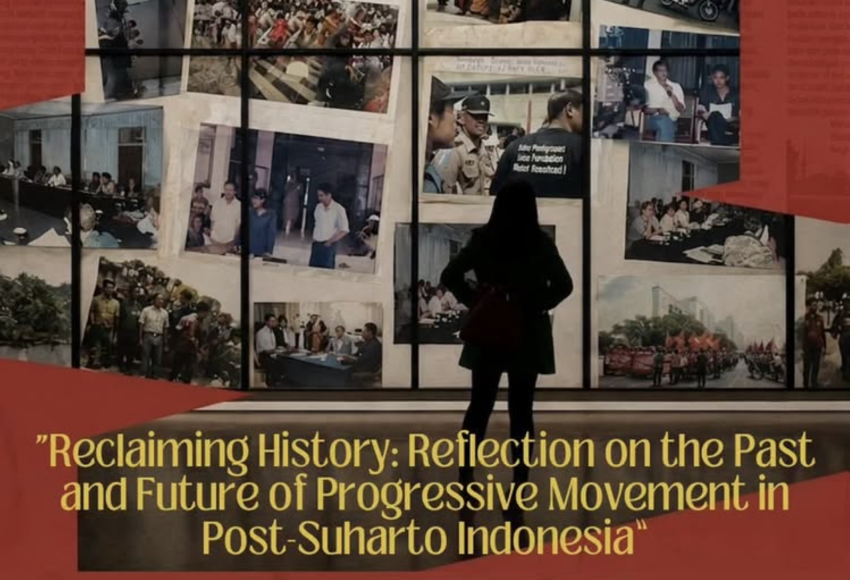
An exhibition and seminar titled Reclaiming History: Reflection on the past and future of progressive movements in post-Suharto Indonesia will take place at Taman Ismail Marzuki — an arts, cultural and science centre in Indonesia’s capital Jakarta — on August 29. Register here to attend.
Green Left has made available some of its photographs and posters from the Australian solidarity campaigns with the movement against the Suharto dictatorship for this important event. GL’s Peter Boyle spoke to exhibition organiser Esty Pratiwi Lubarman.
* * *
Please tell our readers a bit about the groups organising this event.
This event is organised by the Institute of Indonesian Socialist History (Lembaga Sejarah Sosialis Indonesia, LSSI) in collaboration with the Indonesian People’s History Foundation (Yayasan Sejarah Rakyat Indonesia, YSRI) and supported by Rosa-Luxemburg-Stiftung.
LSSI is an initiative established to uncover, document and preserve the historical legacy and critical literature of the Indonesian left movement that was systematically suppressed during the Suharto “New Order” dictatorship.
By collecting both official and unofficial archives — such as newspapers, journals, organisational documents, photographs and audio-visual recordings — LSSI is committed to providing a space for political education and critical reflection for working people, current movements and young people to ensure that this history of resistance is not forgotten.
What will be on display and who will be the speakers in the seminar?
The event is structured around two main discussion formats — a public seminar and a webinar — alongside an archival exhibition. For the onsite public seminar, the speakers include representatives from socialist youth organisations, 1998 uprising activists and historians. The webinar will feature ’98 activists, historians and representatives from LSSI.
Running alongside these discussions, the archival exhibition, titled Techne of Movement: Capturing the movement against authoritarianism, beyond spontaneity, will display a range of historical attributes and artifacts from the Reformasi [democratic reform] era.
Visitors will be able to see protest banners, People’s Democratic Party election t-shirts, documentary photos, audio-visual recordings, meeting minutes and underground propaganda material.
The exhibition concept will feature three periods of the 1998 Reformasi.
The first is the movement-building period (the 1980s to 1996), which highlights the development of the progressive movement at the peak of the New Order repression, when various forms of the regime’s domination were carried out to restrict every form of resistance.
The second is the period of the 1998 Reformasi momentum — tracing the breaking point of the 1997–98 economic crisis, which culminated in a wave of mass resistance and the collapse of the New Order regime. This period will showcase the various elements of the progressive movement that converged at a single historical juncture.
The third is the post-Reformasi period, which will show how the dynamics of the progressive movement unfolded once the space for democratisation opened up, along with the fragmentation the movement had to confront.
The exhibition features secured glass display cases, LED screens showing looping archival footage and a dedicated platform (“Zone of Movement Organisation Stands”) where contemporary left-wing youth organisations can showcase their ideas, literature and current movement techniques.
What is the objective of this event and why is it important that it is taking place now?
The main objective of this event is to draw concrete lessons from the struggle against the New Order military regime, highlight the contributions of the Indonesian left and pro-democracy movements in opening up democratic spaces and create a space for critical reflection on the trajectory of progressive movements today. Additionally, it aims to provide a platform for youth organisations to publicise their perspectives and current struggles.
This event now is crucial to re-establish and uphold the tradition of struggle against the New Order military regime. This has become especially urgent in light of the current political context, where several former ’98 activists have chosen to co-opt with and support the Prabowo-Gibran regime. This dynamic demonstrates that the project of de-politicisation and historical distortion has not ended.
This event serves not only to preserve collective memory, but also to reaffirm that the principles and consistency of resisting militarism and authoritarianism must be kept alive by the youth and popular movements today.