
An escalating wildfire crisis in Indonesia since July has covered much of Southeast Asia in a protracted and hazardous smoke haze.
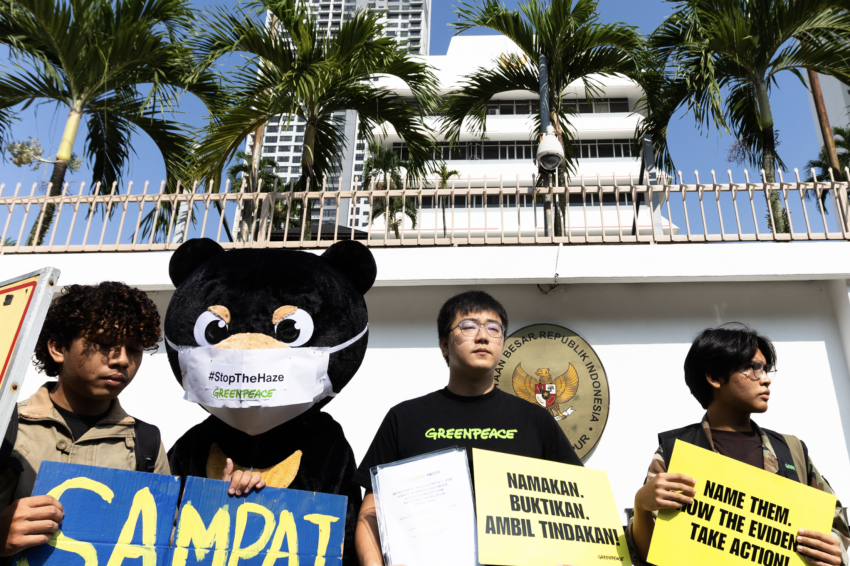
Greenpeace Malaysia and Himpunan Advocacy Rakyat Malaysia (HARAM) held a peaceful protest outside the Indonesian embassy in Malaysia’s capital, Kuala Lumpur, on September 4, in solidarity with all communities affected by the cross-border haze and the loss of wildlife, suffered most severely in Indonesia.
The protesters did not blame Indonesians for the crisis but, instead called for the corporate interests that are complicit in the crisis — including Malaysian companies — to be named and shamed.
"While corporate executives sit comfortably in their air-conditioned offices earning millions of dollars in profit, it is the common citizens, workers, students and even the children of Malaysia and Indonesia who are breathing in and dying from the haze. Schools are closing down, and our basic human right to breathe is being taken away from us. Clean air doesn’t have a passport, nor does environmental devastation. We stand firmly in solidarity with the communities in Indonesia who are affected by these fires,” HARAM chairman Brendon Gan said in a statement.
“Our action called on the government of Indonesia to formally disclose concession maps, hotspot and fire investigation data, and other evidence identifying Malaysian-linked companies associated with fires and haze in Indonesia,” Heng Kiah Chun, interim country representative of Greenpeace Malaysia told Green Left.
Corporate responsibility
“Investigations by Greenpeace Indonesia linked Malaysian-owned palm oil companies to transboundary haze, through the largest burned areas, between 2015–18, on their subsidiary land in Indonesia”, he explained.
Indonesian authorities announced on August 31 they are investigating 19 companies holding concessions where fires have affected 11,047 hectares across seven provinces. They said that 42 companies have been identified as holding concessions with high wildfire potential, but the companies under investigation have not been publicly named.
“We also called for the Indonesian government to publicly name the Malaysian companies it has identified as being involved, so that Malaysian civil society, regulators and parliament can pursue accountability within Malaysia.
“We further called for Indonesia to share this evidence with the Malaysian government on an ongoing basis through existing ASEAN mechanisms or direct bilateral channels, rather than relying on public allegations and press statements alone.
“Ultimately, we are calling for reciprocal disclosure and enforcement between both governments. This will provide each country with the means to investigate and hold accountable companies within its own jurisdiction, based on evidence that is openly shared between Indonesia and Malaysia.
“Transparency and cooperation are essential to ensuring that those responsible can be properly identified and held accountable, while protecting communities and the environment from recurring transboundary haze.”
The vast majority of palm oil traders have continued with business as usual to supply some of the world’s largest consumer brands in the Global North, Chun said. So the Global North has a responsibility ensure that these supply chains “are in accordance with the No Deforestation, No Peat, and No Exploitation (NDPE) policy”.
Financial institutions, such as banks, should equally have strong safeguards to ensure that their investments do not go into financing deforestation, peatland destruction, land degradation or activities linked to forest and peatland fires, Chun added.
“There is also a regional dimension to this responsibility. For example, Malaysian palm oil companies themselves should show their commitments through full transparency and by upholding the NDPE policy.”
Meanwhile, the Malaysian government has taken a number of measures to respond to the immediate impacts, including intensifying air-quality monitoring, prohibiting open burning, conducting cloud-seeding operations, providing firefighting assistance to Indonesia and closing schools where necessary, Chun added.
It declared an emergency in Serian, Sarawak, when the Malaysian Air Pollutant Index exceeded 500 and Prime Minister Anwar Ibrahim has called for ASEAN to review its mechanisms for addressing transboundary haze and its impacts on public health.
“However, these measures largely address the symptoms of the haze rather than its root causes. Cloud seeding, air-quality monitoring and emergency responses may help communities cope with hazardous air in the short term, but they do not prevent the fires from occurring in the first place or establish who is responsible for them.
“Malaysia needs long-term solutions through stronger preventative and accountability mechanisms, particularly greater transparency around fire locations, concession ownership and investigation findings. Where there is credible evidence linking companies to fires and transboundary haze, there must also be mechanisms for Malaysian authorities to investigate and hold Malaysian companies operating overseas accountable.
“This is why we are calling for stronger domestic legal mechanisms, including a Transboundary Haze Pollution Act or a Clean Air Act with transboundary haze provisions that will provide Malaysia with the legal authority to ensure that those responsible can be held accountable. This goes hand-in-hand with the need for stronger cooperation and information-sharing between Indonesia and Malaysia.”
Root causes need to be addressed
See Yong Feng, from Singapore Climate Rally, agrees that the root causes of these wildfires — which occur every year and seem to be getting worse — need to be identified and seriously addressed.
“This is a perennial issue but this year it's probably the worst since 2015 and this is a direct result of peatland fires in Sumatra and Borneo, he told GL.
“Much of this is the result of land clearing for oil palm plantations or other plantations.”
When peatlands are drained this makes them drier and more susceptible to fire and when the fire starts they are are hard to extinguish because the underground peat keeps fuelling the fire, he explained
“Peat is formed from many years of carbon accumulation and now it serves as a carbon sink. So the wildfires contribute to global warming.”
The previous two biggest Indonesian peat fires took place in 1997 and 2015 — both El Niño years.
According to Carbon Brief, the 1997 fire season generated carbon emissions equivalent to 13-40% of all global fossil-fuel emissions that year.
A separate study of carbon dioxide emissions from the 2015 fires found they were greater than the total of the European Union’s fossil-fuel emissions that year and were linked to more than 100,000 premature deaths across Southeast Asia.
See told GL: “Many of the plantations are owned by Singaporean and Malaysian companies, or even if they are registered in Indonesia, the CEOs or directors of the companies might be Singaporean or Malaysian.
“And there are many others in the chain through which MNCs [multinational corporations] — like Unilever — buy these commodities.
“There is also Wilmar, a Singaporean company, which is the biggest palm oil trader and has a lot of control at every point in the chain.
“Wilmar could introduce stricter checks on where the palm oil is coming from and make sure it doesn't come from plantations where they have cleared the land, but it has not done so.
“And, the MNCs’ push to increase their profits and lower costs drives people to find all kinds of ways to grow more [palms] — and this includes clearing peatlands.”
Migrant workers worst affected
While people in Indonesia are suffering the most in this crisis, in wealthy Singapore it is migrant workers who are most heavily impacted, because of a combination of pollution and more extreme heat.
“One very big issue is heat and, as we saw in Europe this year, heat waves caused a lot of deaths. In Asia, the problem is even worse because of the high humidity, which makes it more difficult for the body to eject excess heat.
“In Singapore there are many outdoor workers — many of them migrant workers who are in construction — who are the most vulnerable to the impact of heat, because they also don't have access to air conditioning where they live.
“Recently the government in Singapore set up a task force to deal with this heat issue for outdoor workers. But I think the policies introduced are not doing enough to solve the problem. Some of these include providing workers with a sheltered rest area or ensuring that they drink water, but these don't give these workers enough protection.
“We know the effects of heat aren’t only during the day, when they’re working, but also at night when the body needs to be cool enough to recover and sleep well. But they can’t sleep well if they’re not provided with air conditioning in their dormitories.
“Heat is something everyone feels physically every day. So I think it is an issue that we can organise around together. For example, there was a campaign to tell the government to stop cutting down forests because they are a natural way to reduce the urban heat impact.
“There is growing awareness among Singaporeans of the poor conditions that migrant workers face and the huge fees they have to pay to come to Singapore in the first place. But of course, I think more education needs to be done.”
See explained that there are heavy restrictions on organising migrant workers. “They don't have the same political rights as citizens. Even when we held the Labour Day rally in the Hong Lim Park (which is the only legal place for citizens to hold political events), migrant workers are not allowed to take part.
“We had a booth for migrant issues but we had Singaporeans on the booth and speaking about migrant worker issues, as they are not allowed to organise or speak out. Historically, migrant workers who have spoken up have been deported because the government only wants compliant migrant workers to continue fuelling investment, production and development.”