
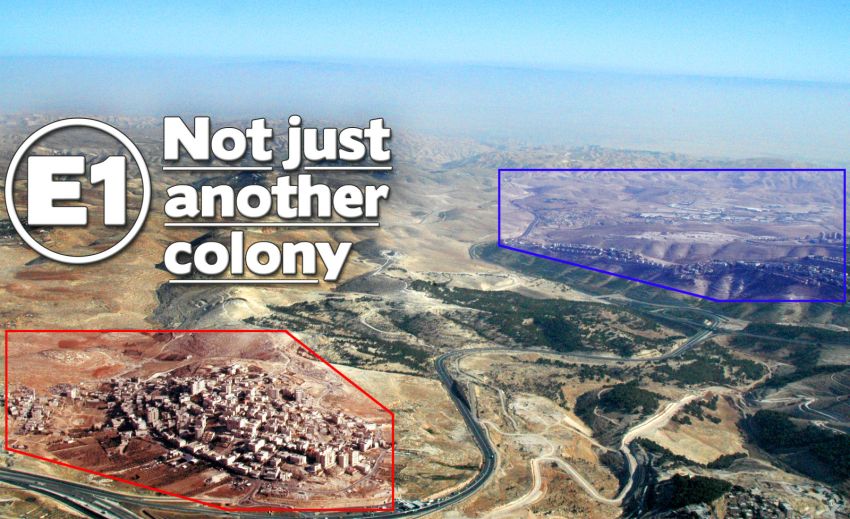
Governments and global institutions around the world — including some of Israel’s closest allies — have released statements in opposition to the Israeli government’s issuing of a tender for the colonial E1 project, located in the eastern outskirts of occupied Jerusalem city.
On September 8, Britain, Canada, France and other countries even announced sanctions on imports from illegal Israeli settlements.
On August 18, Israel’s Ministry of Construction and Housing announced a tender for 1234 housing units for Israeli Jews, giving contractors until October 19 to bid on the new colony.
“Tenders within the colonial-settlement system mark a transition from the planning stage to the stage of actual implementation,” Amir Dawood told The Electronic Intifada.
Dawood is head of documentation at the Palestinian Authority’s Colonization and Wall Resistance Commission, which is focused on protecting Palestinian land from Israeli seizure.
The E1 settlement scheme had been halted for more than two decades under international diplomatic pressure due to the devastating impact it would have on the feasibility of a Palestinian state. The Israeli government officially revived it in August 2025. At that time, settler leader and minister Bezalel Smotrich said publicly the goal of the plan was to “bury” the idea of a Palestinian state.
The plan was originally devised in 1994, by the late Israeli Prime Minister Yitzhak Rabin who had instructed the Housing Ministry to begin building a new illegal settlement in the area of E1. The broader master plan was formally approved in 1999.
“This plan is one of the most dangerous settler-colonial plans in the entire occupied West Bank,” said Dawood.
About 30 Democratic United States senators, including several who are supportive of Israel, published a letter on August 28 urging the Israeli government to reverse its decision to advance the E1 colony and “immediately rescind these tenders”.
This followed a joint statement of opposition released on August 20 by Britain, France, Germany, Italy, the Netherlands, Canada, Norway, Australia, New Zealand, Sweden, Belgium, Spain, Austria, Greece, Cyprus, Finland and the European Commission. In it, they said the project will “further undermine Israel’s international standing”.
Such diplomatic pressure has so far shown no sign of being effective. Atallah Mazaara, the spokesperson for the Jabal al-Baba Palestinian Bedouin village, whose 450 residents face forcible transfer as part of the colonial project, said that despite these statements, “there is global inaction”.
“We are being left to face our fate on our own,” he told The Electronic Intifada.
The plan
E1, short for East-1, is a new Israeli colony — Mevaseret Adumim in Hebrew — to be built between the colony of Maaleh Adumim, the largest by area in the West Bank, and the occupied city of Jerusalem. Upon completion, it will span approximately 12 square kilometres of land stolen from the Palestinian villages of Anata, Al-Zaayyem, Al-Eizariya, Abu Dis and al-Issawiya.
The goal is to create a continuous settlement belt and easy travel between Maaleh Adumim, home to nearly 40,000 Israelis, and occupied Jerusalem.
About 22 villages, home to at least 7000 Palestinians, face forced transfer, erasure and dispossession to build the E1 colony, Bassam Bahar, head of the eastern Jerusalem Land Defense Committee, told The Electronic Intifada.
Israel has already been carrying out demolitions of Palestinian homes and structures in the area of E1 for years. At least 900 residents have been forcibly displaced since 2009 in more than 500 demolitions, according to the United Nations.
The location — east of occupied Jerusalem, along the historic road between Jerusalem and Jericho to the east — is precisely what makes it so destructive, with profound consequences for Palestinians and for the territorial contiguity of the West Bank.
First, E1 would consume land that is crucial to Palestinian development and expansion. For Palestinians in occupied East Jerusalem, where access to land for housing and urban growth is already severely restricted by Israel, the area around E1 represents one of the few remaining spaces with potential for expansion.
Second, the development of E1 will complete the encirclement of occupied Jerusalem with Israeli colonies from the north, east and south. This would cement the physical separation of Palestinians between occupied Jerusalem and the occupied West Bank — severing the everyday vital movement of people, goods and communities.
Third and most importantly, E1 threatens the territorial continuity of the occupied West Bank itself. In addition to tying Maaleh Adumim with Jerusalem, the new colony will also reinforce the wider settlement network extending eastward toward the Jordan Valley. That area is one of the narrowest and most strategically sensitive parts of the occupied West Bank. Developing E1 would sever the most direct territorial connection between the northern and southern parts of the occupied West Bank, and would effectively split the territory in half.
Israel is also building a network of roads as part of the E1 plan, ironically labelled the “Fabric of Life”. The network is intended to reroute Palestinian traffic between the southern and northern West Bank, away from the E1 and Maaleh Adumim area, allowing Israel to restrict Palestinian access to the area east of occupied Jerusalem, all the way eastwards towards the Jordan Valley, while expanding Israeli colonies.
“This new route will prevent Palestinians from traveling on the historic Jerusalem-Jericho road, and imposes a new layer of apartheid on Palestinians,” said Amir Dawood.
Forced urbanisation
Beyond its far-reaching geopolitical consequences for Palestinians and the future of the Palestinian question, the E1 plan also threatens to inflict profound and potentially irreversible harm on the Palestinians living in the area. For the Bedouin villages facing forcible transfer, the plan is not only about losing their homes.
“We will lose our Bedouin cultural heritage, lifestyle and legacy that we grew up in and that our forefathers protected and preserved, centered on pastoralism and livestock husbandry,” said Mazaara.
Between January 2023 and August 31, 130 Palestinian villages across the occupied West Bank have been fully or partially forcibly displaced through settler and military attacks and related restrictions on access, predominantly affecting Palestinian Bedouin and herding communities. Of these, 48 villages have been completely and forcibly displaced.
In total, more than 6400 Palestinians, including more than 3100 children, have been displaced, since January 2023. This year alone, more than 2500 people, including 1200 children, have been displaced.
The Bedouin lifestyle, in remote areas away from population centers, is what makes these villages particularly vulnerable and easy to target for armed settlers and soldiers.
“We are an integral part of the Palestinian social fabric and we contribute greatly to the resilience and diversity of the Palestinian economy,” Mazaraa said. “This portion of society is being exterminated and wiped out.”
According to Mazaara, the number of sheep in Jabal al-Baba dropped from 3500 in the 1990s to only 1000 in 2026.
Displacing Palestinian Bedouins is part of Israel’s efforts to force the urbanisation of these portions of Palestinian society, he said, in order to squeeze the population into the smallest land mass possible — a goal publicly stated by top Israeli officials.
“I wasn’t raised to live in a city or a big village. I will live as a refugee among my own people, in my own homeland. We will be forced to live in our own society as strangers. And we will lose our entire source of income and livelihood,” Mazaara said.
It’s not just the Bedouin. In recent years, Israeli settler and military attacks have gone beyond targeting Bedouins to attacking larger villages and farmers across the occupied West Bank. This includes mass shootings and killings, home demolitions, besieging homes, mass seizure of farming land, building of colonies on private land, and destruction of crops, farmhouses and equipment.
“They are fighting us on everything that sustains our resilience, our livelihoods and our very presence on this land,” said Mazaara. “They try to take everything from us before they have to kill us.”
[Reprinted from The Electronic Intifada. Zena Al Tahhan is an independent writer and TV reporter based in occupied Jerusalem.]