
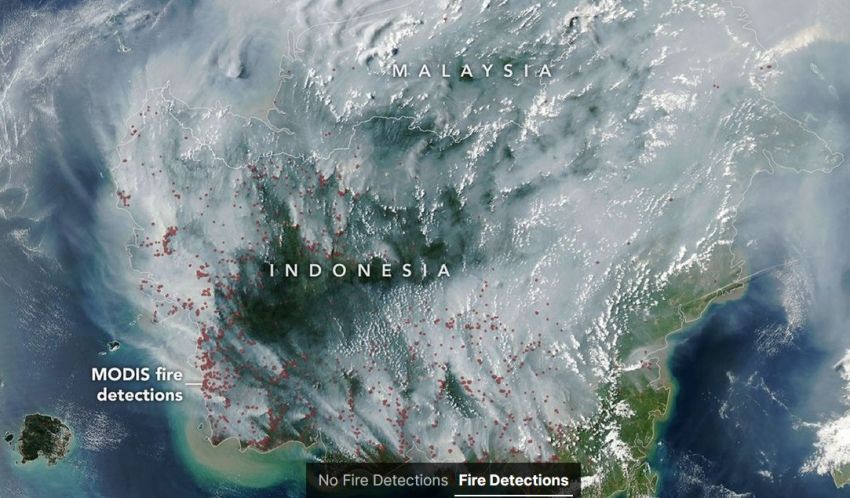
Indonesia is facing another wildfire catastrophe. This year’s El Niño has caused a severe drought making Indonesia’s forests and peatlands much drier than usual. The fires have covered the island of Borneo in smoke. West Kalimantan is the worst area for fires, with about 40,000 hectares burned. These are the worst fires in Indonesia since 2015 when about 2.6 million hectares burned.
In July and August 2026, Indonesia’s Health Ministry recorded more than 50,000 cases of respiratory infections linked to the fires. At least 5.5 million people in Borneo and Sumatra have been directly exposed to smoke.
Between since July 2026, more than 200,000 hectares have burned in Indonesia.
Arrests
Many of the fires are deliberately started. Recently, Indonesian police announced they had arrested 72 people for starting fires. Mohammad Irhamni, director of special crimes at the National Police's Criminal Investigation Agency is reported by Associated Press as saying that “Plantation owners and traditional farmers often start fires to clear land for farming.”
“We will not stop at the perpetrators on the ground,” Irhami added. “We will determine who benefited from these activities and who was ultimately behind them.” Investigators are tracing financial records to work out whether companies financed or ordered the land clearing, AP reports.
Indigenous communities, many of whom are currently involved in firefighting operations, are often accused of starting the fires.
But the reality is that the problem dates back to the Suharto regime, when huge areas of rainforest were cleared for logging, industrial plantations, and large-scale “development” projects. Perhaps the most notorious was the Mega Rice project, which aimed to create 1 million hectares of new rice fields in Central Kalimantan. The forest was cleared but no rice was ever harvested.
Indonesia is currently running an even larger deforestation project in West Papua. Recent analysis by the Indonesian Forum for the Environment (WALHI) shows that hotspots in South Papua are in areas that are part of the government’s Food Estate program and concessions linked to the National Strategic Project.
“When landscapes that have long been safeguarded by indigenous communities are transformed into industrial-scale production zones, the ecological function of these areas as a buffer against fire is also weakened,” Maikel Peuki, executive director of WALHI Papua said in a press statement.
El Niño
El Niño means things are only going to get worse. Malaysian atmospheric scientist Jayaprakash Muralitharan told Al Jazeera that “El Niño came in and made conditions drier. Now you have the extreme drying of the peatland.”
In peatlands, fires can remain alight, smouldering underground for months. The fires can flare up again — until the wet season starts. The fires could “go on until end of September or October when the rain comes in,” Muralitharan said. “I hope that rain comes in by then.”
“The strong El Niño is making the dry season drier over the fire-prone parts of the country and exacerbating burning,” Robert Field, a researcher at Columbia University, says. “Just as we anticipated it would.”
NASA writes that, “Peat fires are a recurring challenge in Indonesia, which is home to about 36 percent of the world's tropical peatlands. When parched by drought, the archipelago's peat landscapes have become unrelenting infernos on several occasions over the past three decades, with fires producing blankets of smoke for weeks on end and upending daily life for millions of people.”
Carbon bomb
The 15 million hectares of forest and peatland in Indonesia store huge amounts of carbon — as much as 55-57 billion tonnes, according to one estimate. When the peat burns, a carbon bomb is released into the atmosphere consisting of millions of tons of carbon dioxide, carbon monoxide and methane.
In 2016, following the devastation fires in 2015, the government set up the Peatland Restoration Agency (Badan Restorasi Gambut, BRG), with the mandate of restoring 2.4 million hectares of damaged peatlands by 2020. UNDP provided institutional and technical support with financing from Norway. FAO was also involved, with a peatland mapping and monitoring program.
According to the UN-REDD website, “As a result of this partnership under the UN-REDD Programme, BRG has been able to carry out regulations developed by Indonesia’s Ministry of Environment and Forestry that govern authority delegation and budget transfer to the provincial level, accelerating peat restoration activities.”
But a study published in 2022 found that “the restoration of the peatland area of 2.4 million hectares faces several problems”. One of the key problems is that 1.4 million hectares of the target area to be restored are company concession areas. The companies are responsible for restoring the peatlands.
The researchers, Agung Wicaksono of Corvinus University of Budapest and Zainal of Universitas Islam Riau, write that, “Companies that are obliged to restore peatlands in their concessions do not comply with regulations set by the government. As the program’s leader, the Peatland Restoration Agency is powerless to do much because its authority extends only to supervising the company’s concession area.”
Approximately 900,000 hectares of peatland was restored outside company concessions by 2019, or 87% of the target. But only 500,000 hectares was restored inside concession areas, or 29% of the target.
In 2021, Indonesia’s then-president Joko Widodo extended the agency’s mandate for four years and renamed it the Peatland and Mangrove Restoration Agency. In December 2024, the agency closed down, having restored 1.6 million hectares of peatland and about 84,000 hectares of mangroves.
A 2023 study identified 5.65 million hectares of peatlands in Indonesia that should be conserved but are outside protected areas. The researchers note that peatlands in Indonesia face a series of threats. “Of particular concern,” they write, “is Indonesia’s plan to double the level of palm oil production compared to 2010, which would result in extensive replacement of primary forests with monoculture industrial plantations leading to reduced biodiversity and threatening the extinction of mammal and bird species.”
In 2025, data from the Indonesian NGO Auriga Nusantara revealed that Indonesia’s deforestation increased by 66% compared to the previous year — the highest level in eight years.
[Reprinted from REDD Monitor. Slightly edited for style.]