
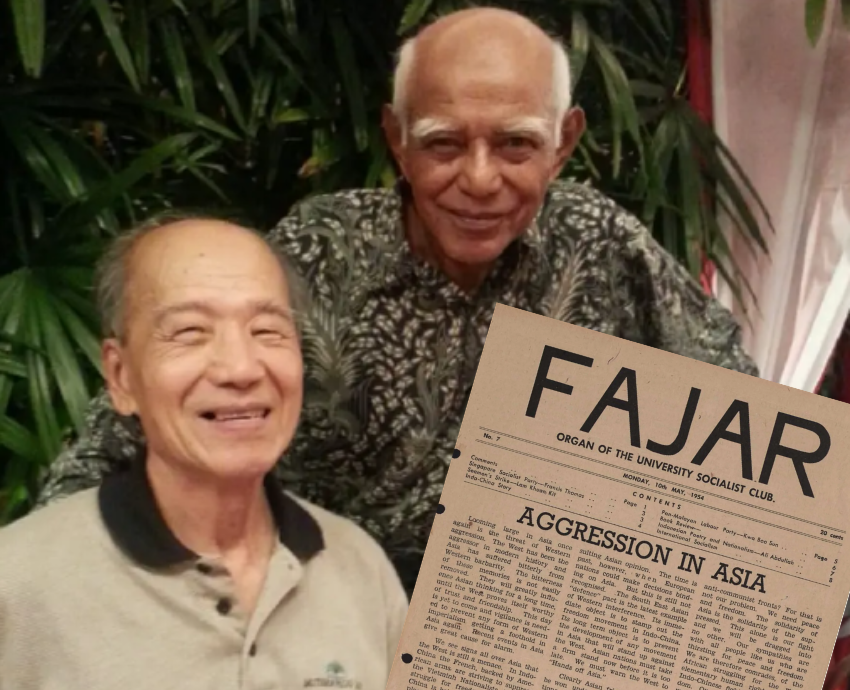
The dominant history of modern Singapore was meticulously constructed under the banner of the “Singapore Story”. By presenting the material interests of the ruling elite as the universal interests of the nation, the state narrative reduces the mass anti-imperialist movement of the mid-20th century into a fable; one wherein a heroic bourgeois leadership single-handedly navigates a vulnerable island state through the perils of communism to construct a prosperous capitalist metropolis.
In his six-part oral history series with Pintjin (PJ) Thum, Dr Poh Soo Kai, former student activist, co-founder of the People’s Action Party (PAP) and the Barisan Sosialis (Socialist Front) — and former political prisoner detained for nearly 17 years without trial — delivers a vital historical materialist counter-narrative.
In 36 minutes of personal testimony, Poh unpacks the class dynamics, state coercion, and geopolitical shake-ups that dismantled working-class power and shaped Singapore's transition into a disciplined capitalist state.
Class foundations and the Fajar Trial
Poh begins by recalling how post-World War II Malayan households were adorned with portraits of Indonesia’s Sukarno, India’s Nehru and Gandhi, and China’s Chiang Kai-Shek, who were seen as regional anti-colonial leaders. The struggle in Singapore was bound to broader anti-imperialist movements across Malaya, Indonesia, and Vietnam.
Poh’s account of the 1954 Fajar Trial undermines the state’s origin myth, which positions the trial of eight members of the editorial board of Fajar (Dawn) — the University of Malaya Socialist Club’s newspaper — as Lee Kuan Yew’s (LKY’s) personal legal breakthrough.
[Editor’s note: Harry Lee Kwan Yew co-founded the PAP, was a barrister and opposition figure and became Singapore’s first Prime Minister in 1959.]
As president of the University of Malaya Socialist Club, Poh helped publish Fajar, an anti-colonial paper opposing the anti-communist South East Asian Treaty Organisation (SEATO) and foreign military bases. When the editorial board was charged with sedition, Queen’s Counsel DN Pritt arrived to lead the defense. Poh recounts Pritt greeting him warmly at the Dolphin Hotel before turning to LKY, who was acting as local junior counsel, and saying, “Harry, now you can go.”
Pritt dismissed LKY specifically to formulate an anti-colonial strategy directly with the student activists, recognising that the trial was a political battlefield rather than a legal technicality.
This moment symbolises the clash between the radical student movement and LKY’s legalism, and how official history later repackaged a left-wing victory as an LKY solo masterstroke.
The Merdeka years and the neutralisation of class consciousness
As the PAP rose to power, internal contradictions between its left-wing mass base and moderate leadership erupted.
Poh recounts how the left wing consistently pushed for true self-determination, confronting PAP Chair Toh Chin Chye to issue a public statement supporting then-Chief Minister David Marshall’s 1956 call for internal self-rule — a move that infuriated LKY upon his return from London.
[Editor’s note: Marshall was appointed Chief Minister after contesting the 1955 election as a candidate for the Labour Front. After failing to secure self-rule, he resigned as Chief Minister in June 1956.]
Chief Minister Lim Yew Hock’s violent crackdowns on trade unions and Chinese school students from 1956 onward served a dual purpose: suppressing working-class organisation while allowing LKY to position himself as the sensible alternative acceptable to British imperial interests and local capital.
When dissident MPs and activists walked out to form the Barisan Sosialis in 1961, every PAP branch including LKY’s own Tanjong Pagar constituency defected to the new party. The PAP was left as a hollow electoral vessel without organic mass support.
To preempt an electoral defeat, the state deployed Operation Coldstore in February 1963. Officially framed as a security operation against a communist plot tied to the 1962 Brunei Revolt, Coldstore was a draconian political purge that sought to decapitate the political opposition, dismantle union leadership and ensure PAP hegemony.
The state weaponised identity politics to divide the multi-ethnic working-class by branding Chinese-educated labour leaders and Barisan Sosialis members as “Chinese chauvinists”. It replaced class-based solidarity with state-directed multiracialism that contained labour organising within non-threatening boundaries.
Declassified British colonial intelligence files and Special Branch transcripts uncovered by PJ Thum validate Poh’s memory. They confirm that figures such as Lim Chin Siong and Poh were acting as legitimate, independent political figures advocating for peaceful democratic processes, not foreign-directed covert agents.
1965 and labour suppression
Following Singapore’s expulsion from Malaya in 1965, Poh was briefly released and held a press conference where he labeled LKY a “political pimp” for surrendering Singapore’s sovereign resources and labour to foreign capital.
The dissolution of Barisan Sosialis and radical trade unions was a prerequisite for Singapore’s transformation into an export-oriented industrial economy. The state decapitated independent labour and paved the way for the 1968 Employment Act and Industrial Relations Act. These legislative measures deprived workers of important bargaining rights, banned strikes and instituted wage freezes, crafting a hyper-disciplined, frictionless environment that attracted Western multinational corporations.
Re-detained without trial for opposing this model, Poh spent years in isolation.
Conclusion
Poh’s oral history is an important document that restores class struggle to the centre of Singapore’s founding narrative. By demonstrating how state power was consolidated through the violent suppression of popular anti-colonial movements, Poh dismantles the myth of a technocratic miracle.
That said, we also need to take into account the limitations of Poh’s framing. Sometimes his story is driven by personal animus, converting complex structural shifts into LKY’s personal duplicity. A hard-edged historical materialist perspective precludes the reduction of history to individual morality; LKY was not an opportunistic actor, but the embodiment of a rising bourgeois class whose structural interests naturally aligned with foreign imperial capital over local labour.
Ultimately, Poh’s testimony shows that Singapore’s history is an ongoing site of ideological contestation. He sustains the alternative visions of society based on anti-imperialism, labour solidarity and social justice, and the suppressed struggles of the 1950s and ‘60s open to critical re-examination.
[Ilyas Muzaffar is a Singaporean writer focusing on a Marxist critique of political, economic and social systems in South East Asia]