
The disaster in Nepal and the need to build resilience: An ecosocialist energy transition perspective
Nepal and the Philippines share a fundamental climate condition: both are low greenhouse-gas emitters yet highly exposed to climate risks and suffer from climate disasters created by the rich countries of the Global North. In 2024, Nepal and the Philippines emitted only 0.63 and 1.51 tons of greenhouse gases per person, respectively, compared with more than 14 tons per person in the United States and Australia.
Global warming is a major driver of increasing glacier retreat and ice loss, contributing to greater melting and floods risk in the Himalayas. Warming alters the glacier–lake–mountain system in ways that make certain catastrophic events more likely. This is now a demonstrable pattern.
The chain is roughly: Global warming → glacier retreat and ice loss → more and larger glacial lakes → unstable ice, rock and moraine slopes → sudden collapse or overtopping → glacier lake outburst flood (GLOF) and flash flood → downstream destruction.
The most immediately vulnerable Hindu-Kush Himalayan countries, apart from China and India, include Afghanistan, Bhutan, Nepal and Pakistan, all with very low levels of emissions. The scale of the disaster, which spread across borders, demonstrates the stark reality of the existential climate emergency.
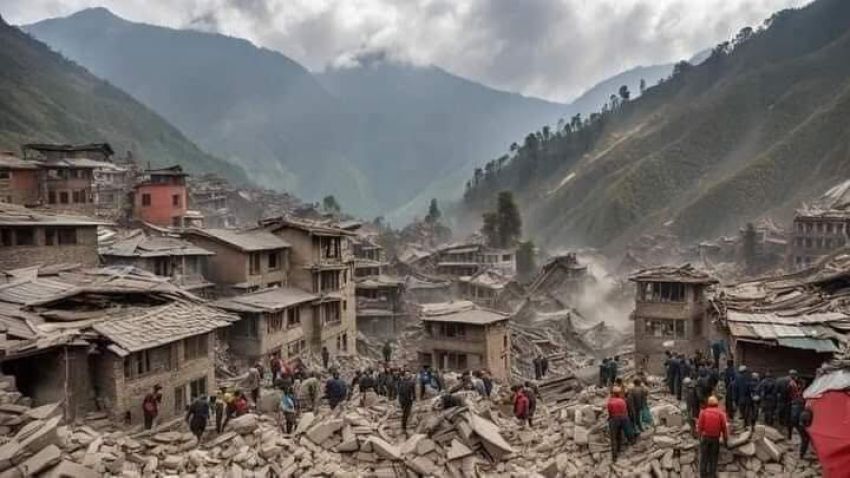
The disaster in Nepal’s Rasuwa District and other affected areas exposed entire communities, hydropower and border-trade workers, security personnel and downstream populations to severe and rapidly cascading risks. Nepal’s government, the National Disaster Risk Reduction and Management Authority (NDRRMA), security forces, medical teams and emergency services mobilised search, rescue and evacuation operations and worked to restore roads, bridges, electricity, telecommunications and water services.
But the speed of the event, the narrow Himalayan valleys and communications failures left little time for warning or evacuation. Timure and Rasuwagadhi were severely affected, while transport, power, communications and Nepal–China trade were disrupted. Beyond the immediate destruction, displacement and prolonged disruption to hydropower, tourism, transport and local livelihoods will produce wider social and economic consequences.
The growing danger of cascading high-mountain hazards
The disaster in Nepal’s Bhotekoshi–Trishuli corridor reveals the growing danger of cascading high-mountain hazards. Ice or rock failures can trigger landslides and debris flows, block rivers, generate sudden surges or outburst floods and devastate downstream communities within hours. Cryospheric, geological and hydrological hazards can combine rapidly and cross national borders.
This exposes a deeper problem: resilience cannot mean simply responding more effectively after infrastructure fails. We must ask why communities and critical infrastructure are increasingly concentrated in landscapes exposed to interconnected and difficult-to-predict hazards.
Beyond individual infrastructure projects
Official assessments show that this was not a collection of isolated hydropower failures. The Ministry of Energy initially placed about 754 MW of generation capacity within the affected or damage zone.
Subsequent assessments identified around 431 MW of generation as lost or disconnected. According to preliminary reports from the Nepal Electricity Authority (NEA), 431 MW of operating generation across 12 projects was immediately affected, including 406.1 MW of hydropower and a 25 MW solar plant. Fifteen hydropower projects under construction, with a combined capacity of about 470 MW, also sustained damage.
The affected system included generation facilities, substations, transmission infrastructure, roads and construction sites across the Bhote Koshi–Trishuli corridor. These included Rasuwagadhi, Chilime, Upper Trishuli 3A, Trishuli, Devighat, Sanjen Khola, Sanjen, Mailung Khola, Salasungi Sanjen and Langtang Khola, as well as the 25 MW solar plant and strategically important 220 kV Nuwakot substation.
This challenges conventional project-by-project infrastructure planning. Projects are usually assessed by installed capacity, financial returns, construction costs and electricity output. But the real risk is systemic:
What happens when multiple power projects, transmission corridors, roads, settlements and communities are exposed to the same cascading hazard?
The cumulative impact of development
The Himalayas and their river systems are shared ecological and social systems, not simply collections of sites for competing infrastructure projects. The key question is therefore not only how many megawatts a river or valley can generate, but what cumulative risks development creates across an entire river basin.
Hydropower depends on transmission networks, roads, bridges, communications and access routes; communities and economic activity depend on the same corridors. When one hazard strikes, these systems can fail together.
Damage to one component can disable others, while disrupted transport and communications can prevent emergency services and workers from reaching affected areas. The result is cascading infrastructure vulnerability — the overall failure can be far greater than the sum of individual project failures.
This changes the question of reconstruction. With preliminary national reconstruction requirements estimated at US$4–5 billion, and energy among the major infrastructure losses, resilience cannot mean simply rebuilding what existed before. Reconstruction must reconsider where, how and at what scale infrastructure is built.
From downstream response to source-to-downstream risk management
The disaster also exposes the limits of conventional rainfall-based flood warnings. Risk management must cover the entire hazard chain — from high-mountain sources to downstream settlements.
This requires transboundary monitoring and data sharing on glaciers, snow and ice, landslides, avalanches, seismic activity, river blockages and river conditions. Early-warning systems must integrate cryospheric, seismic, geomorphological and hydrological indicators rather than treating floods as isolated rainfall events.
It also requires anticipatory evacuation: clear triggers, safe areas, evacuation routes, community drills, sirens and redundant communications. Infrastructure and land-use planning must anticipate cascading hazards through alternative access routes, backup power and communications.
Community-based early-warning experience across the Hindu Kush Himalaya is crucial. Information alone does not save lives; communities must be able to interpret warnings and act on them. Real-time risk information must reach local decision-makers and communities in a form they can understand and use.
Observation by ICIMOD specialists after the Lhende Khola event reinforce this point: a cryosphere hazard can become a catastrophic settlement flood within hours. As the pace of cryospheric change accelerates, national institutions acting separately will struggle to keep up. Regional cooperation is therefore not optional but increasingly necessary.
Resilience requires regional planning
Nepal cannot address these risks alone. Himalayan river systems and hazards cross Nepal, Tibet/China, Bhutan, India and other states. Institutions such as SAARC and ICIMOD, together with other regional mechanisms, can provide foundations for cooperation — but their orientation must shift from fragmented development toward collective resilience and ecological sustainability.
This is not merely a technical question. It is political. Development is largely organised through competing national agendas, corporate investment and individual projects. Each project may appear rational in isolation while collectively increasing ecological risk and concentrating communities and critical infrastructure in vulnerable landscapes.
The alternative is democratic regional planning that meets social needs within ecological limits, directs public investment toward these goals, and ensures an equitable distribution of benefits and risks.
This principle has major implications for the energy transition. The objective cannot simply be to replace fossil-fuel electricity with more renewable megawatts. Renewable infrastructure can also reproduce concentrated vulnerability when built in exposed landscapes without basin-wide risk assessment.
Energy planning must therefore compare large projects with alternatives such as distributed solar, storage, microgrids and smaller-scale community energy. A resilient renewable-energy system should decentralise where appropriate, use robust interconnected networks, incorporate storage and microgrids, and be designed around community needs and participation.
Above all, it must reduce concentrated risk. If one valley, transmission corridor or substation carries a large share of regional generation, a single disaster can produce system-wide consequences.
The central question is not simply, “How much renewable energy can we build?” It is: What kind of energy system can meet social needs, remain within ecological limits and withstand cascading climate and geological hazards?
An ecosocialist approach to resilience
The lesson from Nepal extends across the Asia-Pacific. Climate disasters do not respect national borders, yet political responses remain overwhelmingly organised within them. Glacial instability, landslides, debris flows, river surges and flooding in the Himalayas illustrate a wider regional reality: typhoons, floods, droughts, heatwaves, wildfires and sea-level rise increasingly affect interconnected communities and economies across borders.
Yet governments continue to compete for investment, energy resources, strategic infrastructure, supply chains and markets even when the ecological systems on which they depend are transboundary. Rivers, coastlines, fisheries, forests, glaciers, atmospheric systems and electricity networks cannot be governed effectively as isolated national assets. Infrastructure built upstream or in vulnerable coastal and mountain regions can transfer risks far beyond project and national boundaries.
The contradiction becomes sharper as governments expand military spending and prepare for geopolitical conflict. Enormous public resources are being directed toward weapons, military infrastructure and strategic competition precisely when societies urgently need investment in climate adaptation, disaster preparedness, resilient infrastructure, public health, food and water security, and just energy transitions.
This points to a different conception of security: human and ecological security rather than military security.
Regional cooperation should prioritise shared disaster-risk monitoring, early-warning systems, transboundary river-basin governance, climate-resilient infrastructure, regional energy cooperation, emergency response capacity and protection of vulnerable communities.
Resilience therefore requires democratic public planning at local, national and regional levels, linking the energy transition with ecological protection, disaster resilience, decent livelihoods and social ownership. It means placing social need before private returns, ecological limits before endless infrastructure expansion, regional cooperation before competitive development, and public investment before speculative finance.
A genuinely just energy transition is more than changing the technology used to generate electricity. It requires transforming how energy, infrastructure and natural resources are planned, financed, owned and governed. The goal is a socially just, ecologically sustainable and resilient energy system — and a regional model of sustainable and sovereign industrialisation.
The Nepal disaster makes the choice immediate. We must move from fragmented projects to interconnected systems; from downstream response to source-to-downstream risk management; from national competition to regional cooperation; from private accumulation to public investment; and from market-driven development to democratic planning based on social need and ecological limits.
The objective is not merely to protect infrastructure from disaster. It is to build societies that are less vulnerable to disaster in the first place.
September 4, 2026.