
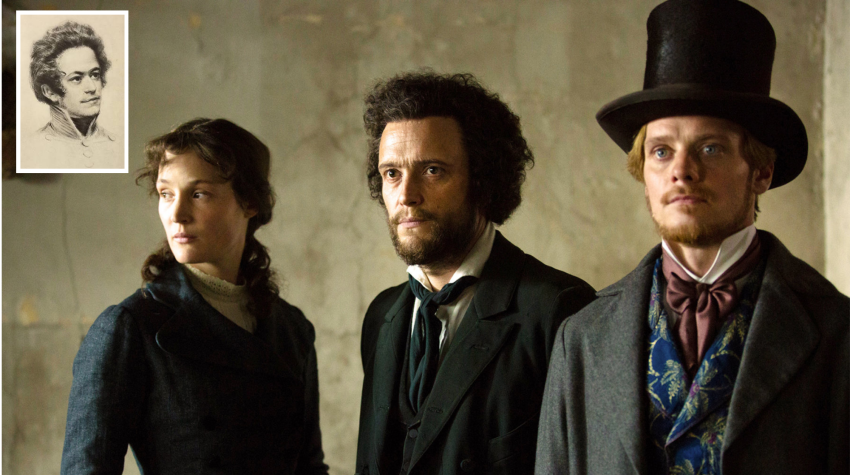
A screening of The Young Karl Marx, directed by Haitian filmmaker and activist Raoul Peck, at the Muloobinba/Newcastle Resistance Centre on August 29 drew a crowd of socialist activists and local campaigners. The film covers the early years of the partnership between Marx and his lifelong collaborator Friedrich Engels.
The film begins by establishing the social and political context of Europe in 1843, when Marx was in his twenties. It captures the end of feudal society, ruled by monarchs, and the emergence of a new class, the proletariat, created by the Industrial Revolution.
These men, women and, of particular ire to Marx and Engels, children, who worked as factory hands, chimney sweeps and labourers, were the driving force behind booming industrial cities.
The film depicts Marx writing for the radical newspaper, Rheinische Zeitung (Rhineland News) to condemn the abuse of peasants by wealthy landlords. Meanwhile, in England, Engels witnesses the brutal mistreatment of workers at his father’s factory, inspiring him to publish The Conditions of the Working Class in England in 1844. The two men met for the second time that year, beginning their revolutionary partnership.
The film explores the personal and ideological struggles of Marx and Engels as they get more involved in the socialist movement. Marx struggles to support his family while facing persecution from the state, including being exiled from France.
The film also depicts the experiences of Jenny von Westphalen, Marx’s wife and former aristocrat, and Mary Burns, Engel’s lifelong partner. Both women were actively engaged in political struggles, with Burns being depicted as Engels link to the working class in England.
The film explores how, in the face of persecution, Marx and his collaborators fought to establish scientific socialism. It depicts Marx’s famous 1846 conflict with Wilhelm Weitling, a proponent of utopian socialism, based on “Christian love” and “brotherhood”, which conflicted with Marx’s view of a socialism based on material interests and economics.
The film concludes with the monumental publication of The Communist Manifesto in 1848, which put forward Marx and Engels vision for the communist movement and codified for wide consumption ideas of scientific socialism and historical materialism.
[This was the first film screening hosted by Red Cinema at the Muloobinba/Newcastle Resistance Centre. The next screening will be of Bill Guttentag’s Soundtrack for a Revolution, on Saturday, September 26.]