
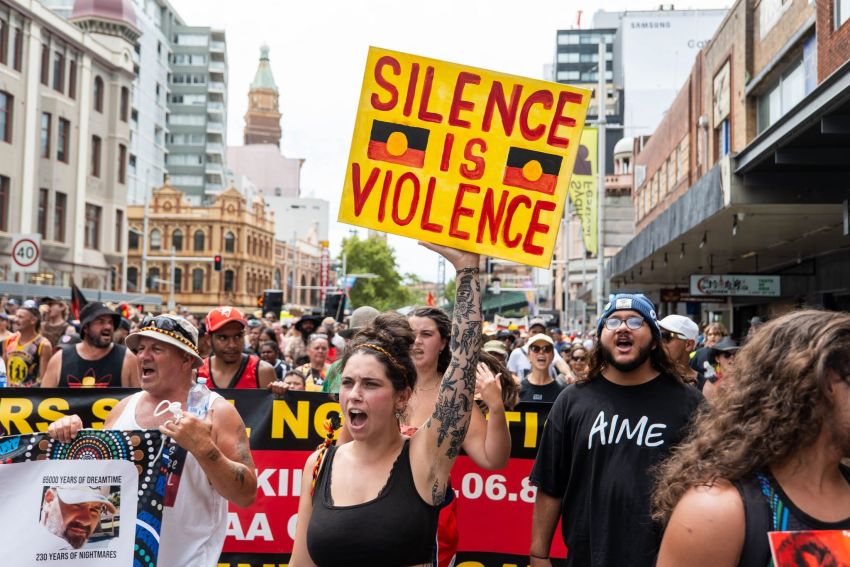
The three-month federal inquiry into racism, hate and violence directed at Aboriginal and Torres Strait Islander people wrapped up in Naarm/Melbourne on August 7.
It received hundreds of written submissions, detailing widespread abuse, harassment and structural discrimination against First Nations people.
It was called in response to a racist attack on Camp Sovereignty, in Naarm in August last year, and an attempted terrorist attack on an Invasion Day rally in Boorloo/Perth in January.
At public hearings across the country, harrowing accounts of attacks on First Nations people were heard. They included attacks on community events for Stolen Generations survivors, First Nations children being bullied for their culture and police ignoring First Nations survivors of domestic violence.
First Nations legal service officers told the inquiry that racism is entrenched in child protection systems, pointing to the removal of children from their families and communities to culturally unsafe environments. Today, more First Nations children are being taken from their families than at any time during the Stolen Generations; about 20,000 children live in out-of-home care across the country.
There were accounts of First Nations communities being subjected to torrents of online racism, at the Gimuy/Cairns public hearing, which the Royal Australian College of General Practitioners described as a “public health emergency”.
Ngarrindjeri woman Marissa Williamson Pohlman, the first First Nations woman boxer to represent Australia at the Olympic games, told the inquiry about the widespread abuse and racism in Boxing Australia. Other sportspeople and representatives from community sporting organisations gave details about the racism First Nations players and clubs face every day.
Millions of racist posts and comments about First Nations people are often algorithmically boosted by design and by social media companies’ failure to moderate content on their platforms. Representatives from Meta — the parent company of Facebook and Instagram — revealed to the inquiry that none of its content moderators were First Nations or based in Australia.
The Northern Land Council (NLC) said in its submission that “racism, hate and violence experienced by Aboriginal people in Australia today must be understood as the direct legacy of historical processes and legal doctrines instituted through colonisation”.
The NLC said the 2023 Voice to Parliament referendum marked a “critical inflection point” and that, since then, it has observed “a clear increase in the openness and hostility of racism”.
NLC CEO Yuseph Deen told the inquiry on July 15 in Garramilla/Darwin that the impact of online racism on young First Nations people’s sense of identity and belonging is a huge concern. “That harm is real, and it is measurable,” Deen said.
The normalisation of online racism and abuse translates into real-life attacks on First Nations people, such as when 56-year-old Andrew Brien deliberately ran over two 12-year-old-boys with his car in Mildura, Victoria, earlier this month.
Two people again attacked Camp Sovereignty on August 2, leaving 37-year-old Ash Ni Mara, a Gunnai, Gunditjmara and Palawa person, with facial injuries.
Victorian independent Senator Lidia Thorpe, a Gunnai, Gunditjmara and Djab Wurrung woman, a member of the parliamentary committee leading the inquiry, said racism in Australia is “like a cancer”.
Thorpe had wanted the Royal Commission on Antisemitism and Social Cohesion to also include racism against First Nations peoples, but she, like others, was ignored. She said the inquiry must address systemic racism and the “structural barriers embedded in systems and institutions across this country that quietly keep us down”.
The inquiry “must not become another tick-a-box exercise, or a delaying tactic that ends in another long report added to the too-hard basket”.
State and territory governments’ refusals to participate in the public hearings — with the exception of Tasmania — show their lack of commitment to even discuss the racism embedded in their courts, police, hospitals, schools and child protection systems.
While there is a significant under-reporting of statistics, multiple studies and reports point to growing racism against First Nations people.
Reconciliation Australia found that 54% of Aboriginal and Torres Strait Islander people surveyed in 2024 had experienced racism in the previous six months — a 15% jump from 2014.
The Gari Yala 2: Speak the Truth report, released in March, found in its survey of First Nations workers that more than half experience racism.
Despite holding public hearings in all major cities, the inquiry has received scant media coverage, especially compared to the antisemitism royal commission. This is unsurprising, given the corporate media’s complicity in fuelling racism by platforming racists, including Pauline Hanson, and perpetuating racist stereotypes in its coverage of First Nations communities.
Systemic racism stems from historical and ongoing colonisation, which continues to dispossess and dehumanise First Nations people. Many have been calling for truth-telling and treaty, as a starting point to address centuries of colonisation.
The inquiry’s final report to parliament is due by the end of the year.