
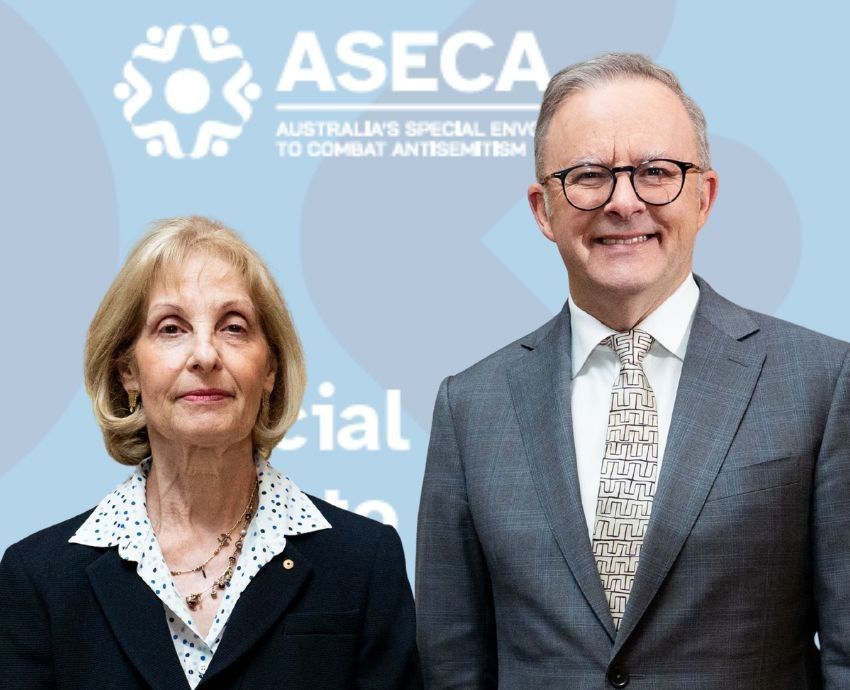
Jillian Segal, Australia’s unelected Special Envoy to Combat Antisemitism, continues to push to insert a Zionist definition of antisemitism — prejudice towards Jews — into all Australian institutions. This is because she knows it serves to stifle criticism of Israel.
Prime Minister Anthony Albanese appointed Segal to the newly-created position on July 9, 2024.
The United States first appointed an antisemitism envoy in 2004. Canada, Greece, Israel, Romania, Britain and the European Union have antisemitism envoys. The Organisation of the American States also has an envoy.
Soon after being appointed, Segal attended a meeting of the Special Envoys and Coordinators Combating Antisemitism conference in Argentina.
Segal wants all public institutions to adopt the International Holocaust Remembrance Alliance (IHRA) definition of antisemitism, which helps propagate Zionists’ narrative that any criticism of Israel is antisemitism.
The basic two-line IHRA definition, developed in 2005, was accompanied by 11 examples of prejudice towards Jews; seven of these specifically mention Israel. Since Albanese adopted Segal’s Plan to Combat Antisemitism, prominent Zionists have been regularly conflating any criticism of Israel’s genocide in Gaza with antisemitism.
Jamie Stern-Weiner writes in his 2021 doctoral thesis on the IHRA definition that representatives of the May 2016 IHRA plenary did not properly vote to adopt it. Kenneth Stern, one of its drafters, has since warned that Zionists are employing the IHRA to shield Israeli human rights abuses.
Zionism, developed by Jewish Austrian journalist Theodor Herz, rose in Europe in the late 1880s. It promoted that a new state, Israel, be founded on historic Palestine.
The federal Labor government ignored the envoy’s plan to combat antisemitism until the ISIS-inspired Bondi Beach mass murder on December 14, 2025. Four days later, Albanese suggested the envoy should be made a “permanent feature”.
Segal’s Plan revolves around getting all levels of government, public institutions and regulatory bodies to adopt the IHRA definition.
The Australian Health Practitioner Regulation Agency (APHRA) was the first major institution to adopt it, in June, despite the backlash from many of its members. Health practitioners could now face discipline or even unemployment if they are critical of Israel’s policies.
The envoy’s next focus is on making arts funding dependent on the IHRA adoption.
Now the Tertiary Education Quality and Standards Agency is requiring that tertiary institutions adopt either the IHRA definition, or the February 2025 antisemitism definition established by peak body Universities Australia, by early January 2027.
The Universities Australia definition is based on the IHRA one.
Australia Palestine Advocacy Network in early October again called for “governments at all levels, universities, schools and other institutions to reject calls to adopt definitions of antisemitism”. It warned that the definitions being promoted “entrench anti-Palestinian racism and threaten political expression”.
Two recent court cases reveal that the judiciary has not been bullied into Segal’s views on antisemitism.
Justice Angus Stewart found in the July 2025 Federal Court case of Wertheim versus Haddad that “the ordinary, reasonable listener would understand that not all Jews are Zionists or support the actions of Israel in Gaza and that disparagement of Zionism constitutes disparagement of a philosophy or ideology and not a race or ethnic group”.
“Needless to say, political criticism of Israel, however inflammatory or adversarial, is not by its nature criticism of Jews in general or based on Jewish racial or ethnic identity,” Stewart said.
More recently, NSW Supreme Court Justice Desmond Fagan condemned the use of the IHRA definition in August in a case that involved a man on arson and graffiti charges which involved anti-Israel messaging.
Fagan found that the graffiti was not antisemitic, despite the repeated assertions of NSW authorities.
Despite this, Segal continues to push for institutions to incriminate those speaking out against Israel’s ethnic cleansing and apartheid-like policies.
[Paul Gregoire writes for Sydney Criminal Lawyers, where a version of this article was first published. Join a rally to protest three years of genocide in Gaza.]