
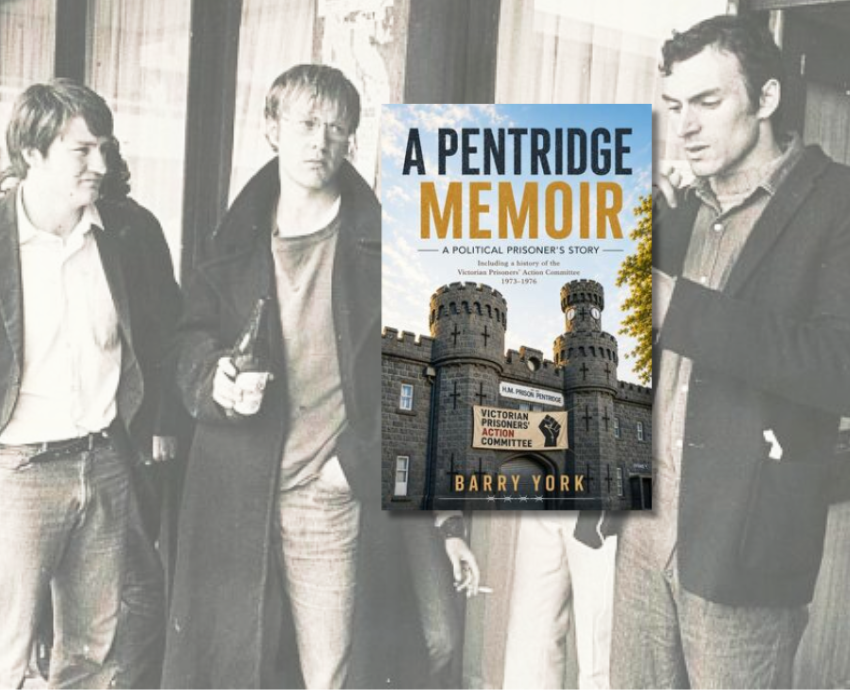
A Pentridge Memoir: A political prisoner's story, including a history of the Victorian Prisoners' Action Committee 1973–1976
By Barry York
Self-published
Sept, 2026
RRP $34.95
In 1972, three student radicals from Melbourne’s La Trobe University — Barry York, Fergus Robinson and Brian Pola — were sent to Pentridge Prison for being in contempt of the Supreme Court of Victoria.
The three were seen as ringleaders of one of the radical student groups causing major problems for the authorities in the late 1960s and early ‘70s, during the Vietnam War.
There had been no trial, they’d been given no chance to defend themselves, and there’d been no sentencing. As far as they knew they were going to jail forever. A Pentridge Memoir: A political prisoner’s story is York’s personal account of this harrowing experience: what it was like to be sent to a high security prison for the “crime” of being an effective political activist on a university campus.
York, Robinson and Pola had been instrumental in organising mass meetings and protests against Australia’s involvement in the war. They staged anti-Apartheid protests against the all-white South African Springbok rugby team's tour, and contributed to the resignation of La Trobe University Chancellor, Sir Archibald Glenn, after he was exposed as being the managing director of Imperial Chemicals Industries (ICI). ICI was directly connected to Australia’s Vietnam War effort, and the Apartheid regime in South Africa.
La Trobe came up with a novel way of dealing with objectionable left-wing student leaders. “The La Trobe Three”, as they came to be known, were suspended from the university, but, on top of this, the University Council took out an injunction against them in the Supreme Court, barring them from setting foot on campus.
There were meetings and protests in support of the banned students. Even political enemies thought they’d been unfairly treated, and the Council was seen as interfering with students’ right to freedom of speech and assembly.
Naturally the La Trobe Three ignored the injunction, and were eventually arrested and incarcerated.
However, the administration’s bright idea of locking them up and throwing away the key backfired spectacularly. Against all odds, they stuck it out, and weren’t broken.
York vividly describes what prison was like for a young student who’d never even been in trouble with the police, let alone been in jail before:
“What stays with me most were the nights in A Division, locked in my cell, lights out, no escape — and the sounds echoing from H Division, the prison’s maximum security wing. Thuds. Kicks. Fists. Screams. The screws in H didn’t merely enforce discipline. They enjoyed inflicting pain on men who couldn’t fight back. They beat defenceless men — unarmed, caged.
“Then there was the crying. A prisoner in an observation cell in our own division, just wailing. Not weeping — wailing. Hour after hour, this long haunted howl of anguish that cut through everything. I couldn’t block it out; it became part of the atmosphere, the texture of the night.
“And I can’t forget the young man in the cell beside mine. He died during the night. Alone.”
It’s a horrific story.
York spent 44 days in prison; Robinson, 4 months; and Pola, 3 months.
York and Robinson were Maoists, members of the Communist Party of Australia (Marxist-Leninist), while Pola was a member of the Moscow-aligned Communist Party of Australia (CPA).
They came out stronger for the experience and were fortunate in being committed communists with knowledge of history and Marxist theory to support them. They understood jail was just another part of the class struggle.
They had a sense of identity and purpose that other prisoners didn’t have. They knew they were political prisoners and, as such, had something to live up to. They had committed no crime. They were in jail for protesting the crimes Australia was committing in an imperialist war; and the crimes of the university, as they saw it, denying freedom of speech and assembly to its students.
They didn’t give in. They never “purged” their contempt by apologising to the Supreme Court.
Eventually, La Trobe backed down. The Vice-Chancellor made an offer — which Ted Hill, their Communist lawyer, recommended they accept. They agreed to renounce violence (they’d never been in favour of violence and hadn’t committed any) on condition that the university also renounced violence — such as its use of police against protesting students. The university then approached the court and requested their release.
As Marxists they understood their task was to continue the struggle wherever they found it — even in prison. They collected information from prisoners and identified tensions within the prison, and between the prison and the outside world. They listened to prisoners’ grievances and then collectively worked out what could be done about them.
When they were eventually released, they didn’t just continue protesting about university regulations and structure, or the war in Vietnam. They set up support groups for prisoners and became active spokespeople for prison reform and prisoners’ rights.
They took on the minister responsible for prisons and had him removed from the University Council. They made the public aware of what was going on in Pentridge, and arranged jobs for former prisoners.
What York describes is a perfect example of dialectics at work. He and his comrades were jailed for their activism against the Vietnam War and La Trobe University's connection to it. They had overwhelming support from the student population and the Student Representative Council, but the University Council decided to make an example of them. They suffered the barbaric conditions at Pentridge and brutal treatment by prison wardens, and they met and learned from ordinary prisoners.
But, most importantly, once released from jail, their activism changed direction and they formed prisoner support groups, both on campus and in the broader community, getting support and publicity from some of the country’s most powerful trade unions — especially, the Builders Labourers Federation (which went on to become part of the CFMEU).
Their activism was taken to a new level. The negative prison experience was transformed into something new — and wouldn't have happened if they had not been jailed. This is a good example of the negation of the negation; quantitative experiences making the leap into a qualitative change.
Maoism had also taught them an important thing: theory without practice is worthless.
Hill gave York some useful advice: If you’re ever arrested by the police for political activism the best response to questioning is “I’ve done nothing wrong” and “I’ve got nothing more to say”.
Readers can order York’s prison memoir directly by emailing: [email protected].
York also wrote an account of his student activism at La Trobe University in Student Revolt: La Trobe University 1967-73, which he has made available for free at: c21stleft.com/wp-content/uploads/2015/09/student-revolt-by-barry-york.pdf.