
For French lycée (high school) students, this week has been an important step in their education. You can study books about the role of the state and of the forces of law and order, of political deception and media bias, and of organisation and solidarity; but that is not the same as practical experience.
This week they learnt the meaning of authoritarianism, and that the official values of the French Republic — liberté, égalité, fraternité (liberty, equality, fraternity) — have to be fought for again and again. They have also provided a lesson in solidarity for us all.
The movement erupts
As in other countries that have undergone years of neoliberal austerity, French schools suffer from chronic underfunding. This affects everything from teacher shortages to building maintenance, and is especially bad in poorer areas. The students have had enough of this undermining of their futures and are on strike.
They are protesting the lack of crucial teachers and other staff, large class sizes, overloaded timetables, badly maintained buildings, and the discriminatory system for allocating university places.
Their main form of action has been blockades of their lycées, supplemented by spontaneous marches and supported by general assemblies.
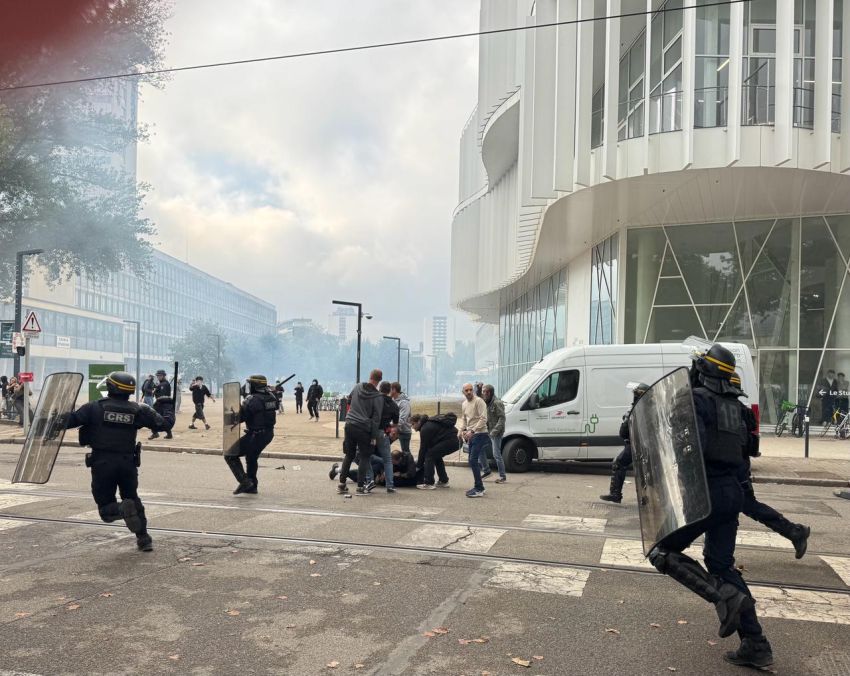
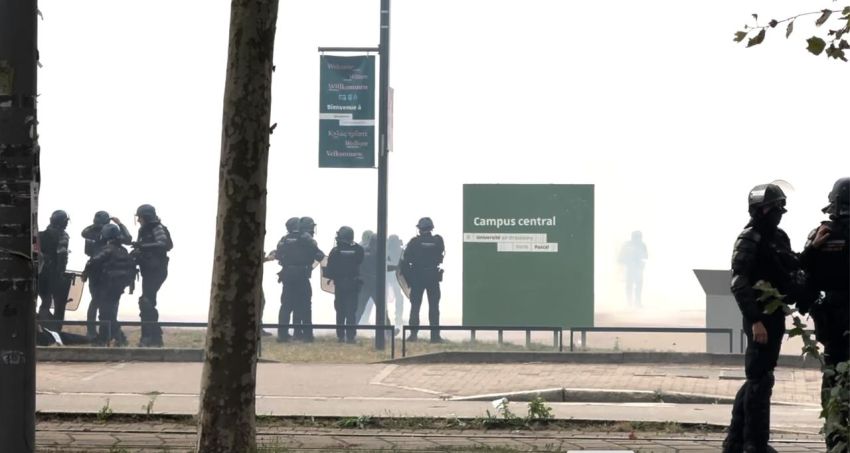
President Emmanuel Macron’s government is responding to discontent the way it always does — with violent suppression. Instead of listening to the students and acting on their concerns, they have sent in the police — riot cops armed with tear gas against teenagers demanding a better education.
Protests first erupted on September 21 at the Lycée Saint-Exupéry in Créteil, in the south-eastern suburbs of Paris, which was short of several teachers. By the end of the week, actions had spread to around 60 lycées throughout the Île de France (the Parisien basin).
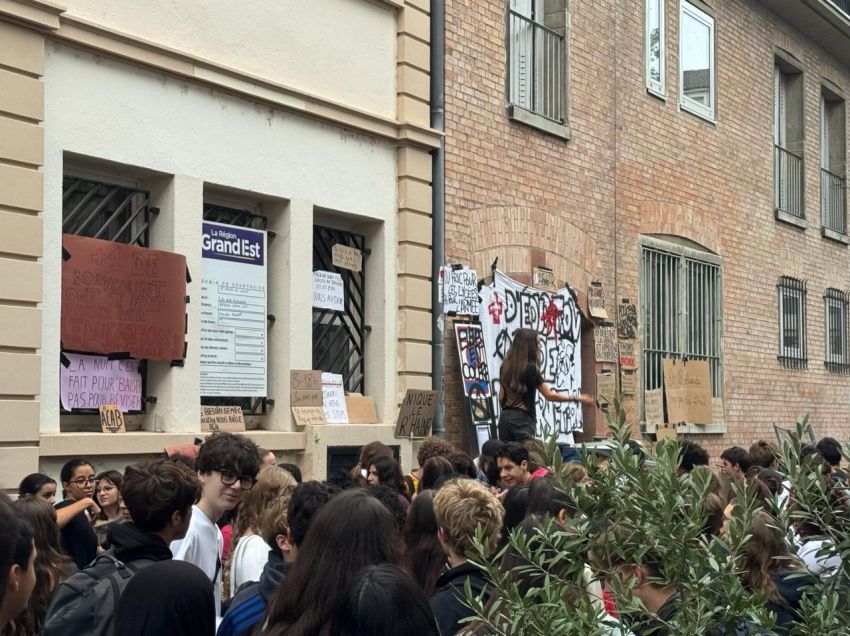
The action was taken up in lycées in other parts of France, on September 28 and the following day, the Union Syndicale Lycéenne (students’ union) called for blockades everywhere. Lycée students marched with striking public sector workers. Police arrested 440 students.
Blockades and other actions continued on September 30, and students from more privileged schools came out in support of the students and the principle of equality.
The Lycée students were joined by students at a number of universities, on October 1. The Union Étudiante (University students’ union) claimed they closed 640 lycées and around 30 university campuses. Their statement read: “These blockades are an expression of young people’s anger at the contempt they face. Over nearly 10 years of anti-social and discriminatory policies, Emmanuel Macron and his successive governments have eroded our living and learning conditions.”
About 2000 people were arrested on October 1. Actions continued the following day.
Representatives of the Lycée students finally met with the Minister of Education after 10 days of protests, but reported that they had not received a “concrete announcement”. More actions are planned for October 5 and preparations are underway for major protests on October 6, supported by the trade unions.
Police violence
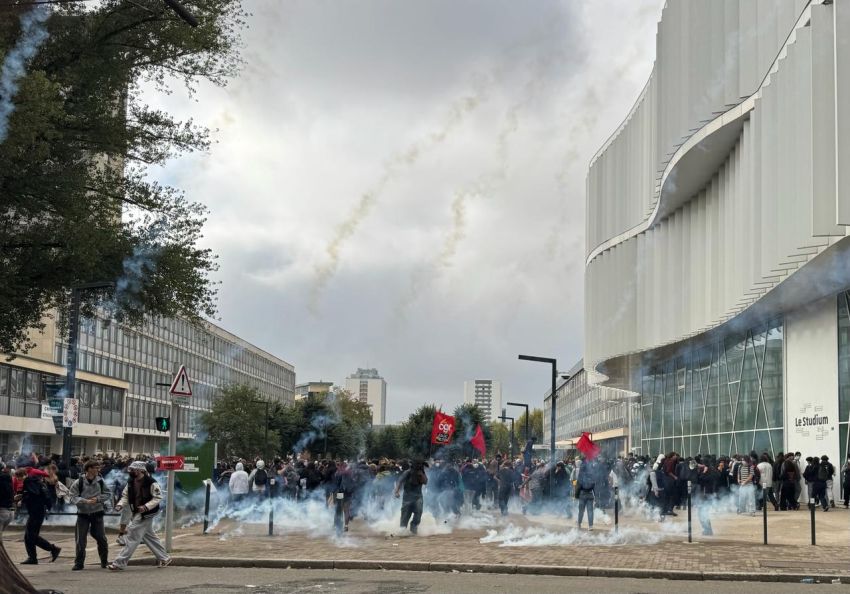
The streets were turned into a battleground as police fired off rounds of teargas and dragged thousands of teenagers into custody, using the sortof violence that we are sadly becoming accustomed to.
A 14-year-old suffered a broken jaw and missing teeth after being hit with a teargas cylinder at point blank range. Another teenager lost an eye. A newly-emerged video shows a police officer holding a youth in water, as if to drown him.
The government could not have chosen a better way to ensure that the protests spread. The Union Étudiante said: “They think they’re putting an end to the movement, but all they’re doing is fuelling it.”
Protesters in France, including lycée students, readily take to the streets, but this time the response has exceeded expectations — in both size and determination – boosted by the aggressive behaviour of a police force that is clearly enjoying its license to terrorise.
Teachers have been supportive of the students’ demands, and also of the students themselves and their right to protest and not suffer police attacks. Trade unionists and elected representatives have tried to give the students an element of protection. And popular support is evident in the reactions of passers-by and of people watching the protests from neighbouring flats and cafés.
Demonising the students
However, not everyone is happy to support the protests, and much of the media — which is largely owned by a handful of billionaires — is working hard to demonise them and to tell a very different story.
With thousands of angry teenagers facing attacks from the state, it would be absurd to expect the protests to cause no damage. There will always be a few individuals who want to push things further, regardless of the consequences, and there are not always others able to stop them. We must expect that agents provocateurs are active, too.
Most damage has been limited to burning bins and shattering bus-stop glazing — a gift for those looking for images to sully the students’ cause — as well as the purloining of lose items for use in constructing barricades.
However there have also been more serious destructive acts, including arson attacks on parts of the very lycée they want to see improved. A fire at the Lycée Nelson-Mandela in Nantes is said to have caused €2 million in damage.
And of course, some students have lashed out at the attacking police, and people have been hurt in the general mêlée — though the worst cases quoted by the politicians have turned out to be fabrications.
While the streets are full of heavily-protected police armed with teargas, it is student violence that has been a major theme of media reports, and interviewees sympathetic to the students are always called on to condemn this violence.
Compounding this mis-portrayal, a young man who has been interviewed on television channels as a “representative” of the lycée students has been discovered to be an employee of a Macronist communications agency and an advisor to Gabriel Attal, the presidential candidate from Macron’s Rennaisance Party. Unsurprisingly, he kept close to the government script.
Blaming La France Insoumise
The political establishment and their media friends do not simply want to dismiss and crush the protesting students. They see this as an opportunity to attack the left, and especially La France Insoumise (LFI), whose leader and presidential candidate, Jean-Luc Mélenchon, is increasingly portrayed as a major danger to the country.
LFI deputies have been prominent in the demonstrations, showing their support for the students’ demands and helping them to get heard. They bear witness and provide a measure of protection, and help ensure that the protesters remain non-violent, despite police provocations.
The Interior Minister has talked about “urban violence” and claimed that the movement is being instrumentalised by LFI. Far-right presidential candidate Marine Le Pen claims Mélenchon “bears a heavy responsibility for the situation our country finds itself in today”. And television debates run above headlines such as “Mélenchon a ‘firefighter who is a pyromaniac’?”
Meanwhile, Mélenchon himself insists on the importance of remaining non-violent, and stresses: “The ‘Insoumis’ movement does not lead grassroots movements. They lead themselves, through their own self-organisation and their representatives. We protect them, we help them, and then they decide.”
A particular target of the attacks against LFI is Bally Bagayoko, the popular mayor of Saint-Denis — a working-class commune where schools have been disproportionately deprived. Bagayoko was welcomed by the protesting students and videoed surrounded by students all singing the Marseillaise.
He also warned the students to be prudent, and helped extinguish a fire that had been lit. But this did not prevent the Chief of Police from reporting him to the public prosecutor, accusing him of “provocation to commit a crime”.
Turbulent times
Establishment politicians and media have no qualms about instrumentalising the situation to discredit LFI — and no interest in the issues raised by the protesting students. They are prepared to use misrepresentation alongside physical force to divide the country and ignite fires of hatred that will long outlast burning wastebins.
The run up to April’s presidential election is set to be increasingly turbulent, but the scale of this week’s protests and the coming together of lycée students and trade unionists provides a source of hope for all to build on.
[Sarah Glynn is a writer and activist based in Strasbourg. Visit her blog at: sarahglynn.net.]