
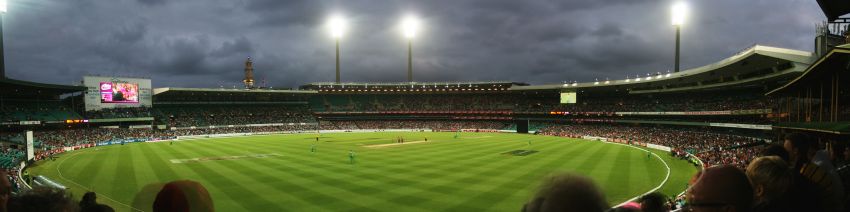
Former NSW Liberal Premier Mike Baird has resigned as chair of Cricket Australia (CA) as opposition grows to its proposed privatisation of the Big Bash League (BBL) — the Australian 20 over competition.
Former Australian Test batsman David Boon will take over as CA interim chair.
Baird has long been a privatisation crusader, particularly as NSW premier over 2014-2017, when he privatised and sold off the state-owned power facility Ausgrid and pushed to privatise huge swathes of public land, buildings and other assets.
He also rammed through major parts of the federal Coalition’s public sector cuts.
It should therefore come as no surprise that he played a key role in CA’s campaign to sell off major parts of the BBL to private investors.
Baird was told mid September that Cricket NSW, chaired by John Knox, had withdrawn support for him to take another three-year term. It also rejected a suggestion that Baird move into a recently-vacated independent director’s spot, until a new chair could be found.
Cricket NSW slammed CA’s decision to introduce private investment earlier this month. “This decision risks leaving cricket in NSW and Australia strategically and financially worse off, with direct consequences for our ability to invest in grassroots cricket,” it said on September 9.
CA, under Baird’s leadership, had earlier approved the partial and full privatisation of (BBL) and Women’s Big Bash League (WBBL) franchises in September, starting with a 100% sale process for the Melbourne Renegades ahead of the 2027-28 season.
Under the original plan, individual state associations could choose whether and when to sell stakes in their respective teams — the “opt-in” or “self-determination” model. It remains to be seen if some states attempt to move ahead with partial privatisation.
Even the pro-privatisation Australian Financial Review said in April that “there is no clear financial evidence for the claim that Cricket Australia must sell permanent equity in its best commercial asset to secure its future”.
CA had wanted to sell stakes in the eight BBL franchises, to raise about $600 million. The AFR argued that “the case for this particular sale doesn’t stack up” largely because of the “duty to steward the game”. It said “cricket is ... a key part of our cultural heritage [and] as the steward of that, Cricket Australia has the responsibility to nurture the game here, not to extract every last dollar from it.”
This fight over CA forms part of a worldwide fight over the future of sports competition under capitalism.
Most controversial has been the push led by Federation of International Football Association (FIFA) President Gianni Infantino’s to privatise world soccer. He wanted to create a commercial body, FIFA Forward Enterprise (FFE), valued at up to $30 billion. FIFA intended to sell a 20-30% private equity stake to outside investors, including a consortium backed by Joshua Kushner’s Thrive Eternal and financial backing from JPMorgan Chase.
National member associations were offered a $20 million one-off payment and higher annual payouts to secure votes before a planned September deadline.
The Union of European Football Associations (UEFA), the Confederation of North, Central America and Caribbean Association Football and the Asian Football Confederation opposed the move, accusing FIFA of selling “football’s soul”.
UEFA threatened a complete boycott of FIFA tournaments, putting players’ careers and the international calendar at risk. Senior advisers and executives criticised the move’s lack of transparency and motives, leading to high-profile resignations.
This international backlash by soccer federations, players and fans forced Infantino to scrap the privatisation plan in just days.
While sport has been made a commodity under capitalism, the outcry over CA’s latest corporate plan is welcome. The struggle to maintain the co-operative and human basis of sports is a positive sign and shows that there is still fundamental public opposition to big business control of every aspect of social interaction.