
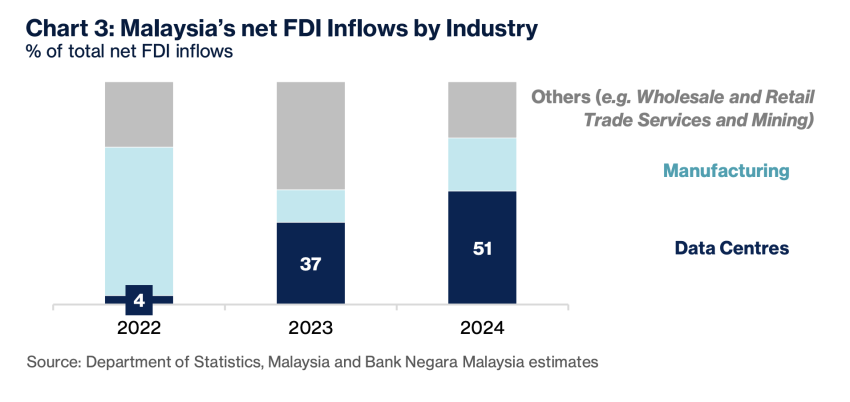
Malaysia is experiencing an unprecedented Artificial Intelligence (AI) data centre boom, with AI data centres having overtaken manufacturing as the major destination for investment in the country.
Data centre and cloud computing projects, totalling RM95.8 billion (A$33.44 billion), accounted for almost 44% of Malaysia’s approved investments in the first half of last year. Since 2021, approved data centre investments have totalled RM385.7 billion (A$134.62 billion).
However, if the government wants Malaysians to celebrate this investment boom, it should publicly release the full balance sheet on jobs, economic development and environmental impacts, Socialist Party of Malaysia (PSM) deputy secretary-general Gandipan Nantha Gopalan, told Green Left’s Peter Boyle.
* * *
What are these data centres being used for and whose interests do they serve?
Data centres are the physical infrastructure behind much of the digital economy. They store and process data, run cloud services and increasingly provide the computing power needed for AI training and inference. The important questions that everyone should ask are who owns it, who controls it and who captures the economic value generated from it.
Malaysia has attracted major global operators and investors including AWS, Microsoft, Google, Bridge Data Centres, DayOne, AirTrunk and Vantage Data Centres. It is time, as a global south country, that we distinguish between investment coming into Malaysia and economic ownership remaining in Malaysia.
Our central bank, Bank Negara Malaysia (BNM), has already warned that Malaysia remains dependent on imported specialised equipment, which limits local value creation and technology transfer. It also notes that foreign-owned firms can repatriate profits.
BNM’s own research shows that data centres typically create fewer jobs than manufacturing, because of automation and remote operations.
From my perspective, data and computing are becoming increasingly important means of production. The question is whether Malaysian workers and Malaysian society gain ownership and productive capacity, or whether Malaysia mainly provides land, electricity, water and infrastructure for multinational capital to accumulate elsewhere.
What are Malaysians actually getting for providing the land, electricity, water, infrastructure and incentives that make these investments possible?
How much are we subsidising these companies through tax incentives, discounted utilities, land and infrastructure? How much corporate tax and other revenue are data centre operators actually returning to Malaysia? What is the government’s net fiscal gain after all incentives and public infrastructure costs are counted?
And how many permanent jobs are being created? How much technology is being transferred to Malaysian companies? How much of the equipment and services are being sourced locally? How much of the profits will remain in Malaysia?
These are questions the government urgently needs to answer.

Around the world, there is rising concern about the impact of AI data centres, especially mega data centres, on energy and water resources as well as on the people who live near them. Are there similar concerns in Malaysia?
BNM estimated that a 50-megawatt data centre can consume electricity equivalent to around 22,000 households and water equivalent to around 2200 households every day. It also warns that unchecked expansion can put pressure on electricity grids, water resources and land, and can potentially displace manufacturing, housing, public amenities and agricultural activity.
Reuters reported that data centres accounted for around 9.3% of Malaysia’s total electricity use by mid-August 2026, compared with an average of about 7%, with demand potentially rising substantially further as more projects come online.
So PSM’s concern is about who bears the cost of this expansion.
If a corporation earns the returns while society bears the pressure on the grid, water supply, land and public infrastructure, then we have to ask whether the economic model is socialising the costs while privatising the gains.
That is fundamentally a question of economic power and class.
United States President Donald Trump is opposing calls for greater regulation of AI and data centres using the excuse that the US is in an “AI arms race” with China. Where does the expansion of AI data centres in Malaysia sit in this new arms race? Which companies are investing in these data centres and whose side are they on in this race?
From the US, we have corporations such as Microsoft, Google Alphabet (partnered with local entities like Dagang NeXchange Berhad), Amazon Web Services and NVIDIA (partnered with YTL Power, Equinix, Digital Realty and Vantage Data Centers). From China: ByteDance, Alibaba Cloud, Tencent Cloud, GDS Holdings and Bridge Data Centres (Chindata).
The issue should therefore be digital sovereignty. Malaysia should not simply become a geographical location where global corporations place servers because electricity, land and connectivity are available.
The AI arms race is being driven by states and corporations. Malaysia should be careful not to become merely the infrastructure provider for that competition.
AI technology is increasingly integrated with the weapons industry. Is there a danger that these data centres could help carry out more genocides like we see ongoing in Gaza?
There is a risk. We already have evidence that commercial cloud and AI technologies can become part of military infrastructure. The Associated Press reported that Microsoft and OpenAI technologies had been provided to the Israeli military, while reporting by The Washington Post found that Google supplied AI tools to Israel’s military after the October 2023 attack.
So, like any other technology, the cloud and AI infrastructure is dual-use infrastructure. The same computing capacity can support ordinary commercial applications, healthcare or education, while also supporting surveillance, intelligence analysis or military systems — depending on who the customer is and how the infrastructure is used.
That is why leaving these questions entirely to corporations is inadequate. And this raises a very important question for Malaysia.
Our government describes Malaysia’s foreign policy as independent, proactive and non-aligned. At the same time, Malaysia has maintained a strong position in support of Palestinian rights and has said that it will not remain neutral on fundamental rights such as the Palestinian struggle.
So how do we reconcile that position with building Malaysia into a major regional hub for cloud and AI infrastructure operated by global technology corporations?
This is where the government needs to demonstrate policy coherence. Malaysia should know who is using strategically important computing infrastructure located on our territory, what categories of services are being provided and whether Malaysian infrastructure could be used for surveillance, military intelligence or other activities that contradict our stated foreign-policy principles and international humanitarian law.
We are not saying that every data centre in Malaysia is supporting military operations. But the possibility is serious enough. If Malaysia is prepared to provide the land, electricity, water, connectivity and infrastructure for global AI companies, then Malaysia should also have the right to impose conditions on how strategically sensitive infrastructure is used.
Big tech CEOs Sam Altman, Mark Zuckerberg and Jensen Huang, say we should trust their corporations to self-regulate and act responsibly. What does PSM say to this?
From PSM’s perspective, why should the Global South be asked to trust corporations headquartered in the Global North to regulate themselves when they are operating on our soil, using our resources and building infrastructure that affects our sovereignty?
We don’t think that is sufficient.