
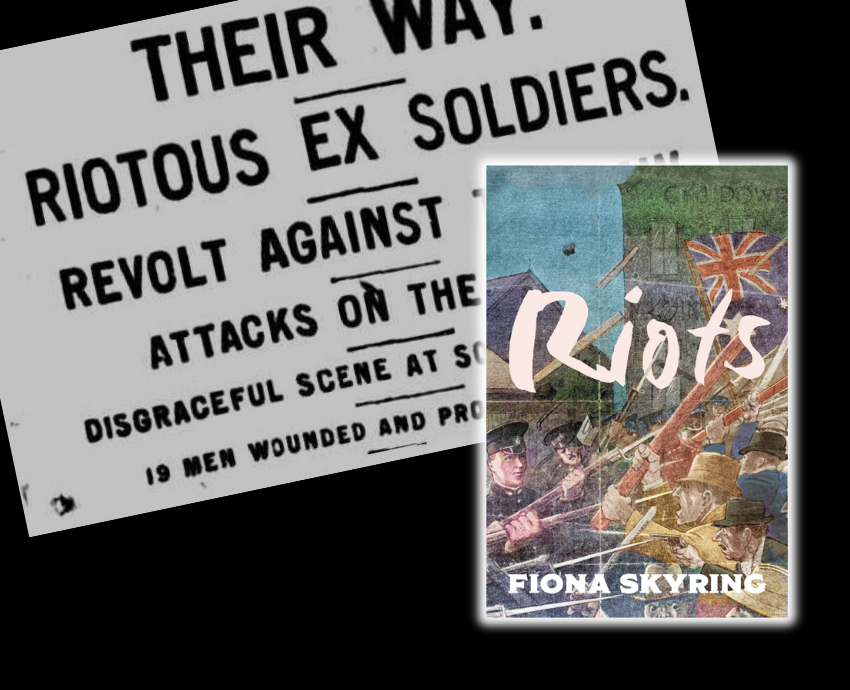
Riots: Returned soldiers and public disorder in Australia at the end of World War I
By Fiona Skyring
Perth: UWA Press
November, 2025
225pp
RRP $39.99
Peace Day celebrations were held across Australia on November 14, 1918, following the end of World War I.
Even though the shooting had barely ended, the social tensions created by the war would be exposed in riots and brawls involving returned soldiers in Adelaide, Broken Hill and Townsville. These were predecessors to the riots that occurred from 1919–21.
Author and historian Fiona Skyring explores this history in her 2025 book, Riots: Returned soldiers and public disorder in Australia at the end of World War I.
In Townsville and Broken-Hill, riots and brawls occurred between self-styled “loyalist” soldiers and trade unionists, socialists and anti-conscriptionists. In Adelaide, soldiers showed their support to striking tram drivers, 300 of whom had served in the Australian Imperial Forces (AIF), by organising and attacking strikebreakers.
The Australia that WWI soldiers returned to was deeply divided by class, religion, social and political issues. The country had been rocked by the 1916–17 anti-conscription referenda, the 1917 New South Wales general strike, and international events such as 1916 Irish Easter Uprising, the 1917 Russian Revolution and the 1918–19 influenza pandemic.
In 1918–19 these divisions continued, as the country experienced a cost-of-living crisis, which was compounded by the mass bereavement due to the war.
Industrial upheaval continued in 1919 with 6.3 million days lost to industrial action, figures unmatched even in the 1970s. The largest strike was waged by the Seamen’s Union, which shut down wharves across the country between May and August.
In Riots, Skyring examines the way the ANZAC legend was being constructed by writers such as Charles Edwin Woodrow Bean, even as WWI continued.
In Bean’s ANZAC Book, published in 1916, the stories of soldiers who said they didn’t want to fight, thought their comrades’ deaths were futile and felt the class divisions between officers and ordinary soldiers in the AIF, were excluded.
Bean wrote in 1919: “Australia (has become) a new nation. Five years ago, the world barely knew her. Today, the men who went to fight for her have placed her high in the world’s regard.”
The celebrated legend of the ANZAC was dominated by the ideal of the overwhelmingly white, tough man from the bush; a classless citizen soldier whose sacrifice was made in the name of nation, empire and freedom. This narrative excluded the 1000 Aboriginal men who served in the AIF and who would experience more discrimination upon their return after the war’s end.
The message that civilian society should honour the soldiers’ sacrifice and any criticism of WWI being seen as “an attack on the soldiers” made it easy for right-wing politicians, industrialists and organisations such as the Returned Soldiers and Sailors Imperial League of Australia (RSSILA) to paint anti-war activists, trade unionists, socialists, Irish republicans and members of the Industrial Workers of the World (IWW) as “disloyal”.
When 1000 socialists and members of Brisbane’s Russian exile community carried red flags on a march through the city in defiance of the 1914 War Precautions Act, on March 23 1919, the conservative press and other forces in collaboration with military intelligence whipped up xenophobic anti-communist sentiment.
This resulted in a crowd of 7-8000 returned soldiers marching to South Brisbane, attacking the headquarters of the Russian Workers’ Association and engaging in an anti-Russian pogrom. These events became known as the Red Flag Riots.
Further soldier’s riots would occur in Fremantle, Melbourne, Kalgoorlie-Boulder and Sydney between 1919 and 1921. The Sydney 1921 riots inspired D H Lawrence’s 1923 book, Kangaroo.
However, the soldiers’ riots were not all directed against socialists and trade unionists.
Skyring describes the events of November 1918, when returned soldiers acted in solidarity with striking tram drivers in Adelaide by attacking strikebreakers.
Soldiers returning home on a troop ship to Fremantle Port in Western Australia on May 5, 1919, also gave their support to striking lumpers – workers who loaded and unloaded shipping cargo. There are accounts of soldiers fighting with police on Fremantle’s streets, in the days following.
In Melbourne, soldiers fought police for four days straight, in July 1919, over the lack of jobs, high cost of living and their treatment by the government.
In response to the rioting that occurred earlier that day working-class returned soldiers took part in a 5000-strong march of the anti-war Labour Volunteer Army (LVA), in Broken-Hill, on November 14, 1918. At a celebration of the Russian Revolution in the town on November 10, 1918, many were surprised that returned soldiers in the crowd knew the words to the Red Flag.
In the immediate post-war period, many soldiers were sympathetic to Labour and socialist politics. Victoria Cross recipient Hugo Throssell gave a speech in Northam, Western Australia, detailing how the war made him a socialist.
Even organisations such as the RSSILA experienced a decline in membership as many working-class members left after becoming disillusioned with its anti-labour politics. By 1923 it represented less than 10% of returned soldiers.
When soldiers directed their rage against what the ruling class termed “disloyal elements”, such as the 1919 Brisbane Red Flag Riots, their actions were painted as “Taking matters into their own hands”, whereas riots where soldiers showed pro-union sympathies or fought the police — such as in Adelaide, Fremantle and Melbourne — the same press were quick to downplay or deny the role of returned soldiers.
In Riots, Skyring examines a part of Australian history that is conspicuously absent from official commemorations of the ANZAC legend. It is important to remember this history, given the continued capitalist crisis and the rise of the far right.