
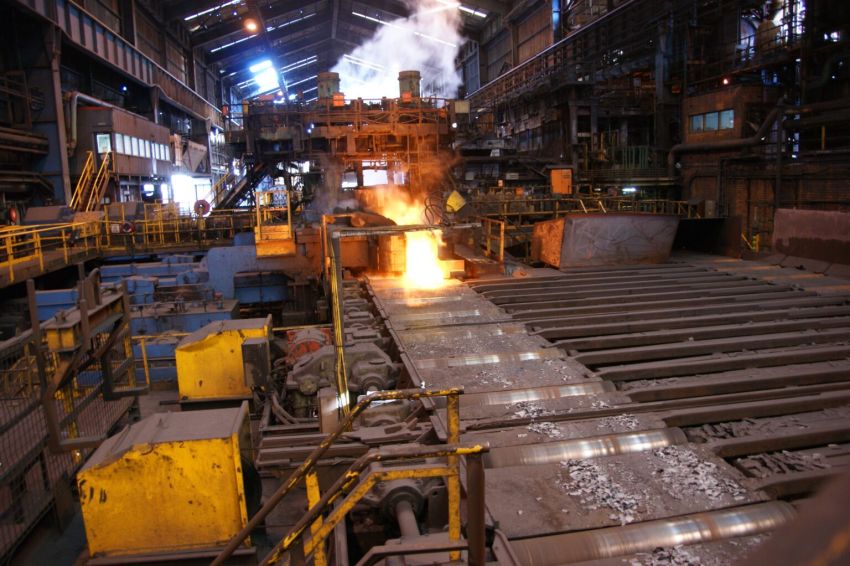
The firm of administrators charged with selling the Whyalla Steelworks plant in South Australia announced on September 14 that efforts to repair the plant’s blast furnace had been abandoned. Smelting of iron ore would cease and of the plant’s total of close to 1700 regular workers, some 500 would lose their jobs.
Joining them would be about 100 “labour hire” workers and many of the 200 “embedded contractors” working at the plant but employed by other companies.
It is hard to overstate the impact of the sackings on Whyalla and its 21,000 people. It is thought that about five further local jobs are to be created from the spending of each full-time steelworks employee. A huge chunk of money will thus be gouged out of the city’s narrowly-based economy. Small businesses will shut their doors, and property values will crash.
One of many ironies is that demand for the steel plant’s main products remains strong.
Whyalla, in recent years, has produced about three-quarters of Australia’s structural steel and all of the country’s output of “long products” such as steel rails and girders. Production of these goods will continue, with the plant’s rolling mill processing imports of semi-finished steel “blooms”. Also carrying on will be production — now for shipment elsewhere — of smelter-ready iron ore pellets, on the basis of the ore resources of the nearby Middleback Range.
But the integrated nature of Whyalla’s steel industry, from ore mining through smelting and processing to shipping through the city’s port, has ended. It was this integration that, for many years, allowed the plant to survive despite inept management and gross under-investment.
Currently, South Australian government-appointed administrators project a sale by the end of the year to one of two final bidders — Indian corporation Jindal Steel or Brisbane-based metallurgical coal firm M Resources.
Private interests, however, have an unimpressive record of running the Whyalla complex.
The plant’s present spell in administration — effectively, bankruptcy — is its second in less than a decade.
British financial adventurer Sanjeev Gupta’s eight-year reign over the steelworks came to an end early last year when the SA government stepped in, citing unpaid mining royalties of $18.5 million. Gupta also had unpaid debts of more than $1 billion to trade and other creditors.
Since then, the ABC has reported that federal and state governments have committed nearly $3 billion to supporting and modernising the steelworks. SA’s Mining and Energy Minister Tom Koutsantonis said: “What we’re trying to do is recapitalise with government money to make sure we’re never here again.”
But questions need to be asked.
Since Australia has a need for a modern steel industry and taxpayers are shelling out vast sums to “recapitalise” Whyalla, does it not make sense for the plant to belong to the public? Is selling the steelworks to another private buyer really the way to “make sure we’re never here again?”
Perhaps Koutsantonis and his federal Labor colleagues believe this is a case of “third time lucky”.
There is no guarantee that selling the plant will allow the two governments to recoup their outlays. The eventual buyer can be counted on to drive a ruthless bargain. Once the sale goes through, the question remains over whether the new owner will make the serious investments needed to bring the complex up to world standard — rather than, as in previous iterations, delaying new capital spending, skimping on maintenance and cutting corners on safety.
Inevitably, a genuine renewal will be expensive.
According to the Australian Financial Review, the plant’s administrators estimate a total price of as much as $8 billion to “build a modern steelworks at Whyalla and fully develop nearby iron ore mines”. Would a large global metals corporation such as Jindal Steel think it worthwhile to spend such sums on what is a relatively small plant with modest profit potential?
When these questions are answered honestly, the conclusion is compelling.
If the Whyalla steelworks is to be properly redeveloped, a publicly-owned corporation would be best as it would be able to borrow at the cheap rates available to state bodies. Only a government instrumentality is likely to commit the resources needed, over the time-frame required.
A range of technical and environmental considerations point in the same direction.
The global steel industry accounts for a massive 7‒9% of all greenhouse emissions, and this alone makes a return to coal-based steel-making at Whyalla unacceptable.
Some variety of “direct reduction iron” technology will have to be used in place of the now-defunct blast furnace.
For at least a decade, interest in “green steel” technology has grown. This is the smelting of iron using hydrogen gas produced by the electrolysis of water, with the iron then being turned into steel in an electric-arc furnace.
This technology would be an excellent match with the state’s huge renewable energy potential and its abundant, conveniently-located reserves of iron ore. Carbon emissions from the steel plant could be cut by as much as 95%.
The state’s Labor government once embraced this prospect enthusiastically. In 2022 it allotted $593 million to a Hydrogen Jobs Plan, to include an electrolyser and associated power plant near Whyalla. But, in February last year, after the steelworks entered administration for the second time, this plan was shelved and the remaining funds were redirected to the plant’s rescue program.
Hydrogen‒Direct Reduction Iron
Although still a novel technology, the Hydrogen‒Direct Reduction Iron process is past the “pilot plant” stage and now nearing industrial implementation.
In northern Sweden, a full-scale installation is largely complete. Costs, however, are still at 20‒30% above those for conventional steel. This means that to be economically viable, “green steel” needs some combination of a price premium for “green credibility” and sales of “carbon offsets”. The Swedish plant is to benefit from both, with Google contracting to buy “environmental attribute certificates” to hide the emissions created by its AI data centres.
“Green steel” in SA, however, would not have such subterfuges available.
Conceivably, the new owner of the Whyalla steelworks would be able to sell offsets under the federal government’s controversial Australian Carbon Credit Unit Scheme.
But there is no guarantee that prices would be high enough to make “green steel” at Whyalla a paying proposition.
This makes it likely that the Direct Reduction Iron process at Whyalla will use natural gas — a highly polluting fossil fuel. Jindal Steel already uses such a method at a plant in Oman.
This is unacceptable. A state-owned corporation could be subsidised to make up for the extra cost.
Whyalla needs advanced, low-emissions steel making. But there is little prospect that private capital, which needs to seek maximum profits in the shortest possible time-frame, will bring it about.
This means that the federal and state Labor governments, that have spent huge sums at Whyalla and now effectively own the plant, must nationalise it.
The sacked workers should be guaranteed retraining on full pay and be first in line for jobs constructing the new installations. Subsidies must be provided to sustain green steel manufacturing until intensive, government-backed research and investment cut the prices of renewable energy and hydrogen, to the point where the new, clean steel-making process can compete.