
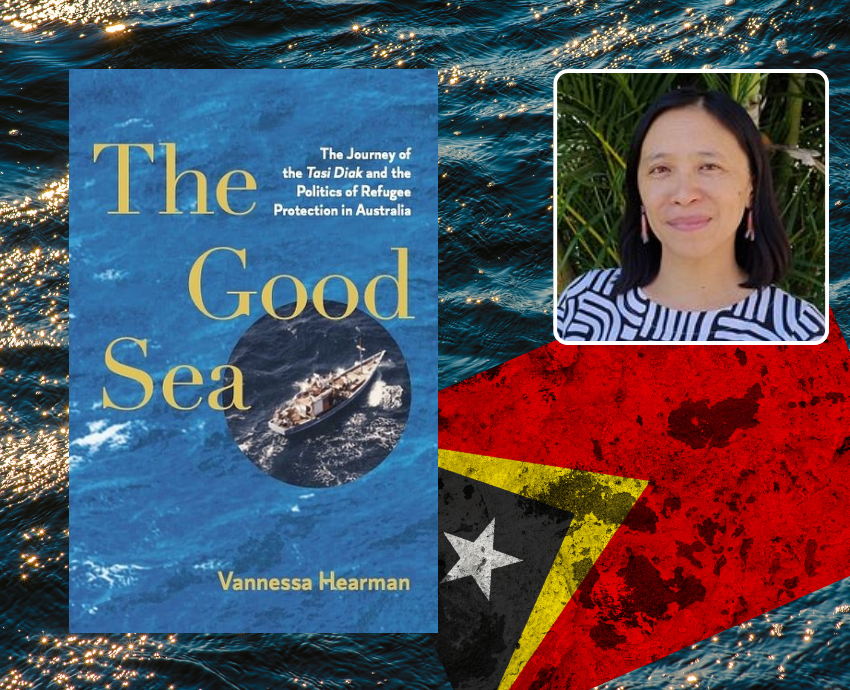
The Good Sea: The Journey of the ‘Tasi Diak’ and the Politics of Refugee Protection in Australia
By Vannessa Hearman
Melbourne University Press (2026)
256pp. $36.99
A small boat set out from occupied East Timor (Timor-Leste), bound for Darwin on May 24, 1995. On board 17 activists who had been campaigning against the Indonesian occupation of their homeland, as well as a six-month-old baby.
Some of the passengers had participated in protests that had been violently repressed by the Indonesian army. Some had given support to the guerrilla resistance fighters in the mountains. Now they wanted to take the case for Timor-Leste's independence to the people of Australia and the world.
The Good Sea: The Journey of the ‘Tasi Diak’ and the Politics of Refugee Protection in Australia tells the story of their voyage, and their experiences before and after.
Author Vannessa Hearman, born in Indonesia and based at Curtin University in Western Australia, is a historian of Southeast Asia, specialising in political violence, human rights and historical memory in Indonesia and Timor-Leste.
The book covers a range of political issues, including Indonesian invasion and occupation; the Australian government's decades of support for the occupation and its eventual change of policy; Australia's treatment of refugees; and the development of the movements in solidarity with Timor-Leste and in support of refugees.
Indonesia launched its invasion of Timor-Leste on December 7, 1975 (after some smaller cross-border incursions in the preceding months). Resistance to the invasion continued for more than 20 years.
Falantil (The Armed Forces for the National Liberation of Timor-Leste) waged an armed struggle in the mountains against occupation. Protests periodically broke out in urban areas.
On November 12, 1991, Indonesian troops fired on a funeral procession heading towards the Santa Cruz cemetery, in the capital Dili, killing about 270 people. The procession was mourning the death of 18-year-old Sebastião Gomes — killed by Indonesian troops two weeks earlier — and demanding an end to occupation.
Some of those who later joined the boat trip to Australia took part in the Santa Cruz protest. One of them was Jose Da Costa, who hired the boat, the Tasi Diak (Good Sea).
On the departure day, the group gathered at a small town near Dili, where they were farewelled by a pro-independence Catholic priest.
The journey lasted six days. The small boat was buffeted by big waves and heavy rain and began to leak.
The group arrived at Darwin on May 30 and were initially taken to a naval base. Despite protests by supporters, they were then taken into detention at Curtin air base in a remote part of Western Australia.
Supporters around Australia campaigned for their freedom. They were finally released and taken to Broome, on July 20. From there they travelled to Melbourne, Sydney or Darwin, where they stayed with members of the East Timorese community.
The asylum-seekers began to do media interviews about their experiences in Timor-Leste. Jacob Da Silva told of his imprisonment, beatings and electric shock torture as punishment for his protest activity. Others told of being arrested and tortured following the Santa Cruz massacre. These accounts helped build the East Timor solidarity campaign in Australia and elsewhere.
The Timorese were given bridging visas, which did not give them the right to stay in Australia permanently. They did not have access to public housing or Medicare, and were not allowed to work. They relied on the East Timorese community, charities and other supporters.
The long delay in dealing with their refugee claims caused hardship for these asylum seekers and the local East Timorese community. Already there were more than 1000 East Timorese asylum seekers in Australia, most of whom had come on tourist visas.
Solidarity groups worked with the East Timorese community to organise demonstrations and cultural events. A Christian Sanctuary Network was formed. As well as making donations and going to protests and cultural events, supporters pledged to hide the refugees if the government tried to deport them. Prominent religious leaders such as Catholic bishop Hilton Deakin and Anglican archbishop Keith Rayner supported the sanctuary network.
The Suharto regime collapsed in May 1998, due to a combination of factors — the Asian financial crisis, splits in the Indonesian military and political elite, and pro-democracy protests.
Protests continued throughout 1998 in Timor-Leste, including a commemoration of the Santa Cruz massacre in November. Suharto's successor, BJ Habibie, announced in January, 1999, that a "popular consultation" would be held on independence.
However, the Indonesian army gave weapons to anti-independence militias, who carried out acts of violence against supporters of independence.
A referendum on independence occurred on August 30, 1999, with 78.5% voting in support. Militia violence escalated. Houses and public buildings were looted and burnt. About 1500 people were killed during that year.
Habibie agreed to allow a United Nations force — comprising mostly Australian troops — to enter Timor-Leste to stop the violence.
Timor-Leste formally gained its independence in 2002 but had been devastated by years of occupation and violence. Many East Timorese living in Australia chose not to return. Many had jobs and relationships, and had become part of the community.
Most of the Tasi Diak group remained in Australia. Eventually they were given permanent visas in 2003–04.
Some of those who returned got jobs in the new Timor-Leste army or police.
The newly independent country faced severe difficulties, including an outbreak of internal conflict in 2006. One of the Tasi Diak refugees, Alfredo Alves, was killed in 2008 after leading a breakaway group of officers in the Timor-Leste armed forces.
The dispute between the Australian government and Timor-Leste over the maritime border in the Timor Gap meant the Timorese people were being robbed of oil and gas revenues. Timor-Leste eventually won a case in the Permanent Court of Arbitration in The Hague and negotiated a permanent maritime boundary treaty with Australia in 2018.
Links between ordinary Australians and the Timorese people continue. For example, in Ballarat, Victoria, students regularly visit Timor-Leste and residents raise funds for community projects in Ainaro.