
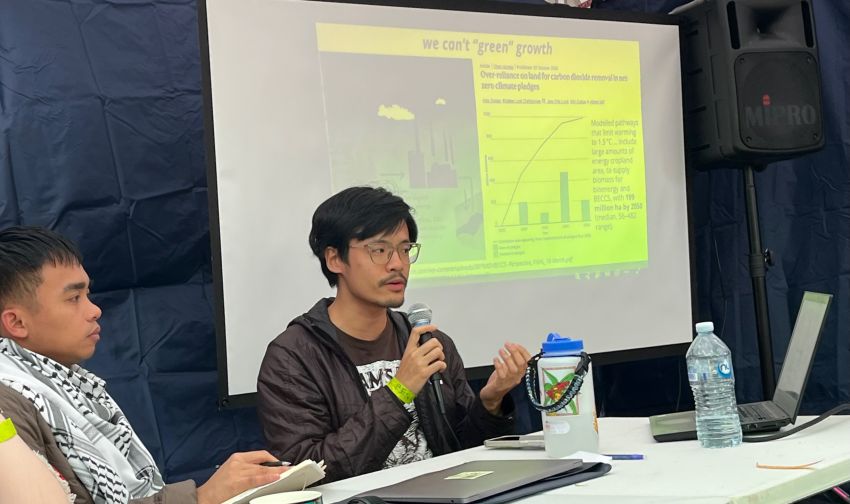
See Yong Feng was one of the guest speakers at the Ecosocialism 2026 conference in Magan-djin/Brisbane on September 11-13. He explained in his presentation, “Degrowth and Ecosocialism” how it would be possible for all people — in the Global South as well as the Global North — to have a good life without crossing planetary boundaries.
See previously worked as an architect and returned to Singapore last year after completing a Masters in political ecology, environmental justice and degrowth at the Autonomous University of Barcelona. He currently works in book publishing and organises with Singapore Climate Rally as well as the independent media network, NIMBUS.
You studied under Professor Jason Hickel in the Autonomous University of Barcelona. He has been at the cutting edge of debates and discussions around ecosocialism and degrowth. What do you think are the most important areas of research that Hickel and his team have covered in the past couple of years?
Research has been done to quantify and prove to conventional economists — and other people who need to see the facts — the extent of the extraction and exploitation that's going on.
A lot of the recent work on unequal exchange has calculated what is the amount of embodied labour, land, energy and material resources that Global North countries get from the Global South — essentially through cheaper prices. It shows how imperialism works within the global trading system that's supposedly based on “fair” prices. This is in addition to the very visible imperialism: invading countries and other military interventions.
Their research makes a very strong point that ecosocialism needs to be anti-imperial and de-colonial.
What this means in material terms is to stop extracting from the Global South to allow it the freedom to develop on its own terms; [for Global South peoples] to have the sovereignty to decide how they want to develop.
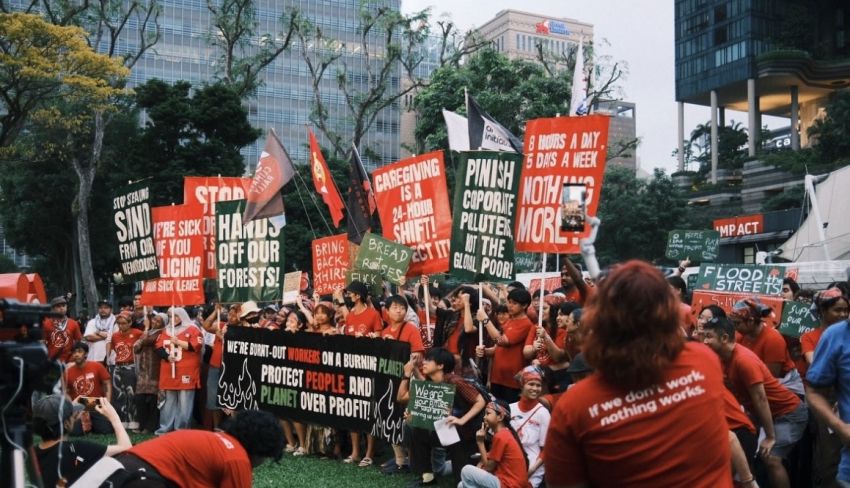
One powerful quantification you shared at the Ecosocialism 2026 conference was what it would cost, in terms of resources, to give everybody on Earth a good life. Is that relatively recent research? How important could it be for taking this issue to a broader audience?
It's not just Jason Hickel but also other researchers. One of the earlier ones was done by Professor Julia Steinberger [from Lausanne University] calculating what it would take to deliver a decent standard of living for all.
Hickel’s paper built on this and other research to show what this would cost in terms of energy and material use and show how viable it is to achieve all these things, as compared to the capitalist argument that only continued economic growth can end global poverty.
It found that we could reduce global energy and material use to less than a third of what we use today and achieve decent living standards for all, even accounting for an increase in the global population to 8.5 billion in 2050.
I think this is important because two of the main arguments against degrowth are that it's not possible or that you're asking people to give up too much to achieve this.
It also shows, of course, that people cannot continue living as some people do in many rich countries, like flying across the world every month. That kind of excessive consumption still needs to be curtailed. But it does show it is possible to have a good standard of living as long as we are able to redistribute wealth, energy and materials fairly and equitably.
Implicit in this is a challenge to the way capitalist economics sees the world. As other speakers at the conference said, its economics through the eyes of a plunderer; stuff to be taken from nature and taken from other human beings. How do you see the challenge of reframing economics around human need, collective control and living with nature?
It's definitely not an easy transition and that's where ecosocialism and the long tradition of organising comes in. What ecosocialism adds is that in addition to fighting for workers' rights and democratic control over production and consumption there also needs to be consideration of what impact it has on the natural world and recognising ecological limits as part of the material conditions we live in.
I think more and more people are becoming aware of this.
There's an article Hickel wrote called “The Double Objective of Democratic Ecosocialism” that sums up the objectives of ecosocialism. It's definitely a big challenge but this is what ecosocialists are calling for.
We need a mass movement to win this and so ecosocialism needs to be something that is attractive and desirable for the masses.
We can't just talk about reducing consumption but we also need to talk about what people have to gain, which is more free time, more time with nature and community and expanding public services and spaces for all to enjoy. We have to show that you can have a better quality of life without needing to spend so much resources and energy and without having so much destructive impact on the environment.