
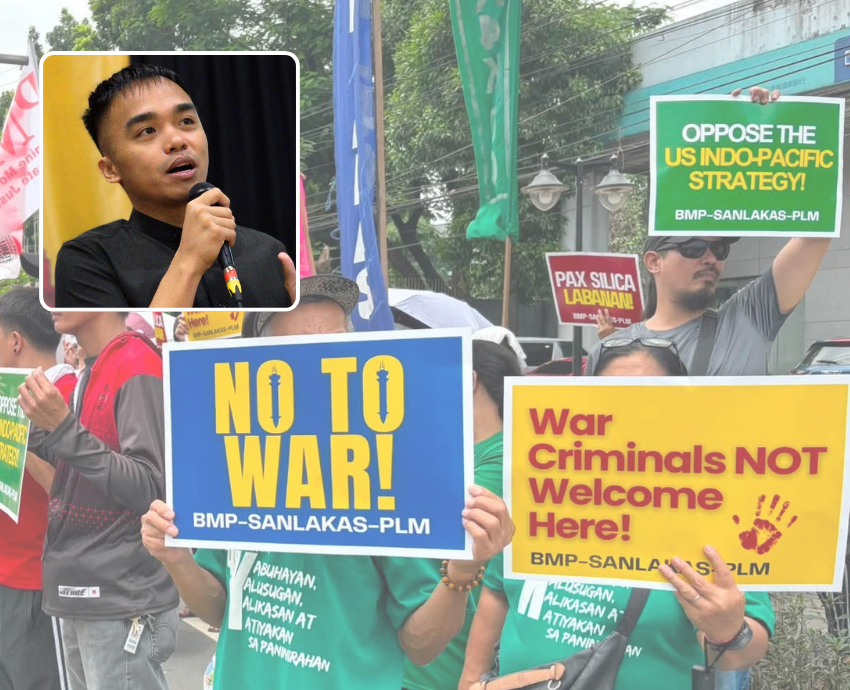
Khyl Ramos works on climate justice, labour rights and grassroots organising in the Philippines. He is the deputy project manager at Transform Asia Gender and Labor Institute and youth coordinator for the Party of the Labouring Masses (PLM).
Ramos was a guest speaker at the recent Ecosocialism 2026 conference in Magan-djin/Brisbane, where he sat down with Green Left’s Ben Radford to discuss last year’s Gen Z protests, recent opposition to the United States-led Pax Silica initiative and the need for ecosocialist alternatives.
* * *
How would you characterise the Gen Z protests in the Philippines last year?
The Gen Z uprising in the Philippines last year was simultaneous with the protests in Indonesia, Nepal and Bangladesh.
The president revealed in July that there was a flood control scandal, in which congresspeople, along with other senior government officials and contractors had corrupted billions of pesos in public funds.
The funds were supposed to go to disaster preparedness and disaster risk reduction management, because we’re a very flood-prone country. But the people in charge of the Department of Public Works and Highways, as well as lawmakers — since they deliberate on the budget in Congress — pocketed the money.
That was the start [of the protests] — students were really enraged about that, especially university students, since there are many universities in Manila situated in flood-prone areas, and they see this as a broader systemic issue of corruption.
In terms of the [Gen Z] movement, it’s very spontaneous. [PLM] tried to maximise on organising around that spontaneity. We’ve revived our youth and student groups; however, not just university students — we are trying to expand to senior high school students — 16- to 17-year-olds — as a new force in the movement.
We’ve been explaining the issue through a number of youth and students’ assemblies against corruption and political dynasties we held in November, 2025. We related it to issues that students can easily understand, for example, around education funding, [and what it would mean] if funds were allocated to education instead of being corrupted.
We’ve been centring our argument to fuel the movement — [explaining] how corruption is really affecting not just grassroots communities, but also students.
We are building an independent youth movement, separate from parents as well, because some of the youth are quite shy when their parents are around. As people in the party say: “Don’t let the parents get involved, let the students do the organising.”
How do the recent Pax Silica protests tie in with struggles for climate justice and resisting green colonialism?
Pax Silica is a US-led economic and technological security initiative, with the US trying to gather allies from around the region. Australia is also part of that alliance, along with Japan and more than 20 other countries, including the Philippines. [The US] has been trying to move its allies away from China, since China is one of the leading countries in the critical minerals and semiconductor industries.
Now, we are being targeted as one of the centres for the Pax Silica initiative. They’re trying to build AI data centres and a manufacturing and semiconductor processing hub in New Clark City [in Central Luzon, about 100 kilometres northwest of the capital, Manila], which will occupy around 1600 hectares of land, which indigenous communities are living on. It is their ancestral lands, which they will face displacement from.
When we started the campaign around April this year, it wasn’t well known... But the campaign against Pax Silica has really boomed in the past two months, because they’ve been trying to fast-track it.
There are different progressive movements making solidarity visits to the area to see the situation and put forward a campaign.
[Pax Silica] also has a geopolitical agenda because of the US conflict with China. We’re in the middle of it, especially with the continuous installation of US presence [through the] Enhanced Defence Cooperation Agreement (EDCA). We had five [EDCA sites] in 2023, and it’s increased to nine now.
Filipino and US troops are doing [joint] military exercises ... firing guns and detonating bombs. Last May 2026, in Leyte, Eastern Visayas, a US Tomahawk cruise missile was launched as part of the Balikatan [military] exercises, and struck a designated target area in Nueva Ecija. The impact on the ground is really being felt by our communities.
They’re planning to build a new capital [in the New Clark City area]. They plan to transfer the industrial-commercial hub there and extend that hub... It is also being targeted as a staging platform for war, since AI is also being used for militarisation. It will be used to intensify the genocide in Palestine and the war with Iran. Their imperialist tendencies will be strengthened because of this initiative.
As an environmental and climate justice issue, we all know that AI uses tonnes of water, and, if my data is correct, [the AI and semiconductor hub in new Clark City] will use 65-90 million litres of water every day (39 billion litres annually). This initiative will feed the global demand for the country’s natural resources already undergoing decades of massive colonial extraction.
The president is pushing it under a “green transition” — their agenda for green capitalism... But it’s also opening tendencies towards nuclear energy. The Bataan nuclear power plant was built by the dictator [Ferdinand] Marcos Snr, but never operated commercially because of safety hazards and environmental risks. Now, they’re reconsidering nuclear power as a national energy policy because of the Pax Silica initiative. These are really interconnected issues.
Then, there’s the economic impact. They say it is going to provide jobs … but we all know that it will all be automated in the end. Filipino workers will just contribute during the construction of the site, but after that? It’s really not sustainable.
Our national sovereignty is being eroded because [under Pax Silica, the government] is planning to give land to the US for free for two years. Surrounding that, there was a law (Republic Act No.12252) passed a year ago, that we can lease our land to foreign “investors” for 99 years ... basically, that is foreign ownership of land — which our organisers are explaining to the communities.
They are completely lying to our faces ... They’re giving our land away to these imperialist powers; not for our benefit, but for their benefit, especially with the US’ war strategies and tactics around the Asian region.
They’re also planning to use the Pax Silica initiative for cyber warfare, since the fight now is not only physical, but digital.
They’re already destroying the environment in the Philippines — it’s been a ground for resource extraction, which will intensify under the Pax Silica initiative. They’ve already been mining in other parts of the country as part of the unjust transition that we’re seeing: the fight for nickel, lithium, cobalt and other “critical minerals”.
In November, a US representative is coming to the Philippines to formalise the agreement. They’ve been holding pre-conferences in the Philippines. There have been protests already, and alarmingly, there have been arrests of activists for protesting Pax Silica.
There was also recent news that the government is appealing to activists to refrain from holding protests during the ASEAN summit, which is absurd and an unacceptable attempt to silence the people.
Hopefully, we can sustain the momentum, since the general public is also against Pax Silica. It is easy to explain how it will affect the environment and how it will doom us.
The Central Luzon region, where the data centres will be built, is scarce in water resources because of local corporations mishandling access and prioritising profit. On social media, there have been campaigns, not just by the left, but also the general public, [demanding] “no to Pax Silica, shut the Pax down”. That’s a great opening for us to continue the campaign.
We’ve talked about defensive struggles, but how, as ecosocialists, are you putting forward alternatives?
An ecosocialist alternative is critical at this point because of the worsening capitalist system in the Philippines. The corporations and businesspeople are controlling the government. The government is working with the corporations.
That’s why we’ve been advocating for democratic planning and democratic consultation with communities as part of an ecosocialist transition.
In terms of resources, public utilities should be in public ownership. An ecosocialist alternative must pursue planned, sovereign industrialisation by investing in Filipino-owned industries, local supply chains, research and scientific capacity.
As part of the PLM’s campaign, we’ve been putting forward the [demand for a] “government of the masses”, because the masses are the ones who really know what the situation on the ground is and what we really need from the government.
We’ve been advocating for workers’ control of resources — water, energy, transportation. Our transportation systems have been sold off to local corporations. We’ve also been campaigning for energy prices to go down because it is also controlled by private corporations, as well as water.
PLM is one of the leading groups at the forefront of the ecosocialist movement. We’ve been trying hard to extend the message to more movements in the Philippines. There are many climate justice movements, but some people in the movement still need convincing on the idea of ecosocialism.
We’ve been trying to put forward public education through a socialist school ... since we’ve also had a new wave of young comrades [join PLM]. It’s great for advancing and explaining what an ecosocialist transition will look like.
Since the disaster in Nepal ... [it is clear that] the capitalist-induced disasters we are facing are not separated. We have borders, but it is felt across countries.
Recently, we had the haze in Manila from [the wildfires in] Indonesia. Some of our Indonesian colleagues and comrades said to us, “you should sue our government”. I tell them we need Asian solidarity with the left parties and movements as well, on how we can make our own governments accountable.
With the disaster in Nepal and the global race for a just energy transition, we must have a regional plan through democratic planning — [for] how we can move as a region in terms of these just energy transition initiatives, and how can we put forward an ecosocialist alternative.
The PLM has grown, particularly in the past year or so. What are the reasons for this?
We have a presence in eight regions and beyond, and each community has different local mass struggles around housing, access to water and resistance to corporations building environmentally destructive infrastructure.
We’ve been maximising the opportunities to organise grassroots communities, since they’ve been looking for organisations or people to help them to file cases, to talk to the government agencies — since we’re in dialogue with the government to register our demands, especially with the housing issues in the urban poor communities in Manila.
People are looking for alternatives, because the politics in the Philippines is ridiculous right now — the elites are fighting each other, which people are seeing on social media and in the news. That’s why we’ve been maximising that opportunity and opening ... it’s the political situation and the need for a socialist alternative [driving the PLM’s growth].
What impact does the PLM’s election work have on drawing people into socialist politics?
We see it as a positive development — we’ve been building the left and socialist movement in the Philippines [through elections]. We’ve been moving forward with how we can expand and extend our message beyond our own networks, especially [in the context of] the connotations and the propaganda against socialist movements. In the Philippines, socialism as a word is still viewed with skepticism and is not widely accepted.
The election has been an instrumental part of this change in the wave of people coming to the left, especially, since in 2022 we were not as visible. The momentum started when we first appeared on mainstream television for debates. I think that’s one of the turning points; when our candidates, Leody de Guzman and Luke Espiritu, really showcased our platform to a wider audience.
The youth campaigning for our candidates is also a significant development, because they’ve been talking to their parents ... [and] campaigning on social media.
When we were participating in the elections, people were telling us, “You won’t win”. But our first goal is to establish our presence, and we’ve achieved that.