
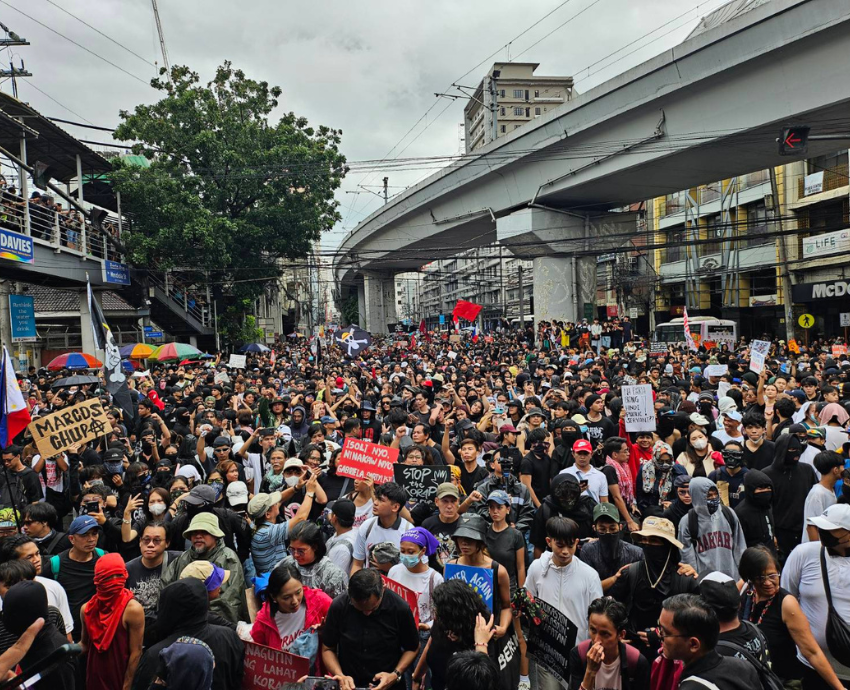
Major anti-government protests took place in the Philippines on September 21 — adding to the youth-led anti-government protests across Bangladesh, Nepal, Timor-Leste and Madagascar.
To get a sense of the scale of this movement and its possibilities, the Green Left Show’s Alex Bainbridge spoke to Philippine socialist leader Sonny Melencio on November 10. Melencio is the chairperson of the Party of the Labouring Masses (Partido Lakas ng Masa, PLM).
Melencio told GL that the protests emerged as “primarily a reaction of the youth to the scandal involving the flood control projects”. This scandal originated last year, when billions of pesos allocated to flood mitigation in Metro Manila and Central Luzon instead ended up in the hands of politicians and their business cronies.
“But it was the straw that broke the camel's back, because this issue was right on the heels of the 2025 national budget where the allocations for social welfare projects and education were cut down by Congress in favour of those projects,” Melencio said.
Upsurge
Melencio said the protest movement “clearly has developed into a character of a youth upsurge”.
“[W]e can even say that this is a kind of uprising of the post-2020 generation. And this has escalated to the point that the presidential palace (Malacañán Palace) called the youth action — especially on September 21, which was the peak of the actions — a riot.
Melencio said a massive rally against corruption in Luneta drew 50,000 participants, mostly young forces, and marched towards Mendiola, close to the presidential palace. Protesters clashed with police barricading the road.
“The protesters wore black, which was the colour theme of the actions in Luneta,” said Melencio. The youth unfurled pirate flags from the One Piece anime series, symbolising rebellion against the government and the establishment.
Melencio said the protests are organic, decentralised and spontaneous.
“They are not centrally organised by left parties or even by official student councils. They spread through shared outrages seen on televisions from congressional hearings and clear evidence of the corruption happening.
“There is an international echo of course, because it happened right in the midst of uprisings in Indonesia, Nepal, Timor, Bangladesh and Madagascar. And this global wave was also telling the youth in Manila that they are not alone. And other young people are rising too.”
Melencio compared the dynamics to the “First Quarter Storm” protests in the early 1970s that he took part in, “where students threw stones, molotovs, pillbox bombs because of police brutality trying to block the rallies. So cars were burned. Symbols of government power were destroyed”.
“But those actions, like what is happening today, were basically driven by a deep disgust by people against the status quo, the establishment and the regime.”
Melencio said actions have continued since September 21 and the movement is “an evolving upsurge” that could lead to a much larger confrontation.
“That's the way we see it because it has not stopped. Student walkouts have happened in many colleges and universities, sometimes supported by the faculty and staff.”
Weekly Black Friday protests actions are taking place against corruption and political dynasty.
Spontaneous
“And it has in a way, spread, not only in Metro Manila, but in the major cities in the Philippines, especially in the universities ... and this is a genuinely spontaneous movement.”
While the organised left, including the PLM, are present at the protests, “we are not leading their spontaneous action”, Melencio said.
Melencio said spontaneous slogans have emerged in the protests, such as calling for all the corrupt to be jailed. “And this chant is now happening, not just in rallies, but in shopping malls, in concerts, in sports intramurals where young people gather or assemble.
“This is quite similar to the Hong Kong youth revolt, where unannounced flash offensives happened in multiple places.
“And the demands are no longer just against corruption. The entire government is being indicted. Everyone is implicated: the president, the vice president, the cabinet, congress, down to the crony contractors.
“Corruption is now understood as systemic, a product of entrenched political dynasty which monopolise resources and power.”
“And these protests are also driven by the conditions of the students themselves. The high tuition fees, unemployment, contractual labour, oppressive gig economy conditions, and the skyrocketing cost of living. These demands are not yet at the forefront, but they will be, especially if the protests continue and deepen.”
Melencio said the PLM describes this as a crisis of legitimacy of the entire government, “for both the Marcos Jnr and [former president Rodrigo] Duterte factions, which is now visibly eroding among young people because both camps are implicated in high-level corruption, patronage politics and they are also the main representatives of dynastic rule.”
Left and liberal forces
Two rallies on September 21 displayed differing characteristics. The Luneta-Mendiola rally was joined mostly by youth and student forces, and was “in a way called by the left groups, including the PLM and the Makabayan Bloc, which was the group of the Maoist tradition”, said Melencio. The other was held at the EDSA shrine and organised by “church groups, liberal political forces and social democratic forces”.
Before the day, the organisers of the EDSA rally held a press conference, where they criticised the youth who were present for carrying placards that held Marcos Jnr accountable for the massive corruption, along with calls for him to resign.
“Their placards were confiscated by the organisers ... and it was publicly announced that no slogans attacking President Marcos Jnr or calling for his resignation would be allowed,” said Melencio.
“The organisers of the EDSA rally also lambasted the violence that happened after the Luneta rally in Mendiola, but they soon kept quiet, because in the social media and other venues, the youth were extolling the ‘Mendiola resistance’.”
Young people also organised vigils in front of the police headquarters where about 70 young protesters were detained in the aftermath of the Luneta-Mendiola rally.
Melencio said young people don’t buy into the propaganda that former dictator Ferdinand Marcos’ rule was a “golden age”, nor do they support attempts to rehabilitate his image and legacy.
Duterte’s war on drugs has also left deep scars on ordinary Filipinos, especially young people.
“Duterte only focused the war on drugs on poor neighbourhoods and urban communities, targeting young people too,” Melencio said.
While initially supported by sectors of the middle class wanting to protect their property from petty crimes and overseas workers who were beginning to buy houses and send remittances to their families, “many later learned the hard way that their own children could become victims of extrajudicial killings in their communities, so the support began to crumble. But even now, there's a base of popular support to target the urban poor, [among] overseas Filipino workers in several countries.
“The students, however, did not share this mindset. They understood that while crime and addiction are real problems, the state bears ultimate responsibility, not only for maintaining peace and order, but for ensuring the welfare and dignity of the entire population.
Challenges ahead
“So I believe the current youth upsurge has shattered the so-called popular rule of the right-wing forces — both Duterte’s and Marcos Jnr’s. However, the youth must still find alternative political channels to consolidate their power.”
The protesters at the Luneta rally raised the chant: “Marcos, Duterte, they’re not different from each other”.
“There is, as yet, no alternative political instrument capable of transforming this upsurge into a sustained political storm,” Melencio said. “Whether that emerges depends on whether the ongoing wave of youth and student protests can be consolidated, further politicised and developed into strong organisational forms.”
Previous regimes have responded to uprisings with repression, Melencio said, and the threat remains, including “the possibility of a declaration of martial rule, which Marcos Snr did during his time to stop the upsurge.
“So, we're in the midst of this situation and we’re trying to develop ways to keep it going and to develop the political instruments that we can use to lead the rupture and work towards systemic change.”
[Watch the full Green Left Show interview. Transcribed by Gabriel Di Falco.]