
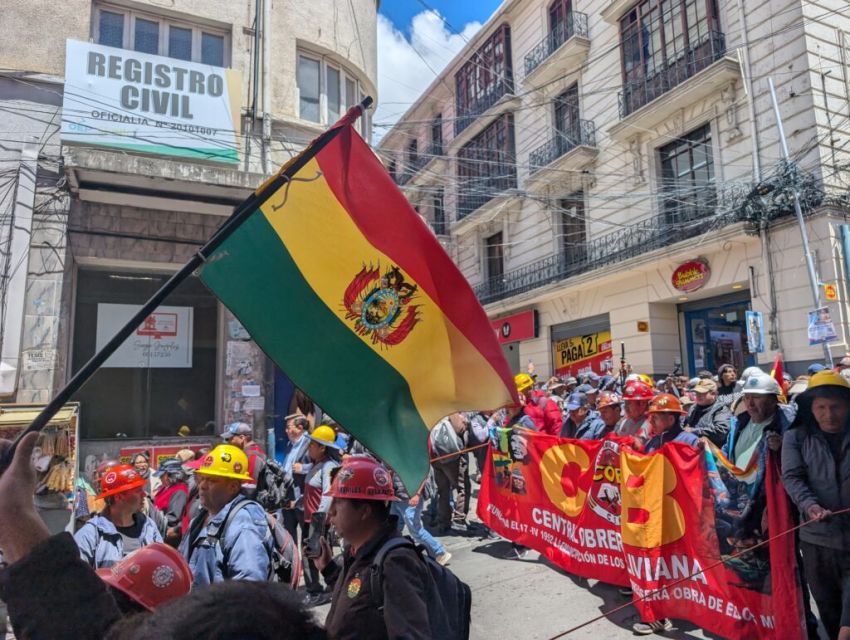
After a series of protests over cuts to fuel subsidies brought the country to a halt, Bolivia’s powerful social movements embark on a new chapter and face new forms of repression.
In late last year and early this year, Bolivia’s cities and highways witnessed another wave of mass demonstrations, roadblocks, hunger strikes and assemblies. Once again, state policy was overturned by street politics, popular mandates and vetoes.
On December 17, President Rodrigo Paz issued Supreme Decree 5503, which lifted fuel subsidies and reoriented economic policy toward neoliberalism. However, 24 days of protests forced the government to back down, although it managed to extract several key concessions from social movements.
This was the first major social conflict since Paz came to power last October. It will hardly be the last, as efforts to establish a new economic regime will face popular resistance. Bolivia is thus entering a new cycle of conflict marked by disputes over the way out of its brutal economic crisis — and the meaning of resistance itself.
Tenuous trust evaporates
Last year’s elections had raised expectations for change. The victory of Paz and his vice president Edmand Lara, dependent upon the support of voters from the countryside and urban popular classes, served as a check on the openly radical right wing led by candidate Jorge Quiroga.
However, after the runoff election, the populist campaign rhetoric dissipated and the alliance between Paz and Lara fractured. The vice president became an opposition figure and Paz responded by isolating him, curtailing his powers and passing reforms that would enable him to maintain his executive powers even when travelling abroad — without ceding the interim presidency to the vice president.
At the same time, Paz leaned heavily on the business and financial lobby to build his government. He appointed a cabinet with profiles linked to private enterprises, agribusiness and the financial sector; travelled to the United States to meet with representatives of Donald Trump’s administration and the World Bank; and upon his return, promoted the narrative of an “economic catastrophe” attributed to “20 years of MAS rule”.
Paz used this same rhetoric to justify Decree 5503. The fuel subsidy, a feature of the Bolivian economy for decades, set domestic fuel prices below international prices, with the state paying for the difference. Although the Paz administration justified the measure as “tax relief” due to the high cost of fuel imports, the costs were passed on to the public and the prices of transportation and food rose. The lifting of the subsidy provoked an immediate economic shock: the price of gasoline rose by 86% and diesel by 160%.
To offset these price hikes, the decree increased the minimum wage and bolstered social programs aimed at supporting the elderly and expanding children’s access to education. It also created a new subsidy for low-income families.
In all, the decree was composed of 120 articles that together sought to “redefine the role of the state and the scope of public intervention in the economy”, according to analyst Ernesto Peñaranda. In other words, the decree opened up the Bolivian economy to foreign investment by cutting regulations and decreasing government oversight on public contracts.
According to economist Jorge Viaña, the neoliberal orientation of the proposed changes could be unconstitutional and open the door to the privatisation of natural resources.
Community organisations take action
In the days following the enactment of Decree 5503, Bolivian media reported scenes of disorder in everyday life. Bus drivers unilaterally doubled fares and merchants speculated on basic goods in anticipation of further price increases.
Between December 19–25, sporadic protests and threats of confrontation kept the atmosphere tense. “The process of coordination was slow,” said Carmen Núñez, a social anthropologist and member of La Pulga Podcast, an independent media outlet focused on Bolivia and Latin America. “The Bolivian Workers’ Union (Central Obrera Boliviana, COB) maintained permanent mobilizations in La Paz, even during Christmas and New Year’s celebrations.”
On December 29, three hunger strike pickets were set up in La Paz, led by the National Committee of Mining Housewives, in response to the government’s refusal to discuss the repeal of the decree.
As this year began, the conflict entered its most decisive phase. On January 3, the COB increased the pressure with a massive march from Calamarca to La Paz under the slogan “Bolivia is not for sale”. Negotiations that began when the demonstration arrived in La Paz on January 5 were unsuccessful. Paz made it clear that he would not back down.
Furthermore, on January 6, the government opened a new battlefront when a convoy from the Brazilian company PETROBRAS entered the Tariquía National Reserve in the south of the country under police protection. There, community land defenders have been defending the reserve from the advance of oil companies for years. Images of police repression and the prosecution of protesters sparked new protests in several cities across the country.
Rural organisations took longer to join the protests. According to Víctor Salvador Guzmán Flores, an employee of the publishing house Informal and current secretary of press and propaganda for the United Workers’ Union of Colomi, access to information about the effects of the decree enabled the organizations to mobilise. “At the United Workers’ Union level, we have organized a number of workshops where expert lawyers have explained the situation to us. These workshops have been for regional leaders, followed by others for sub-unions and union leaders.”
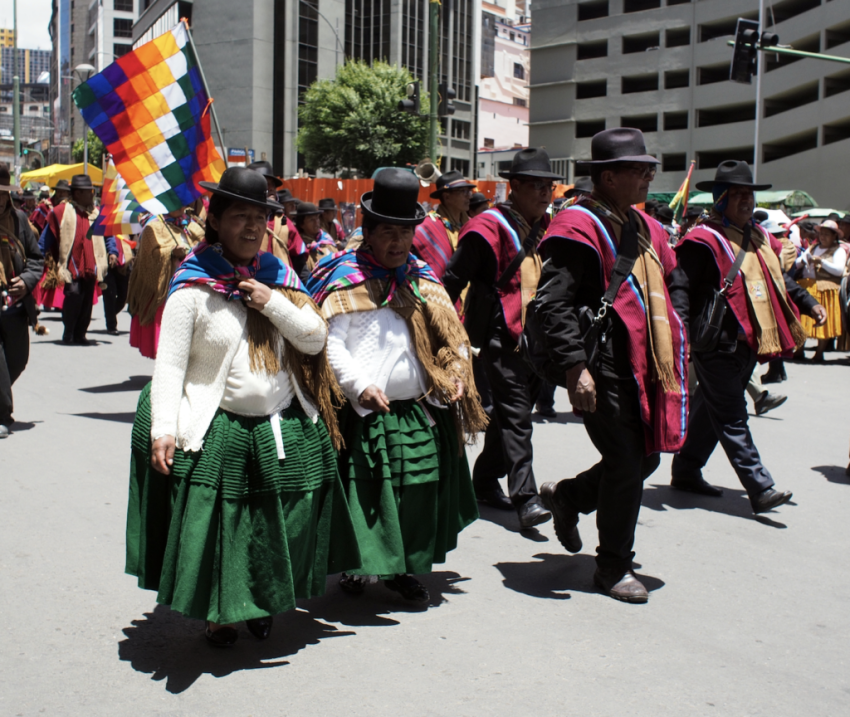
On January 10, the number of roadblocks had grown from nine to 69 after the Union of Peasant Workers of Bolivia (CSUTCB) and the Departmental Federation of Peasant Workers of La Paz “Tupac Katari” joined the demonstrations.
With the country paralysed and the conflict at its peak, the executive branch finally gave in. The government agreed to repeal Decree 5503 and draft a new decree within 48 hours — Decree 5516 — to lift the fuel subsidy along with the social containment measures, rendering the rest of the articles null and void. Little by little, the pressure tactics were eased.
Significant concession
The protests against Decree 5503 have left valuable lessons for the future of the government and its relationship with Bolivian society.
Although tensions persist within social movements, they are not as deep-seated as in previous years. Núñez recalls that “at first, it was difficult to coordinate between different sectors because there is a division caused by the power struggle within the Movement for Socialism (MAS), and there has always been a certain separation between the CSUTCB and the COB.”
Similarly, Salvador highlights an important element in relation to the peasant movement: “Despite there being two parallel [CSUTCB] federations, both have been coordinating with the COB. In one way or another, they are uniting, perhaps not officially, but there is strength in that.”
The COB ended up accepting the subsidy’s removal. This is undoubtedly a significant concession.
Along the same lines, Núñez emphasized that another key achievement was raising awareness about the decree, which she described as “quite misleading”. Indeed, Decree 5503 was scrupulously dissected by a group of non-traditional media actors with a wide reach, including TikTokers and other social media content producers. This contributed significantly to challenging the government’s narrative and exposing the serious consequences that the decree would have for democracy and the popular economy.
Even still, the COB ended up accepting the subsidy’s removal. This is undoubtedly a significant concession, considering that former president Evo Morales himself was unable to cut the gas subsidy in 2010.
“With regard to the subsidy, the idea that [lifting] it was ‘necessary and inevitable’ took hold,” said Núñez. “I believe that it was possible to fight to ensure that the costs were not transferred to everyone, since the subsidy mainly benefited sectors that use more fuel.”
Long road ahead
Everything points to a change in government strategy to push through the economic package through decrees and the approval of laws in Congress. In this regard, Guzmán expressed concern about the enactment of other decrees that are not being discussed.
Indeed, in addition to Decree 5516, the government has recently passed a series of decrees that touch on a variety of key issues, including the implementation of telecommunications services via low-orbit satellites through Decree 5509, the authorisation of unrestricted import of fuel by people and companies through 5517 and a change that enables the president to govern while physically absent from the country, 5519.
The breakneck speed of the government’s reforms has led protesters to conclude that it is part of a concrete strategy. “The problem is that they are trying to spread misinformation among the people and, unfortunately, they are also playing a game of attrition in these protests,” lamented Guzmán. But, he considers the situation to be temporary and believes that the return of the protests is imminent.
In addition, the government has taken measures to suppress demonstrations. Two “anti-blockade” bills are currently being debated in Congress. These bills aim to criminalise protesters with penalties of up to 20 years in prison. Guzmán asserts that if this law is passed, “it will be a constant state of siege: we will not be able to protest in any way and we will be persecuted”.
One thing has become clear in the first social conflict of the Paz administration: the people will not allow austerity measures without a fight.
The “anti-blockade laws” are a disciplinary measure targeting the social actors who mobilised during the crisis. The bills seek to restrict protests with municipal regulations and protect police and military personnel from criminal and administrative liability, in addition to reinforcing their repressive equipment.
All in all, one thing has become clear in the first social conflict of the Paz administration: the people will not allow austerity measures without a fight. For Núñez, a collective memory of earlier struggles still persists. “It is deeply engraved in people’s hearts that natural resources belong to everyone and are for everyone, and that they must be managed by the state at a minimum. This is an echo that has also been seen in the past struggles of the Bolivian people,” she said.
In this new cycle of social struggles in Bolivia, the MAS, which previously acted as the voice of many grassroots organisations, has practically disappeared from Congress. However, as Núñez argues, the repeal of the decree has demonstrated that “you don’t need a party to have influence in the political arena and to have a very powerful say in what is going to happen in this country”.
“Looking perhaps a little further ahead, Rodrigo Paz would have to be president for many years, but less than three months have passed and he already thinks he is a petty king,” said Guzmán. “I don’t think we are going to allow that. Social organizations are not going to allow ourselves to be ruled by a petty king.”
[Reprinted from NACLA. Gabriel Rodríguez Garcia is a social scientist and linguist who researches social conflict, collective actions and subjectivities.]