
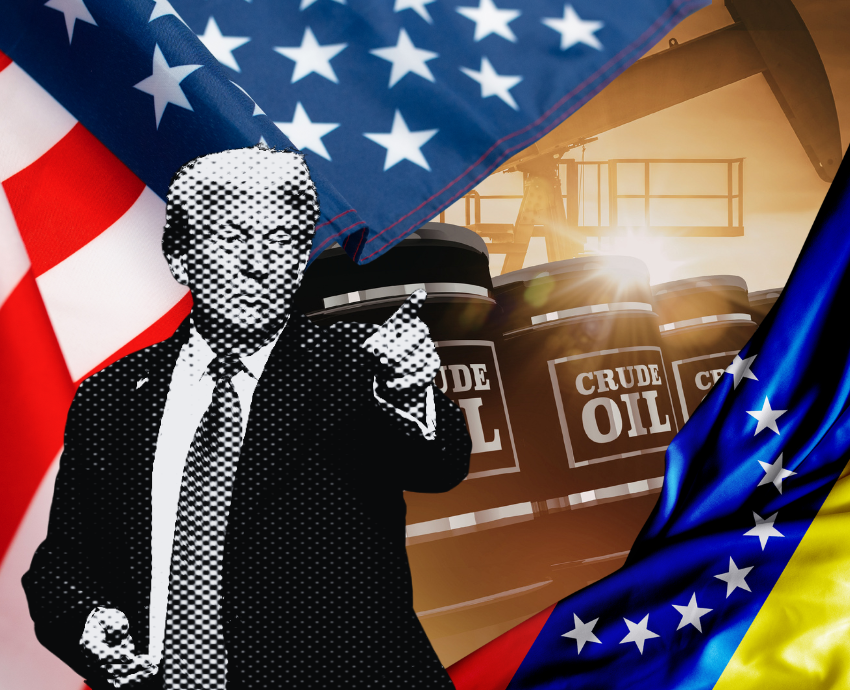
The United States government’s January 3 military assault on Venezuela and kidnapping of then-President Nicolás Maduro and National Assembly deputy Cilia Flores sent shockwaves throughout the world.
Green Left’s Federico Fuentes spoke to Malfred Gerig, a sociologist from the Central University of Venezuela and author of Venezuela’s Long Depression: Political economy of the rise and fall of the oil century, to discuss how this was able to occur, US aims in Venezuela and the region and the role of the right-wing opposition. Read part 2 here.
* * *
How do you interpret the US military actions on January 3? Is this simply about gaining control of Venezuela’s oil?
Obviously, the military intervention relates to oil, because everything concerning Venezuela relates to oil. But it is a bit more complex, because two things converged: the Venezuelan crisis and Trump’s foreign policy.
Venezuela’s long depression, the political crisis, and the externalisation of national politics by the political class — both the Madurista (Maduro-aligned) ruling elite and the opposition elite — ultimately led to an externalisation of their conflict.
The weakening, over so many years, of the sources of national power — economic, political, institutional, military and cultural — resulted in the most humiliating political and military episode ever in the country’s history as a republic.
This weakening of the Venezuelan nation made it appealing for Trump to intervene.
First, because he was acting against a government with no social support base and lacking any legitimacy.
Second, because the country’s political institutions were utterly illegitimate in legal terms and severely weakened in their capacity to wield real power — as shown by the reaction to the military operation.
Third, because the Maduro government, being weak and having undermined national power, was an easy target for the US to begin leveraging its entire foreign policy toward Latin America.
The weakening of the nation was exploited by the “foreign sentinel”, which now seeks to leverage economic and political advantage. Venezuela will pay dearly for this weakening and the errors of its political class.
We will pay with oil, but also with dependency and a loss of popular and national sovereignty over our immediate future.
You said Venezuela was seen as an easy target for the US to begin leveraging its entire policy toward Latin America. What role is Venezuela playing in Trump’s foreign policy?
When Trump [decided to remove Maduro from power], he began to leverage Venezuela as the basis for his now maximalist policy toward Latin America. The target was no longer just Venezuela.
He enacted some completely irrational policies, for example, including Gustavo Petro, Colombia’s popular and legitimately elected president, on the Clinton List [of individuals sanctioned for alleged involvement in drug trafficking and money laundering].
Constant threats of “terrestrial” military interventions in Mexico also began, along with open electoral interference to support candidates aligned with what we might call the MAGA International, particularly in Honduras and Argentina.
That maximalist policy is reflected in the White House’s National Security Strategy and reactivation of the Monroe Doctrine, with its “Trump corollary” that represents a pivotal moment in terms of US grand strategy.
Behind this Monroe Doctrine reactivation lies an entire school of geostrategists who view territorialism in Latin America as essential in a moment of global or hegemonic conflict.
According to this territorialism, North and South America possess the resources that the US needs to survive a major global confrontation without becoming isolated or falling into a general depression due to supply chain disruptions.
That is why we have gone from the Barack Obama administration’s “Pivot to Asia” to Trump’s “Pivot to Latin America”. Latin America is going to pay the price for the empire’s decline and its withdrawal from Europe and, above all, Asia.
Venezuela offered the Trump administration a weakened opponent, with little military capacity and internationally discredited, on which to leverage a policy of reorganising Latin America according to the MAGA worldview.
Venezuela’s weakening under Maduro offered the US a wide range of low-cost victories.
Ideologically, it offers the defeat of socialism, notwithstanding Maduro’s regime being socialist in name only.
Militarily, it offers a demonstration of firepower and persuasion.
Geopolitically, it is a power move at the table of great powers, something Washington was eager for.
Economically, it offers a substantial oil windfall for the US state and the corporations that financed Trump’s campaigns.
There was a lot of talk about regime change. But in the end, power remains in the hands of those who were in power with Maduro. How can we understand this situation?
In The Long Venezuelan Depression, I said that the sanctions imposed by the Trump 1.0 administration failed to achieve regime change from above, but absolutely succeeded in achieving regime change from below.
That is, they achieved regime change in the country’s political economy, steering it towards what I called neoliberalism with patrimonial characteristics and a very sui generis Venezuelan model of crony capitalism.
This regime change from below has now converged with what we could call “outward regime change” or geopolitical realignment.
A prime example of realignment is Anwar Sadat’s Egypt. The US achieved a complete realignment of post-Nasser Egypt, turning it against the Soviet Union. That is what the US is doing now in Venezuela.
Where does this leave the right-wing opposition, which remains out of power?
Regarding the opposition political class, there is much to say.
First, it is important to highlight the idiosyncratic worldview of a sector of Venezuelan society that is ignorant of Venezuela and utterly subservient [to Washington]. This meant that the only strategy available was to externalise the conflict, to put all their eggs in the basket of a foreign sentinel.
If we look at [right-wing opposition leader] María Corina Machado’s speeches, especially after the July 28, 2024, presidential elections, we can see that she was not speaking to Venezuelans in Venezuela. Her only political weapon was emotionally exploiting the Venezuelan diaspora.
This reflected a complete weakening of her domestic political strength, an inability to manage and capitalise on the anti-government and referendum-like climate that led to July 28, 2024, even with government repression. This weakening of the opposition elite’s capacity for domestic resistance was exploited by the US.
Machado’s entire anti-Venezuelan narrative, whether active or passive, was utterly irresponsible and, dare I say, criminal.
Machado and the opposition political class provided the Trump administration with elements, without any evidence whatsoever, to bolster its anti-Venezuelan policy, effectively decreeing that Venezuelans were hostis humani generis (enemies of humanity), to leverage not only its foreign policy but also domestic immigration policy, on the basis of criminalising a nationality.
They committed this crime against the Venezuelan nation. This crime was consummated when they endorsed military intervention and stained their hands with the blood of those Venezuelans killed by a foreign military force on January 3.
We now have an opposition political class, mostly — or at least the most well-known and widely supported, both domestically and internationally — competing to see who can best install the US protectorate. That is the magnitude of our tragedy.
Were you surprised by how quickly relations between the Delcy Rodríguez and Trump governments became so friendly, just days after Maduro’s kidnapping?
No, because it was well known that the Maduro regime had been orchestrating a realignment, in which they were willing to give up everything just to remain in “political power”, as they like to say.
Nor was it surprising that the much-touted “thousand-year war”, “second Vietnam” or “permanent resistance” lasted only two hours and was an extremely humiliating operation for the Venezuelan armed forces.
What is surprising is seeing Delcy Rodríguez in the National Assembly calling Trump’s colonial-administered funds “sovereign funds”.
The situation now is as pathetic as it is concerning. Trump dictates orders, and they obey. He is dictating matters of such gravity, that it is very difficult to say that Venezuela is a sovereign country right now.
[German jurist and political theorist] Carl Schmitt said “sovereign is who decides”, and those making decisions in Venezuela right now are in Washington.
What we are witnessing, in real time, with some rhetoric and attempts to cling to the traditions of the Bolivarian Revolution, is the establishment of a colonial protectorate in Venezuela.
A protectorate where true power lies with the US, and the Venezuelan political class and the Venezuelan people are mere objects of policies dictated from Washington, without influence on our own destiny — at least for now.
It will be up to the Venezuelan people to decide how long this continues. If anyone can act against this national humiliation, it is the Venezuelan people, not the political class that caused the humiliation.