
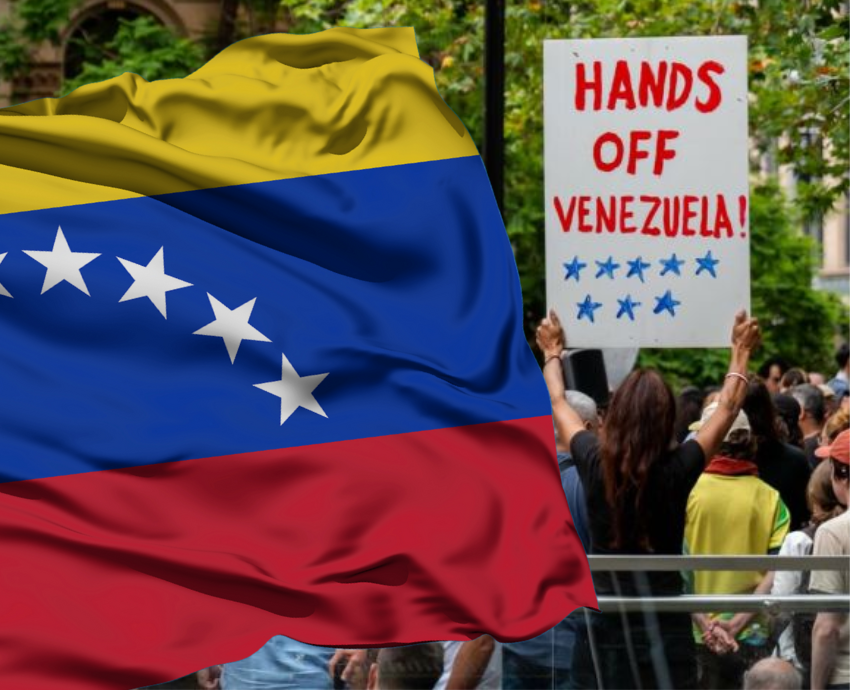
The United States carried out a direct military operation against Venezuela, on January 3. US forces bombed targets in and around the capital Caracas, struck the country’s electrical grid, killed more than 100 people and abducted Venezuela’s sitting president, Nicolás Maduro, along with his wife, National Assembly deputy Cilia Flores.
The Green Left Show’s Isaac Nellist spoke to Federico Fuentes, a socialist journalist and editor of LINKS International Journal of Socialist Renewal, about the attack on Venezuela. Below is an abridged and edited version of the interview.
• • •
Can you briefly summarise the US military attacks on Venezuela?
The Trump administration began with a very sizable military deployment in the Caribbean in August, which, over time, escalated in size and aggression. From bombing supposed drug boats leaving Venezuela, it transformed into a naval blockade on the country.
The progressive build-up indicated that, at some point, the US would carry out some kind of attack, though it was unclear what that would look like, until January 3.
What this campaign has largely achieved is to break the back of the Venezuelan government. Trump has made clear that the new government’s ability to stay in power is now dependent on US military power.
Trump wants to use this new situation to force the government to carry out policies he has always envisaged for Venezuela.
This attack must be strongly condemned, no matter what criticisms anyone has of the Maduro government. The US’ actions represent a dangerous threat to peace, sovereignty, democracy and human rights, not just in Venezuela but the world.
What is the role of Venezuela’s oil supply in this? Is this a resource grab?
Oil plays an important role but it is too simplistic to narrow it down to just that issue.
The most important aspect is that Trump’s January 3 military assault represents the public launch of his government’s new National Security Strategy, which specifically talks about a “Trump Corollary” to the Monroe Doctrine.
If the Monroe Doctrine was the idea that the US would “protect” the Americas from outside foreign influences, the Trump Corollary takes this a step further, saying the US is going to exert full-spectrum dominance across the region.
Trump plans to make this dominance a reality through military means (as we have seen), economic means (tariffs, naval blockades, etc) and political means (open intervention in elections, support for far-right parties, etc).
Trump now plans to not just impose his oil agenda in Venezuela through the existing government but to use Venezuela as the pivot from which to expand this policy across the region.
The Bolivarian Revolution was an inspiring example of people-power politics. What does the current situation reflect about the successes and challenges of that revolutionary process?
The Bolivarian Revolution is generally associated with Hugo Chavez and his revolutionary government, though many argue it predates him with the social mobilisations that exploded at the end of the 1980s and continued through the political crisis of the ’90s.
Chavez was elected on the back of that crisis and social ferment in 1998, unleashing an even bigger process of social mobilisation.
First, because it was necessary to defend his government from attacks by the traditional capitalist class led by the big business chamber Fedecamaras, and the right-wing opposition, both backed by the US.
The first serious attack against Chavez was the 2002 coup attempt. It came just months after Chavez decreed a new oil law that gave the state greater control over the industry at the expense of transnationals.
The defeat of that coup within 48 hours through mass demonstrations not only led to Chavez’s return to power but gave him the opportunity to purge right-wing elements from the military.
The next obstacle Chavez faced came from the state oil company, PDVSA, which was not nationalised by Chavez, as it has been in national hands since 1976, but its board of directors operated as clients of transnationals.
In December 2002, PDVSA’s management sought to bring down Chavez by shutting down the oil industry. Once again, powerful mobilisations, in particular by oil workers, defeated that attack.
With control over the military and PDVSA, and an invigorated social base forged through those struggles, the government now had a favourable balance of forces to deepen the process.
So, we saw a flourishing of progressive policies such as free education and healthcare programs. Importantly, the people were active participants in these programs.
Then we saw attempts at self-governance on the community level with the formation of communal councils and communes.
These flourished under Chavez, though of course, had their problems. The communes never got to the point of replacing the old existing state, but they existed and there was contestation.
Did this continue under Maduro?
For a period. But then due to a number of factors — including increased US intervention; the impact of the loss of Chavez [who died in 2013]; internal debate within the government; and a tremendous economic crisis caused by plummeting oil prices, economic mismanagement and sanctions — we ultimately saw a change in the government’s overall policy direction.
At a certain point, the Maduro government made a definitive choice that to maintain power, it needed to instead seek alliances with, and ultimately govern for, the capitalist class. This led to policies that pulverised workers' wages and removed democratic and trade union rights, while Fedecamaras eventually turned to support his government.
This is fundamental to explaining why Trump carried out the action he did. He understood that the Maduro government had changed its orientation. He also realised it had lost majority support and was a very weak government. Such a government would be easier to control from the outside.
What we have seen since January 3 confirms this, with the US telling the government what to do, and the new Venezuelan government seeking to take credit for the changes, including even the reform of Chavez’s oil law, which has dramatically opened up the oil industry to transnationals.
What is the shape of the resistance within Venezuela? What role is the new government playing?
In terms of the government, this is a government under extreme duress — it just had the US military walk into its capital and kidnap the president, and Trump has said several times he could carry out a second military attack. Plus the naval blockade is still in place. All of this acts like a siege on the government.
So, independently of what the government may want to do, it operates within that very confined situation.
That said, there is a certain continuity in terms of the government’s previous attempts to seek a rapprochement with the US. Yes, under extreme duress, but also because it fits within the logic of the Maduro government’s policies I mentioned.
In terms of resistance, in the day or two after January 3, we saw some small-scale protests. Since then we have seen larger demonstrations, but we are talking protests in the 10,000s, which by Venezuelan standards are small.
More generally, the sentiment is one of mourning and confusion. At the same time, the fact this was not a popular government has led to a mixed reaction, where people oppose what happened yet sense or hope something good could come out of this.
All of this has impacted on the level of resistance. Things may change as events develop — and they are developing very fast, as we see with the oil law reform.
Yet there remains an expectation that things may improve and, if they do, that will ameliorate the willingness to openly contest such colonial policies that seemed unthinkable not long ago.
Nevertheless, we cannot forget that the Venezuelan people have lived through decades of high levels of class struggle and that memory has not disappeared either — it is always there under the surface.
How can we build solidarity with Venezuela?
We have to continue to condemn the January 3 military assault and demand the liberation of Maduro and Flores. We should also campaign to end the siege on Venezuela by lifting the sanctions and naval blockade.
Closer to home, we should demand that the Australian government condemn Trump’s actions and use this as another argument for why Australia must break its military alliance with the US. That means tearing up the AUKUS agreement.
Finally, we cannot be indifferent to or ignore the reasons why many Venezuelans have not come out to defend the Maduro government, such as the loss of basic democratic rights.
We should reach out to and link up with left-wing and working class sectors in Venezuela and help them campaign for these essential rights, none of which are any closer to being restored after January 3.
Such rights are fundamental to ensuring Venezuela does not become a 21st century US protectorate, which is the trajectory it is currently heading towards.