
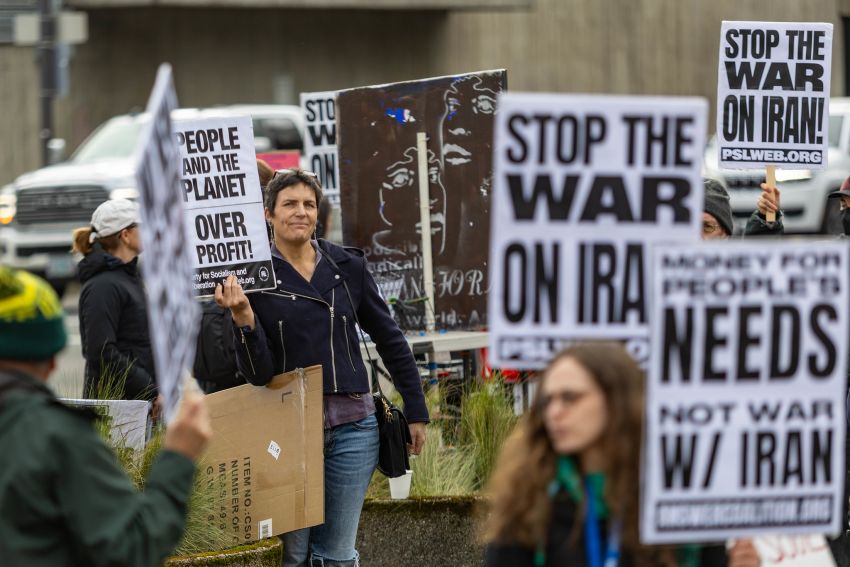
As talks were taking place between Washington and Tehran, concerning Iran’s nuclear program and ballistic missile capabilities, Israel, in concert with the United States, launched a series of attacks on Iran, on February 28.
In addition to bombing a school, killing more than 100 children, Israeli bombs — supported by US intelligence — killed Iran’s clerical leader, Ayatollah Ali Khamenei, members of his family and leading figures in the regime.
The United Nations immediately declared the attacks as in breach of international law. Meanwhile, the US’ and Israel’s allies, including Britain, France, Germany, Canada and Australia, came out in support of the bombings and assassination.
Iran responded by targeting US bases across the Gulf States, threatening to widen the conflict. Iran announced on March 3 that it would effectively block the Strait of Hormuz, plunging global transport and supply chains into chaos. The Iranian regime’s allies in Hezbollah in Lebanon launched rockets into Israel. Israel replied with attacks on southern Lebanon and the capital Beirut.
Meanwhile, President Donald Trump encouraged the Iranian people to rise up against the regime, saying “America is on your side”.
US-Israeli agenda
The “negotiations” between the US and Iran, prior to the attacks, revolved around US and Israeli demands that Iran end its peaceful nuclear program, eliminate its ballistic missiles (its key defence against Israeli attacks) and cease its support for Hamas in Gaza, Hezbollah and the Houthi government in Yemen.
Under US President Barack Obama’s administration, an effective nuclear agreement was struck with Iran. Trump scuttled that agreement in his first term.
The Iranian people have suffered decades of brutal oppression under a theocratic regime that came to power following the 1979 revolution, which overthrew the shah. Hundreds of thousands of protesters, including students, leftists, trade unionists, women and oppressed minorities, have since been arrested, imprisoned, tortured, disappeared and executed by the regime.
However, Operation Epic Fury — the US military’s name for it — is not about bringing democracy and freedom to the Iranian people, but continues US-Israeli military collaboration in pursuit of their colonial projects in the region and US imperialist interests in the Middle East and elsewhere, as set out in its National Security Strategy.
This is illustrated by the fact that while the talks were taking place in Geneva and elsewhere, the US was assembling its largest naval buildup in the Middle East since its 2013 war on Iraq. Two aircraft carriers, 15 destroyers and other vessels were deployed from the Gulf of Oman to the Mediterranean Sea, positioned to attack Iran.
Besides bombing Iran into a democracy, another of Trump’s justifications for his illegal war is that Iran had begun rebuilding its nuclear weapons program (despite him also claiming it had been destroyed in Israel’s 12-day war).
This is also a smokescreen, because just prior to the February 28 strikes, the Omani foreign minister (and talks mediator) told CBS’s Face The Nation that Iran had agreed to convert its existing enriched nuclear material into fuel (an irreversible process) and to “never ever” stockpile any materials that could be used to build a nuclear weapon. It had also agreed to verification of this process by the nuclear watchdog, the International Atomic Energy Agency.
While Trump did not take the decision for war to Congress for debate, bringing Iran to heel is a bipartisan goal of the Republican and Democratic parties and has its history in US interventions in the region since the end of World War II.
Background
Iran’s democratically elected leader, Prime Minister Mohammad Mosaddegh, nationalised the country’s British-owned oil industry in 1951.
Britain appealed to the US, via the Central Intelligence Agency (CIA), to overthrow Mosaddegh. This was finally achieved in 1953 by a joint US-British coup, dubbed Operation Ajax, and control of the country was handed back to the shah (king), Reza Pahlavi. Mosaddegh enjoyed popular support and had been a brake on the shah’s power during his presidency.
The shah’s regime came under the influence of the US. Broad sectors of the population opposed the regime from the start, and it maintained control through extreme brutality, using murder and torture, under the SAVAK secret police, jointly established by Israel’s Mossad and the CIA.
The US embassy, which occupied a city block in Tehran, oversaw the shah’s regime. Tens of thousands of US military personnel were stationed in the country.
The shah’s regime was staunchly anti-communist, and was a staging area for the US to spy on the nearby Soviet Union.
The shah also maintained close relations with Israel, in an alliance against the Arab countries and the Palestinians.
1979 revolution
Iran is a majority Shia Muslim country. The Shia clerical leader in 1953 was Ayatollah Ruhollah Khomeini, who opposed the US-British coup against Mosaddegh. He ended up in exile in Paris, where he kept in contact with the mosques through smuggled tapes of his speeches, and continued to oppose the shah’s regime.
Mass opposition to the shah broke out in 1977, and mass demonstrations developed in 1978. The courageous Iranian masses faced violent repression by the regime, but grew in numbers, nonetheless. Secular opposition organisations emerged, including socialist and communist groups, alongside the mosques.
In September 1978, 3–4 million Iranians took to the streets against the shah’s rule.
In October, workers’ strikes combined into one of the greatest general strikes in history.
In November, there were even bigger demonstrations.
These actions became so powerful that in early 1979 the shah fled the country and appointed a caretaker government. Khomeini returned, and the clerics played a leading role in the movement.
Students joined. There were mass demonstrations by women wearing the chador (the Shia cloak that covers the body from head to toe).
The government continued its bloody repression, using the army against the people.
However, in February 1979, mechanics at air force bases began to demonstrate against the crackdown. At one base in Tehran, the mechanics fought back against the Royal Guard sent to suppress them. They liberated guns from an armoury, and were joined by civilians. The movement spread and the army no longer controlled the streets. Attacks on the army, police, Royal Guard and SAVAK also spread.
In the face of this show of force by millions of ordinary people, the army cracked and soldiers joined the masses. The government was overthrown. The people armed themselves and the insurrection spread.
Popular uprising
A provisional government was formed, which included Khomeini. Workers formed councils to run their workplaces. Following demands by workers, sectors of industry were nationalised, including car manufacturing plants.
Kurds, Arabs and others oppressed by the Persian majority joined the struggle.
This history is never mentioned in the US media. It refutes the convenient narrative that Khomeini carried out a coup in 1979 that established a theocracy. In fact, it was a great mass uprising that overthrew the shah’s regime.
The clergy and Khomeini played a leading role and had prestige. Over time, they dismantled the gains that had been won, including the workers’ councils and the rights won by oppressed peoples against Persian domination. The regime also repressed women’s rights, instigating laws to make the headscarf mandatory and control their participation in society, maintaining these laws with a dedicated “morality police”.
Iran-Iraq war
The US strongly opposed the 1979 revolution and sought to topple the regime. Key to these efforts was the US-backed and orchestrated September 1980 Iraqi invasion of Iran, led by Saddam Hussein. At the time, he was an ally of Washington, and was promised the spoils of war if, as Washington expected, Iran was defeated in the war.
The US calculated that there would be sanctions on Iran, especially from the Arab states, in support of Iraq and an uprising against the Iranian regime.
But contrary to Washington’s expectations, there was not an uprising. Instead, the Iranian people rose up to fight Hussein’s troops and rallied around the Khomeini-led government.
During the eight-year conflict, millions were killed on both sides, and Iraq was defeated. However, the conflict sapped the morale of the Iranian people.
Khomeini had solidified his theocracy by 1983 and rolled back all the gains of the revolution except Iran’s independence from the US and its allies, including Israel.
Trump wants to overturn this, and establish a state under US hegemony. Whether he can achieve that through war remains to be seen, but the Iranian people will ultimately pay the price unless a global movement can be built to demand an end to the US-Israeli war and support the Iranian people’s right to determine their own future.