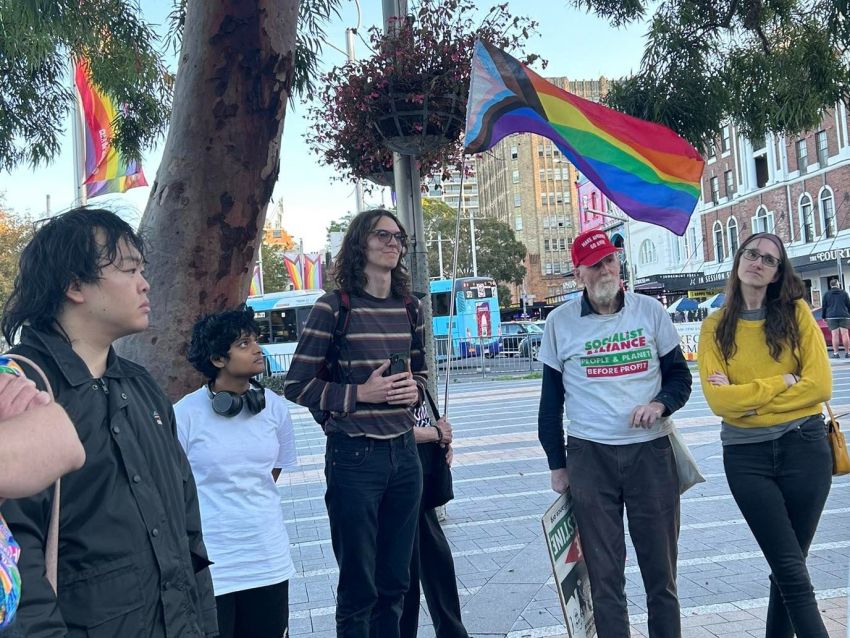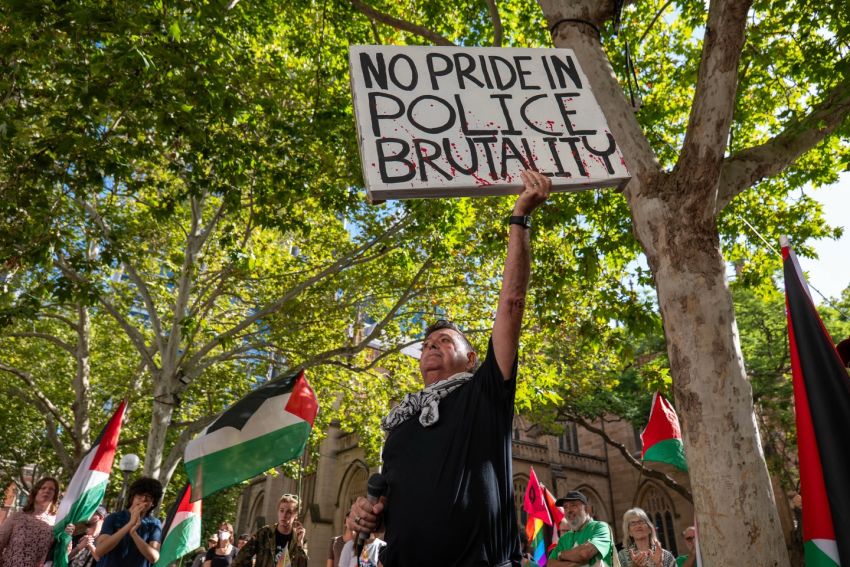
I recently had the honour to lead an inaugural radical 78er History walk, organised by Green Left and Pride in Protest.
I linked past struggles to the present, condemning ongoing police violence against peaceful protesters on Gadigal Country/Sydney this past summer and called for solidarity across movements, subcultures and generations. I didn’t have to say that the task of queer liberation remains unfinished; young people know that.
The questions asked by these activists and the discussion that followed the tour has led me to reflect on the way that history repeats and how new generations are radicalised when they experience the trauma of state-sponsored violence against them.
I recently read and helped launch The Trap, a new novel by Fiona Kelly McGregor. It is based on facts “alchemised by her imagination”, as McGregor says, and retells stories of police entrapment of gay men in Darlinghurst and Woolloomooloo during World War II.
It vividly portrays the frequent raids that took place on queer venues and exposes the harsh reality of earlier queer generations facing relentlessly cruel police intimidation.
You can see that the resistance to oppression that erupted in Sydney in the 1970s definitely had its antecedents in the city in the 1940s, when queer people similarly found ingenious ways to resist.
The walking tour began at the Al Alamein fountain in Kings Cross where, on the evening of June 24, 1978, at the first Sydney Gay and Lesbian Mardi Gras, police violently attacked us.
Even though mass arrests were made, gays, lesbians, trans, indigenous people and other allies refused to be cowed; they fought back. The parallels with Stonewall in New York in 1969 are unmistakable because, for perhaps the first time here, queer people, on a large scale, refused to run away and hide who we were. Instead, we stood up, stood our ground, and, as solidarity took hold, resisted NSW Police brutality.
We were sick and tired of living our lives in fear. All sexual minorities felt the oppressive weight of being criminalised, pathologised, demonised and generally ostracised by society in the 1970s.
I dedicated the history walk to Sandi Banks, who died in 2020 after a fight with breast cancer.
Sandi was one of those arrested that night in June 1978. She was thrown against a paddy wagon and bashed. Like Robyn Plaister, another 78er, she had her arms pulled out of their sockets by two policemen one either side of her. In Sandi’s case, police ripped apart her leather jacket, injuring her breasts.
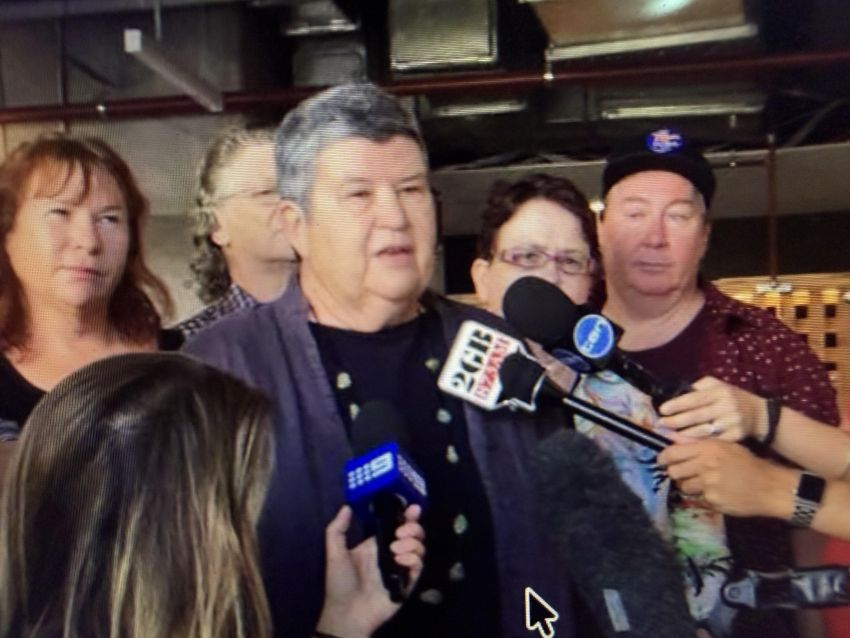
On February 9, I witnessed a number of young male police officers deliberately targeting younger and older women at the anti-Israel Isaac Herzog rally on Gadigal Country and I begin to see now how history on our streets repeats.
I have a clear memory of police in 1978 targeting women and men who might have been perceived as effeminate. Sexism and misogyny in the police force was rampant.
The tour traced sites of protest, nightlife, music, art, loss and survival across Kings Cross and Darlinghurst, and ended at Taylor Square in Darlinghurst.
At Green Park, we circled the Pink Triangle Holocaust memorial and held hands as we honoured those gay men and lesbians killed by Nazis in the Holocaust.
I explained that the 78ers had adopted the pink triangle as a symbol for our struggle because it should forever remind us how vulnerable our minorities are. We need to be vigilant and mean it when we say “Never again”. The pink triangle was sown onto the prison uniforms of men and women by the Nazis to identify them as homosexual in the prisons and concentration camps.
At Taylor Square, we talked about the authoritarian turn in NSW politics this past summer. The brutal large-scale police attacks on Palestine justice protesters on February 9 took me straight back to the violence of the first Gay and Lesbian Mardi Gras in 1978.
Any independent and transparent inquiry into police misconduct should include not only the events of the night of February 9 but also the events at the pre-Mardi Gras parade area of Hyde Park on February 28, where NSW Police beat and arrested seven young LGBTIQ people and allies preparing the Drag Kings float, on which they flew the Palestinian flag in opposition to the genocide.
Nineteen-seventy-eight taught us that the only way to resist state-sponsored violence was through broad collective action.
Mobilising campaigns to “Drop the charges” was as important then as it is now. As in 1978, there is a need to build wider public support for fundamental human rights, such as freedom of speech and assembly.
It is very much in our interests for queers to be part of larger campaigns calling for an Australian Bill of Rights.
I can see now that any nation that suppresses young people imbued with hope and a desire to make the world a fairer, safer, more just and equal place for all, and denies them the right to peaceful protest, cannot really claim to be a democracy.
Young people will always resent a government that says to them “Be young and shut up”.
[Mark Gillespie is a human rights advocate and a 78er.]