
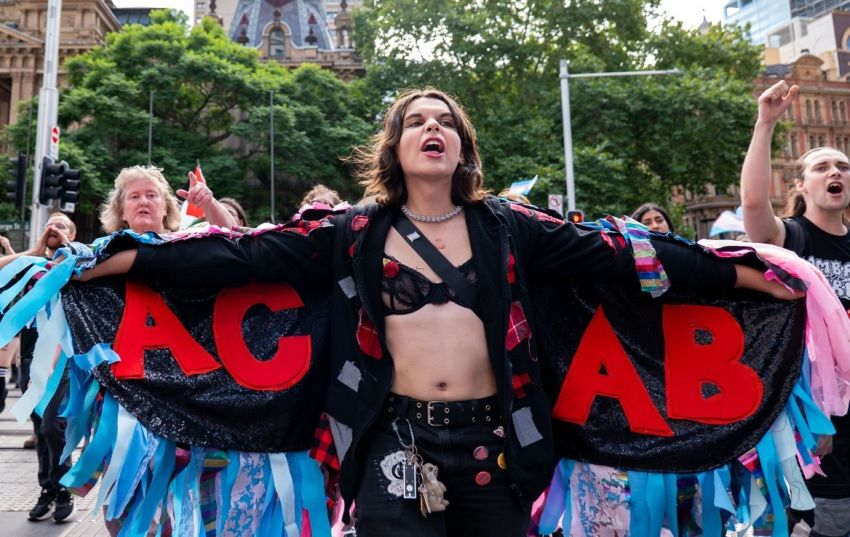
Michael West Media (MWM) interviewed five people and watched videos (not all of which are public) that show NSW Police attacking people and forcing them out of the [Mardi Gras] parade, on February 28, without justification.
All had tickets to join the parade and had waited in the holding areas for some time, admiring other floats and chatting before moving towards the march entrance with the Drag Kings float.
They received no warning before being attacked.
One was carrying a Palestinian flag, which a police officer grabbed. She was then assaulted, with four police officers ending up on top of her while she was calling for help.
There is no Mardi Gras rule against carrying country flags; there were Scottish flags and a whole float from Taiwan, quite apart from hundreds of brand flags.
MWM has also seen a video of the same person being assaulted by Federal Police in last December.
MWM also interviewed marcher Maeve Nelli, who was assaulted, and then made an Instagram post. Nelli had been invited to march with the Drag Kings. He was excited as this was his first parade. He described how police had their hands on his throat and threw him to the ground. His personal belongings and medication were on a trolley that continued in the parade after he was dragged outside. Nelli suffered physical bruising and a severe panic attack
Another Drag King was pulled by her hair and flung against a fence, which collapsed. She was picked up and thrown down again. Others were forced out of the parade by lines of police.
NSW Police said four people were arrested during Mardi Gras, but MWM can find no evidence of that. None of the people violently ejected were charged. This puts the onus back on them to take action against the police and requires briefing lawyers.
While NSW police were assaulting marchers, they had an official float in the parade.
This latest episode of police brutality highlights the escalation in authoritarian policing of protests, evident at last year’s Weapons Expo when pepper spray was used on peaceful protesters and at the anti-Herzog protest on February 9.
MWM sent questions on March 9 to Jesse Matheson, CEO of the Sydney Gay and Lesbian Mardi Gras (SGLMG), organisers of the parade, about what instructions had been given to police about Mardi Gras and what action SGLMG intends to take in response to the assaults. We received no response by our deadline.
Several hours after we sent our questions, Kathy Pavlich and Mits Delisle, Mardi Gras Board co-chairs, issued an update to all members. Pavlich works in the NSW Ministry for Health as a security risk expert and Delisle is the Rainbow Labor convenor.
“Throughout the evening, there were instances where individuals associated with the protest entered or attempted to enter the Parade route without authorisation,” they said. “The Parade route is a carefully managed environment, designed to ensure the safety of thousands of marchers and volunteers, and hundreds of thousands of spectators.
“Unauthorised entry to the route presents serious risks to float operators, performers and those walking near moving vehicles.
“Our focus throughout the evening was to de-escalate where possible and maintain a safe environment for everyone involved. Where necessary, event security and police intervened to remove individuals from the Parade route.”
This suggests that Mardi Gras management was involved in policing decisions, although a spokesperson said it wasn’t.
It skirts around the question of how any of the people violently ejected were unauthorised, as they all had tickets, or were posing a risk to other participants.
What is clear, however, is that rather than “de-escalate”, police placed a number of participants at risk.
78ers apology anniversary
This year is the 10th anniversary of NSW Parliament’s apology to those who marched in the first Mardi Gras, many of whom were violently bashed and arrested. At that time, the 78ers were assured that this sort of violence would never happen again. On repeated occasions since then, violent policing and over-policing have continued.
Mark Gillespie, a 78er, told MWM that the violence at this year’s parade represents a “concerning turn towards authoritarianism”.
“The levels of police brutality on Sydney streets, and sheer scale of premeditated state-sponsored violence, at times suggesting military-style planning, have not been seen since 78ers were savagely attacked at the first Gay and Lesbian Mardi Gras in June 1978.” He said he had seen “disturbing video footage of young male NSW Police constables” targeting young queers, adding that “trust between LGBTQI+ communities and the NSW Police is ruptured”.
Pride in Protest
Some, but not all, of those assaulted were members of Pride in Protest (PiP), which describes itself as a grassroots collective to “restore the protest roots of Mardi Gras and challenge systems of injustice”.
It was recently part of a pro-Palestinian alliance that challenged the constitutionality of the Chris Minns government’s most recent anti-protest laws. It opposes NSW Police having an official Mardi Gras float and came close to winning support for this in a narrowly lost motion at last year’s SGLMG Annual General Meeting.
PiP has a substantial following, with two elected positions on the Mardi Gras Board. One is Luna Choo, who attracted the most votes of any candidate in the history of the board.
Along with many international queer solidarity groups, PiP used the slogan “No pride in genocide” to campaign in favour of Palestine, including within Mardi Gras. When the board passed a motion in support of a ceasefire in the war on Gaza in 2023, the Jewish group Dayenu complained it was not consulted.
Dayenu announced this year it was not going to join the parade, saying, understandably, the Bondi attacks left them feeling unsafe. Less understandable was its citing of the “violent riot” at the anti-Herzog protest at Town Hall. It denied there was any police violence, despite a large amount of evidence that has prompted the NSW Law Enforcement and Conduct Commission to set up an independent inquiry.
Dayenu’s statement upset pro-Palestinian queer protesters and their supporters. PiP accused it of supporting “genocide”. Dayenu denies it is Zionist, but the group has previously received support for its Mardi Gras activities from the Executive Council of Australian Jewry.
MWM asked Dayenu how it can be accurately described and if it were pro-Israel but did not receive an answer.
After negotiations with Mardi Gras, Dayenu rejoined this year’s parade.
The day before the parade, CEO Matheson demanded PiP take down what it said was an offensive social media post on the grounds that it breached conditions of not criticising other participants. PiP tried to call Matheson, who declined to answer. PiP did not retract the post.
In an unprecedented move, Matheson withdrew authorisation for PiP’s float “Celebration without Compromise” a few hours before the parade was to begin. PiP organised a peaceful protest at Sydney Town Hall and marched without incident to Mardi Gras.
Most PiP supporters then left, while those with tickets and links to other groups joined their floats.
PiP denies Dayenu’s accusations of antisemitism, saying it is anti-Zionist and anti-genocide, not anti-Jewish. Pro-Palestinian Jewish protesters attend its rallies.
While PiP was excluded, the NSW Liberal Party, which has called for a review of Mardi Gras funding, marched with placards of leader Kellie Sloane.
The NSW police marched in uniform, guarded by other police, all in the name of Mardi Gras’s policy of inclusivity.
[Sign the petition to the Mardi Gras Board, NSW Police and Premier Chris Minns. Wendy Bacon is a 78er who was arrested for protesting in the first Mardi Gras and on other occasions in the 1970s. She is a member of SGLMG and has also attended Pride in Protest rallies. This piece was first published at Michael West Media.]