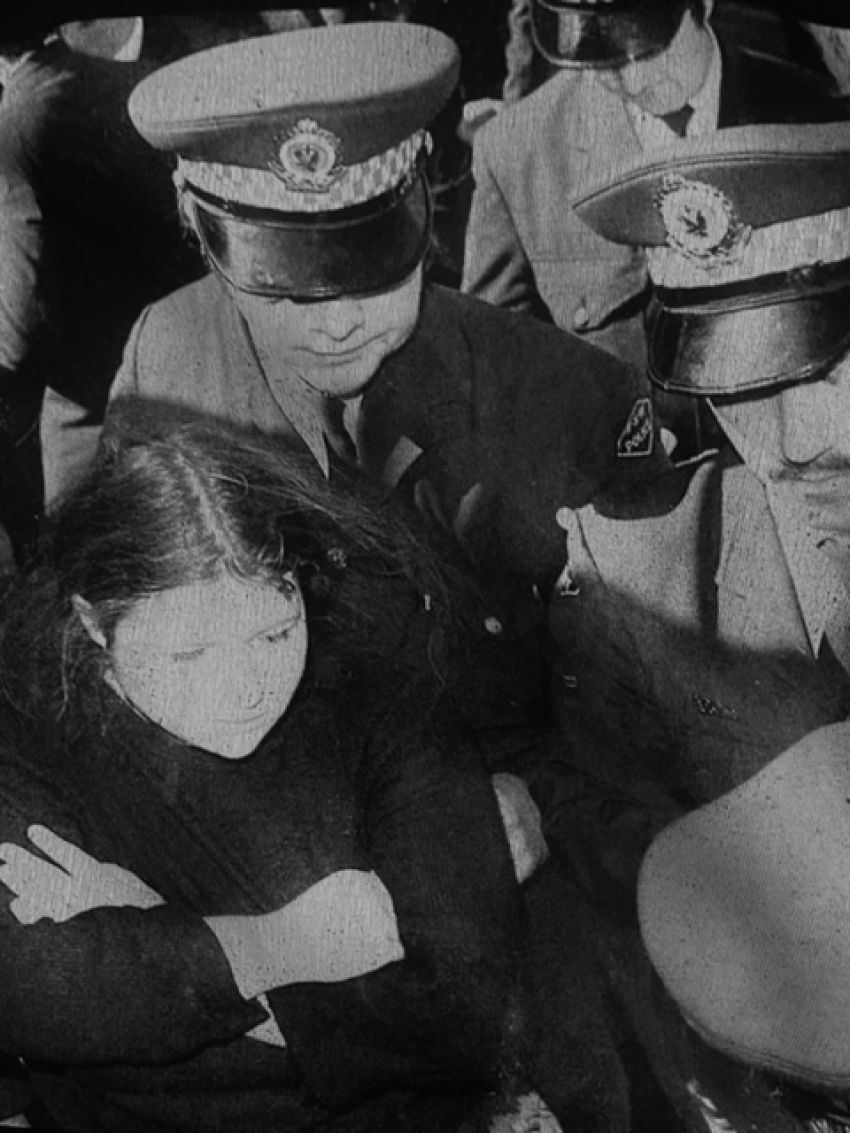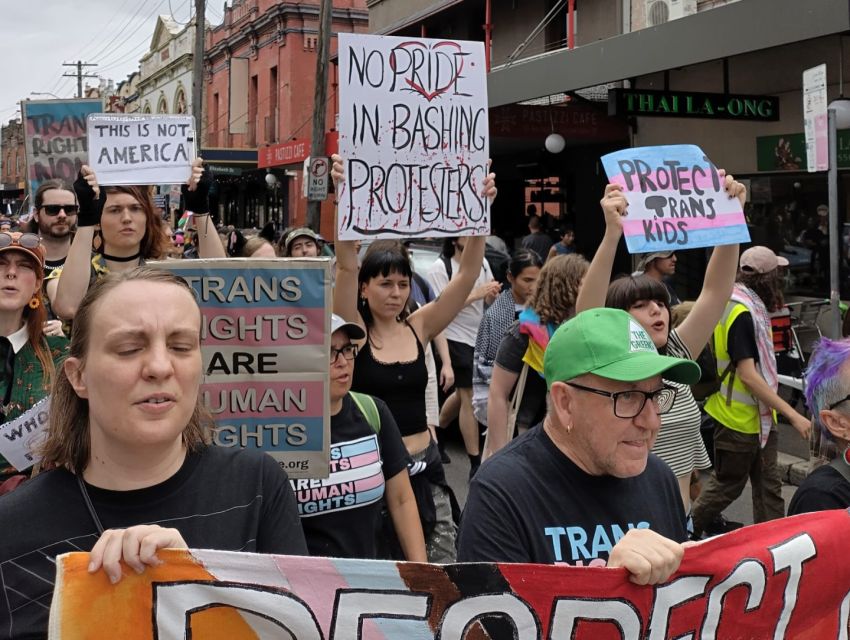
The police violence at the anti-Isaac Herzog protests on February 9 echo the unresolved tensions relating to police inclusion at the heart of Mardi Gras.
Police powers have expanded dramatically since 1978, yet many frontline tactics remain disturbingly familiar: encirclement, crowd crushes and aggressive arrests. The difference now is that police are militarised; they carry capsicum spray. They still have old-school techniques such as singling out protesters and then punching them. But what’s troubling is they are now more brazen. What once occurred in cells, in private, now unfolds in public view, filmed on phones.
The anti-Herzog protest at Sydney Town Hall marks a moment in history when these tactics have become visible and the mainstream comes to know what the marginalised have known all along. Indigenous people are dying in custody at an ever-increasing rate. According to the Human Rights Commission, “deaths in police custody account for 35% of Aboriginal deaths”.
Against this backdrop, Mardi Gras is divided. As police brutality shifts from exception to reality bite, we must ask: what does police inclusion in Mardi Gras now represent? Is marching alongside police a genuine recognition of Gender Diverse and LGBTQ Liaison Officer units and institutional apologies (including my own personal apologies after being ejected from the 2022 Mardi Gras for possessing a protest poster) or is it a sanitised performance of reconciliation that avoids confronting ongoing harm?
Will the recently announced Law Enforcement Conduct Commission investigation lead to an end to heavy-handed policing?
Should police continue to march as a gesture of progress? We also need to ask what it is about Mardi Gras that we need to protect.
It has become so pink-dollar focused that it risks losing touch with younger activists who argue that street protests — like the Mardi Gras Street Rally in Newtown on February 15 demanding "No right to discriminate" and defending trans youth health care — are closer in spirit to the original 1978 demonstrations and, arguably, achieve more.
This debate takes on added urgency as we approach the 10th anniversary of the NSW government Parliamentary Apology to the 78ers on February 25.
At last December’s Mardi Gras annual general meeting, as a 78er, I was a lone voice for a Pride in Protest (PiP) motion to permanently exclude police. It failed, narrowly, but the debate exposed a generational and ideological fault line — between queer trans activists, and more Labor-aligned factions such as “Protect Mardi Gras”, who claim that Mardi Gras may crumble if PiP win.
I felt uncomfortable with the concept of permanent police exclusion as I hold hope for training and learning from past mistakes, but last year was a bad year. Colin Burling, with lived experience of mental distress, was killed on a welfare check, and diminutive former Greens candidate Hannah Thomas was knocked down and nearly lost her sight.
Because of this extremity, I spoke in favour of banning police.
Many PiP members are students and queer sex workers, starting out in their lives and careers. I still remember, as a teenager in a paddy van in 1978, being so depressed because I felt my life was ending before I even had a chance.
I am only too well aware of the long-term effects of trauma and am strongly impacted by my own arrest/assault and by witnessing the attacks on other 78ers, many of whom received no therapy or medical assistance. Many still relive these traumatic events.
My concern is that police are traumatising youth at an ever-increasing rate. These concerns are not abstract.
Last year, a landmark Supreme Court of New South Wales judgment ruled that police strip searches at music festivals were conducted on mass with poor training and no oversight, with tens of thousands of intimate body cavity searches. In 1978, intimately touching women was standard practice in custody. As a teenage girl, this was shocking to experience first-hand. My instinct is now to protect vulnerable queer youth.
PiP is fighting for long upgraded versions of discrimination that major parties have sidelined. Sex work has been decriminalised in NSW since 1995, but is still not a protected characteristic under anti-discrimination laws despite the success of Equality Legislation Amendment (LGBTIQA+) Bill 2023.
In this broader context, the Summary Offences Act was amended in 1979 to allow legal protests without police, but later revisions curtailed these short-lived rights. Many at the margins — particularly First Nations people, sex workers and trans people — have never really felt safe from being targets of the police and the laws reflect that.
Sustained activism and pressure led to the repeal of the Summary Offences Act 1970 by the Summary Offences (Repeal) Act 1979 and the concurrent Prostitution Act 1979 marked the beginning of a long-term process of decriminalising sex work in New South Wales.
Steve Warren, myself and other 78ers kick-started the parliamentary apology that helped formulate the 2016 apology delivered by NSW Parliament.
I was there when the process began with discussions with Bruce Notley-Smith, then Member for Coogee in the NSW Parliament, who introduced the bill on that significant day on February 25, 2016. The apology was historic.
The question now is whether that apology marked a transformation or was just more speechifying about social justice.
Minns apologised to 78ers in 2016. His apology seemed heartfelt and poetic, even quoting Oscar Wilde.
“The continued stigmatisation of those who were arrested in 1978 stands as a troubling marker of how cruel this state can be … We are all in the gutter but some of us are looking at the stars,” Minns said.
“There is a tendency amongst the middle class in Sydney, when they are not talking about the property market, to describe social progress as a gift bestowed on others, usually due to a pang of guilt or a twinge of conscience,” he continued. “The truth is that basic rights for gays and lesbians in Sydney happened because they demanded it. Social progress in this town and in other countries happens because, as Malcolm X said: ‘Nobody can give you freedom. Nobody can give you equality or justice or anything; you take it’.
“The 78ers took their freedom and their rights,” Minns said. “We owe them a great debt for that.” Sadly, many of the community at Town Hall on February 9 were looking up, not at stars but at police.
Happy Mardi Gras.
[Barbara Karpinski is a 78er, writer, documentary filmmaker and teaches workshops in trauma-informed practice.]