
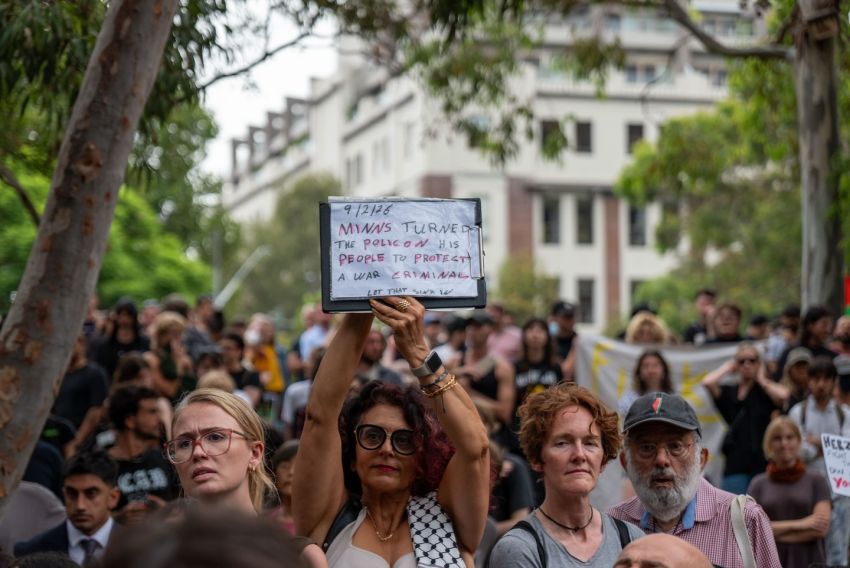
Reading about Queensland under former Queensland National Party Premier Joh Bjelke-Petersen is a chilling reminder of how fragile our right to protest really is.
During that era, street marches were effectively banned, police were empowered to shut down dissent and people were arrested simply for standing together and speaking out. It was authoritarianism dressed up as “law and order”, justified by claims that “order” required the silencing of public voices.
Fast forward to today and, under the Chris Minns government, appeals to “social cohesion” are once again being used, making New South Wales start to look disturbingly familiar.
NSW has adopted more protest restrictions and granted police sweeping new powers.
Peaceful demonstrators are increasingly met with aggression, instead of dialogue. March routes are denied. Assemblies are criminalised. Heavy-handed policing is justified by vague and elastic claims of “public safety” and “social cohesion”.
While the measures are framed as reasonable, even necessary, to keep the community together, history tells us otherwise.
Democratic rights are rarely dismantled overnight; they are eroded incrementally — law by law, regulation by regulation and baton by baton. Each restriction is presented as narrow or temporary. Each police power is described as exceptional. Yet, taken together, they produce a chilling effect, discouraging people from gathering, speaking out or challenging those in power.
The result is a quieter public sphere, not because problems have disappeared but because people are afraid of the consequences of being heard.
The parallels with Queensland in the 1970s and ’80s are deeply uncomfortable. Back then, governments argued that protests threaten order, economic stability and community harmony.
Today, we hear strikingly similar rhetoric about traffic disruption, public inconvenience or the need to maintain social cohesion. The language has softened, but the logic remains unchanged: Dissent is framed as a threat rather than a cornerstone of democracy.
Queensland eventually rejected Bjelke-Petersen because people refused to accept repression as normal.
Journalists, unionists, students, faith leaders and everyday Queenslanders pushed back, knowing that when governments fear protest, democracy is already under threat. Their resistance is a reminder that rights endure only when they are actively exercised and defended.
We should not have to fight the same battles again in 2026. The right to protest is not a privilege granted by politicians or managed by police discretion. It is a fundamental democratic right, essential to accountability, reform and social progress. From civil rights to environmental protection, history shows that meaningful change rarely comes from silence.
If this moment feels uncomfortably familiar, it is because the patterns are well known. History does not repeat itself by accident; it returns when its lessons are ignored.
NSW now stands at a crossroads. It can protect the democratic right to protest, or it can continue down a path where silence is mistaken for unity. The choice made now will define not just this government, but the health of our democracy for years to come.
[Suzette Meade is a Public Service Association union delegate and a community heritage activist.]