
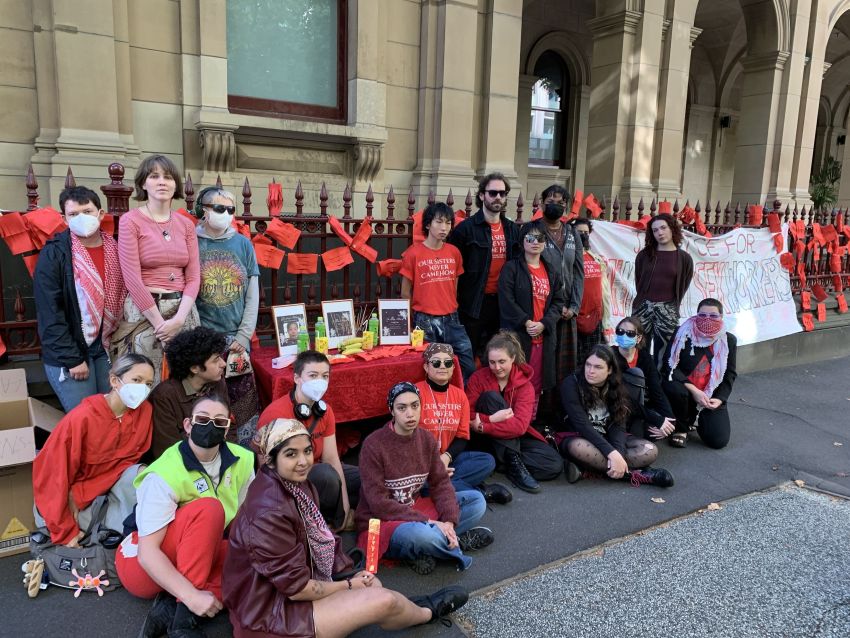
I attended the 40th anniversary of the Kirby Institute’s “A public health crisis: HIV and the need for evidence”.
The Kirby Institute is a trailblazer in research into HIV. It is a major advocate for the representation of marginalised communities, like sex workers, in research, discrimination protections and social justice.
Julie Bates, an icon of the sex worker community, was on a panel and spoke about the importance of making sex work a “protected characteristic” under anti-discrimination laws, to prevent vilification and so she can come out as a sex worker when she picks up her grandson at kindergarten.
Bates is the principal of Urban Realists, a town planning, health and safety consultancy providing advice and support to non-government organisations.
The failure to provide discrimination protection to sex workers makes them more vulnerable. When sex work is pushed to the margins, sex workers are placed in insecure situations on the outskirts of suburbia. Zoning laws that force brothels into isolated industrial areas were initially intended to create distance between sex work and domestic life, the idea being to protect “respectable” people from sex workers. However, this approach has created environments that heighten danger for those working alone and into the night.
The fact that anti-discrimination laws do not cover sex workers in many jurisdictions means they can be vilified with minimal consequences. The interconnected issues of stigma embed precarity for sex workers making them prime targets for the unhinged, those who are predatorial and criminals.
Currently in Victoria, laws make it illegal to discriminate on the grounds of sex work employment practices, particularly under the Sex Work Decriminalisation Act 2022, which includes protections for sex workers.
However, gaps remain. In NSW, there is no specific reference to sex work in anti-discrimination laws, so applicants need to apply under “sex-based” discrimination.
According to Rory La Roche, a street outreach project worker at Vixen, sex workers have historically been vulnerable due to the work’s criminalised status.
“This vulnerability remains while street-based sex workers are still subject to partial criminalisation of our work, as laws still dictate when and where we can work legally on the street.
“When decriminalisation of sex work came in through 2022 to 2023, one of the intended benefits was supposed to be removing the barriers to sex workers’ ability to report crimes against us. The testimony of street-based sex workers was used as compelling evidence to convince politicians to vote this legislative change through.”
However, they said that while “the cops remain as regulators of our industry, they continue to dehumanise our community and see us as potential criminals”.
The over-representation of sex workers in crime statistics is often viewed as an inevitable consequence of “dangerous” work. Support for sex workers is not reflected in mainstream women’s support services. Public outcry only surfaces when violence happens to a non-sex worker, such as in the early hours of September 22, 2012, when journalist Jill Meagher was tragically murdered in Naarm/Melbourne. It was later revealed that the offender had a history of violence against street-based workers.
All lives matter. When those on the margins are treated in a demeaning or dismissive way, in terms of sentencing, negative impacts are inevitable.
Sex workers are frequently excluded from mainstream domestic violence services. Sources report harassment in non-domestic settings, such as a brothel or a private space, which means exclusion from 1800RESPECT. According to its website, it “supports someone through domestic, family, or sexual violence” but sex worker sources report that they were just referred on to other organisations as they did not fit the criteria of being in a domestic setting, as the violence was not in the “home”.
Advocates argue sex work should be included as a protected characteristic in anti-discrimination laws. Independent NSW MP Alex Greenwich fully supported this in the original version of his Equality Legislation Amendment (LGBTIQA+) Bill 2024, but, sadly, it passed only in a compromised and stripped-down form.
Advocates have not stopped fighting for the inclusion of “sex work” in law reform.
Many sex workers experience multiple forms of discrimination. Joanna Megan, former CEO of the non-government organisation Sex Workers Outreach Project (SWOP), argued in a submission to the NSW Law Reform Commission in 2023 that sex work must be included as a “protected characteristic” in anti-discrimination laws.
SWOP’s arguments were based on the lived experience of workers giving details of how housing providers exclude and blacklist “known” or “outed” sex workers, making the vulnerable more prone to exploitative trades — such as sex for housing.
Crimes against sex workers cannot be examined out of context. The precarity, isolation and fear to seek justice, is a direct consequence of the lack of access to justice, freedoms to vilify and a lack of protections.
The premise that sex work is inherently and inevitably high risk leads to a lack of support for legal reform. Danger is structured and sustained by law, stigma and urban planning.
Risk can be reduced. Affirmative consent laws and fraudulent non-payment laws validate consent. NSW and Victoria operate under an affirmative consent model, requiring active communication.
[Barbarella Karpinski is a journalist, filmmaker, “lived experience” researcher and performance artist.]