

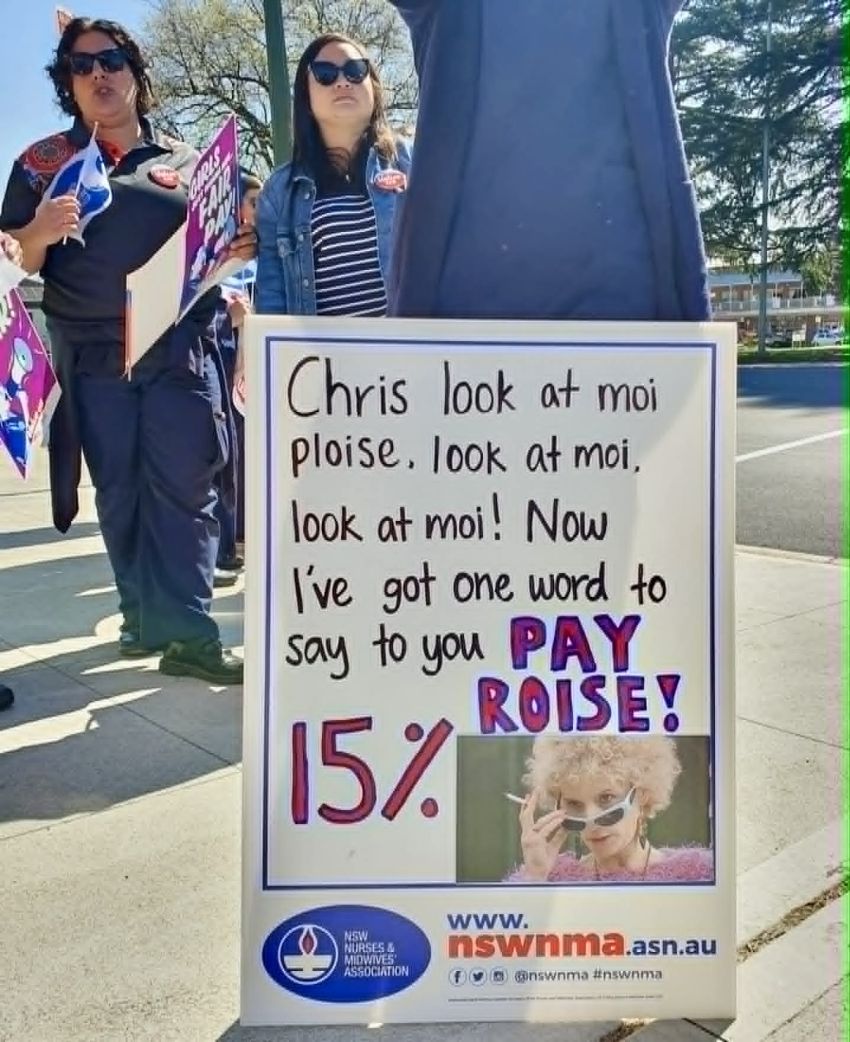
The NSW Industrial Relations Commission ruled in April that nurses and midwives, working in NSW Health, would receive between 16-28% pay rise over three years.
But many are unhappy with the three-year plan, which the NSW Nurses and Midwives Association (NSWNMA) says “doesn’t address structural issues and wage reform that’s desperately needed”.
Viola Morris told Green Left that nurses and midwives would keep fighting for a better deal. She said the highly complex work of these professionals is undervalued.
“NSW nurses and midwives are among the lowest paid across the country, not just in hourly pay rates, but other allowances like night shift loading and overtime rates. Nurses and midwives are highly skilled professionals. The work they do is incredibly complex. It means that many cannot afford not to do overtime.
“Overtime leads to fatigue and is a major contributor to medical errors which impact patient care. Overtime is also linked to increased burn-out.”
Morris said the IRC also decided not to increase sick leave to 20 days, after it was included in the NSW Nurse and Midwives Association claim and leave it at 10 days (teachers receive 15).
“The reason given by the IRC was that unstaffed shifts put too much pressure on wards and leads to burn-out. At the moment, even with overtime, many wards are running with many unfilled shifts. A pay offer which brought nurses and midwives pay in line with other states would lead to fewer nurses and midwives leaving the profession entirely, or moving interstate.”
After Labor took office in 2023, it removed the public sector wages cap. Morris said the NSWNMA took strike action three times in 2024, with more than 50,000 nurses and midwives participating to “attempt to bargain directly with the government for a pay offer”. The union was fined for doing this.
“Members were told that the IRC would be able to consider gender undervaluation and make a correction to NSW nurses’ and midwives’ pay, as well as considering some other factors which have led to our undervaluation.”
She said union members “put their faith into this process” and halted their industrial campaign, hoping to get “something closer to a 25% pay adjustment for 2024-2026 and 10% in 2026-2027 — 35% over three years.
“The IRC accepted that there had been a gender undervaluation of the traditionally female roles in registered nursing and midwifery. But it determined that the NSW economy could not support any more than a 10% rise in pay in the 2025-2026 financial year. The IRC also changed the dates so the award no longer expired in June 2027; it now expires in June 2028 which means an extra year of undervaluation, during an ongoing and worsening cost of living crisis.”
Morris said there has been a rise in violence in hospitals across the state. “At around the same time as COVID-19 funding was reduced, I was informed that many health districts started to reduce their security budgets. Research tells us that 92% of NSW public hospital nurses and midwives have been exposed to violence and aggression at work in the last six months.
“We need to eliminate violence against staff and patients in the hospital and this should be achieved by increasing nursing and midwifery staffing, because they are experts in dealing with confused and agitated patients and the biggest barrier stopping them from doing that is their workload.”
Morris said there needed to be a sector-wide review of security. “NSW has a number of emergency departments which are open without any security, or even a police station in the town.”
But more money in nurses and midwives pockets is also essential, she said.
“A Nurse Unit Manager at Prince of Wales Hospital told me that as soon as they got staff properly trained, staff would move out of the city to start a family because the cost of housing was so high; the tolls and parking made working in the eastern suburbs too expensive when often they had to live a commute away due to unaffordable housing costs.
“I would like to see nurses and midwives able to live near where they work. That might be through pay adjustments, but it could also come from a scheme similar to the military housing one, which has shown it is possible to address housing scarcity.”
Morris said nurses and midwives are being assaulted and overworked on a daily basis. “It’s not unusual for nurses to go to work at 1.30pm and stay until 7.30am because there was not enough staff to cover the night shift. When people are that tired, we know that the chances of near misses, or accidents, are much higher.
“Those are the nurses who were waiting for a pay rise which might address why so many nurses and midwives have to move interstate, or leave nursing and midwifery altogether.
“Pilots and truck drivers have limits on their hours they work. Somehow a neonatal intensive care unit nurse, who is caring for a premature baby born at 25 weeks, working into their 16th hour of continuous work is not only legal, it’s essential to keep that unit staffed.
“The nurses who need to do that are exhausted and the prospect of a decent pay rise which would attract nurses and midwives back to NSW has kept them going. This decision has taken away any hope that they had that something was going to change soon.”
Morris said the IRC’s pay decision will mean that the state will lose more registered nurses and midwives. “With the increase in pay for Assistants in Nurses (AINs) and midwifery (AIMs), we can expect the government to try to fill shifts which have historically been for registered nurses/registered midwives with AINs/AIMs.
“The NSWNMA is going to need to work hard to make sure hospitals do not let that happen. This is for a few reasons: one is that less skilled nursing care leads to greater morbidity and mortality for our patients.
“AINs and AIMs have a place in health but they do not have the skills or experience to care for patients with complex health conditions without the direct supervision of a registered nurse or midwife.
“Hospital admissions are currently shorter than ever before and we try to only keep people in hospital during the acute phase of their treatment.
“Cheaper and less qualified carers in place of RNs or RMs prolong people’s stay in hospitals. For RNs and RMs who work with AINs/AIMs, their work load is also increased because the expectation is that they will provide care for more patients and with patients who have increasingly complex health needs.”
Morris said there is a need to campaign for greater cost-of-living adjustments for nurses and midwives and for a better response to increasing violence in health facilities.
[Viola Morris is a long-term Registered Nurse in the Public Health System and has been an NSW Nurses and Midwives Federal organiser in aged care and the public system.]