
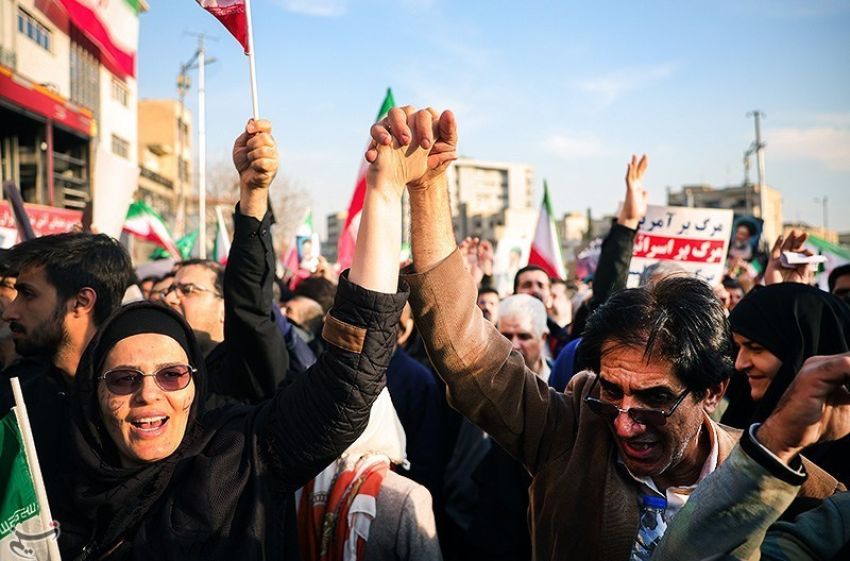
The past two weeks have seen the most massive and pervasive challenge from the Iranian people to the theocratic dictatorship since the 2009 Green Movement that brought millions onto the streets.
In its efforts at repression, the theocratic regime has enacted its biggest bloodbath since it came to power, with the death toll well into the thousands, and tens of thousands more wounded or in the clutches of its prisons and torture chambers.
For the moment, the masses have been driven off the streets by several days of gunfire and massacres, but their anger continues to smoulder. In addition to the regime’s repressive apparatus, the Iranian people also face machinations from equally reactionary elements like exiled dynastic heir Reza Pahlavi and the Trumpist United States.
Beginning with a protest by Tehran bazaar merchants in late December over the currency’s collapse and other economic issues like 52% inflation, the revolt quickly spread widely to smaller cities and rural areas, often thought to still hold some support for the regime. But it quickly spread to populations that have been at the core of opposition for the past three decades, urban women and youth and the Kurdish provinces. In this sense, this year went beyond in size and scope of both the 2019 mainly rural and small-town uprising and the more urbanised and Kurd-centred 2022–23 “Woman, Life, Freedom” movement.
As always in such moments, the youth, especially young women, were in the lead, braving gunfire during street marches, battling police and regime militias and even burning government buildings. Their main chant, “Death to the Dictator”, recast the main one from the 1978–79 revolution, “Death to the Shah”. Merely uttering it is a crime, possibly punishable by death.
Clearly, the people of Iran have reached the end of their rope. Economic problems like inflation, rising impoverishment and mass unemployment — amid neoliberal wealth disparities and corruption — have grown markedly.
Youth and women chafe under the “morality” regulations, which include misogynist restrictions on women’s attire, although authorities have not dared fully to enforce them in urban areas since the 2022 uprising. Youth perceive that they have no future and are emigrating, but are facing racist and nativist barriers everywhere, especially in the US.
Recent days have also seen workers’ strikes and occupations, as well as a general strike in Iranian Kurdistan. But so far, strikes have not spread to key levers of the economy like the oil industry. Nor have we seen a breaking away of elements of the repressive apparatus, whether from the army, the Revolutionary Guard Corps or the Basiji youth militia. This has allowed the regime to survive so far, despite the depth and size of the revolt.
Due to the machinations of the Donald Trump administration and of Maryland-based Pahlavi, the son of the former shah, some reactionary slogans have entered the movement, including the chanting of Pahlavi’s name. However, other slogans have included “No to Shah, No to Sheikh and No to Saviour” and “For Work, Housing and Freedom”.
Pahlavi is so reactionary that he has befriended Israel’s Benjamin Netanyahu, participated prominently in the neofascist Conservative Political Action Conference in the US and has applauded the Israel-US air attacks on Iran. Trump and Israel have also threatened to intervene to “support” the uprising and Pahlavi.
In this sense, the movement faces not one but two reactionary and powerful opponents: the regime itself and the Pahlavi-US-Israel imperialist nexus. The latter, including Pahlavi, claim they just want to “help” but not “take over” Iran. Here, one should remember an ageing cleric who, in 1978–79, had very militant slogans like “Death to the Shah” and implied that he only wanted to stay in the background and be a symbol of the movement, neither ruling directly nor imposing his religious vision on society by force.
Keeping all this in mind, we need to firmly support the Iranian people in their hour of struggle and repression, while also noting the full array of reactionary forces that are contending there and in the region. At the same time, we need to avoid the distorting lens of the campist left, which remains silent — or worse — opposes the mass democratic and revolutionary movement of the Iranian people, among them women, workers, students and oppressed minorities.
[First published at the International Marxist-Humanist. Kevin B Anderson is a sociology professor at the University of California, Santa Barbara. His most recent book is The Late Marx’s Revolutionary Roads: Colonialism, Gender, and Indigenous Communism.]