
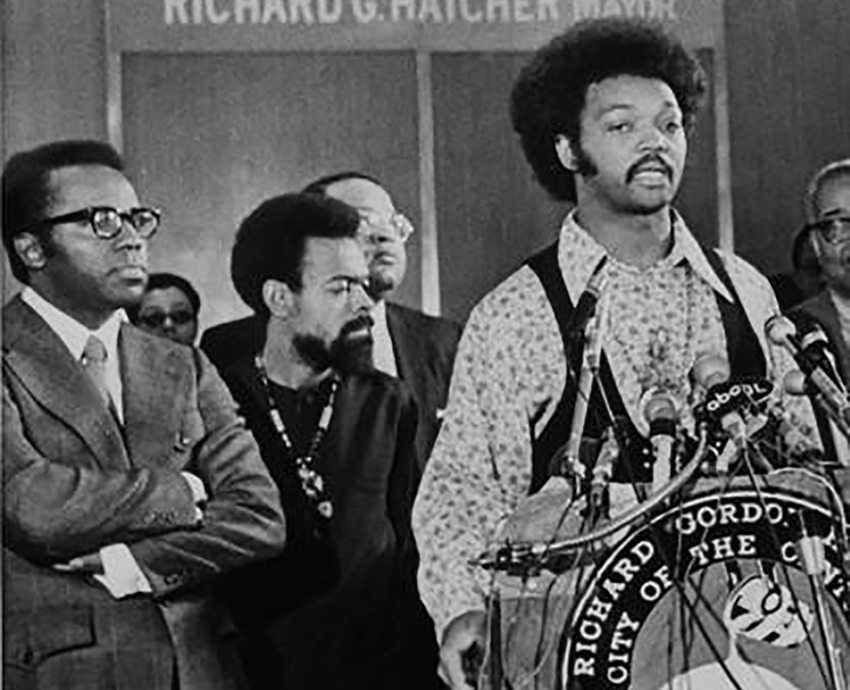
Jesse Jackson died on February 17. Looking back on his life is an opportunity to reflect on the progress and retreat for civil rights and freedom in the United States.
Jackson was a bridge from civil rights icon Martin Luther King jnr to today’s activists against Donald Trump’s white nationalist, MAGA (Make America Great Again) movement.
Today, the victories of the 1960’s civil rights revolution, such as the winning of civil rights (1964), voting rights (1965) and other laws ending legal race-based segregation and discrimination, are under attack.
Today, we are experiencing a counter-revolution against equality for peoples of colour — especially African Americans. Black history is denied. Confederate flags have risen again on military bases. Is the return of Jim Crow segregation next?
The counter-revolution, which began in full throttle in the 1980s, continues to unfold under Trump’s authoritarian regime.
Born in Jim Crow South
Jackson was born in South Carolina in the Jim Crow South. He became a close associate of King and stood on the balcony where King was assassinated in Memphis Tennessee in 1968, while supporting striking sanitation workers.
King spoke out for labour rights and civil rights, and was criticised for it by others in the movement who thought he went too far. King also spoke out against the Vietnam War in 1967, soon after President Lyndon B Johnson signed the civil and voting rights acts into law.
Jackson identified with King’s determination and militancy. King appointed him to lead the Southern Christian Leadership Conference (SCLC) office in Chicago.
Following King’s assassination and after leaving the SCLC over differences with King’s replacement, Jackson set up Operation PUSH (People United to Save Humanity) in Chicago, in 1971. PUSH continued the civil rights agenda King had founded.
Jackson set up the Rainbow Coalition in 1984, as he (unsuccessfully) campaigned for the Democratic Presidential nomination. It was founded on the concept of a country based on hope and ethnic diversity — and against white nationalism.
Barack Obama could not have been elected as the first Black president, 20 years later, if it weren’t for the civil rights movement that Jackson championed.
Between Operation PUSH and his presidential nomination campaign in the 1980s, Jackson remained an outspoken critic of racist politics. He endorsed independent Black politics, supporting former comrades who ran for office in the Democratic Party and who got diverse jobs in industry, banking and higher education — institutions they had been locked out of under segregation.
Unlike many other civil rights leaders of the time, Jackson warned that African Americans could shift their vote to Republican candidates if the Democratic Party did not work for their rights. His framework was always protecting the rights and wellbeing of African Americans. That’s why, during his 1984 presidential campaign, Jackson spoke up for gay and lesbian rights and for women’s equality.
Like King on Vietnam, Jackson spoke up on international issues. He praised the Sandinistas after the 1979 Nicaraguan revolution. He went to Cuba to help free some detained Americans. He met with Cuban President Fidel Castro.
Jackson backed the anti-Apartheid movement in South Africa. He met Nelson Mandela.
He voiced support for the freedom of the Portuguese colonies of Angola, Mozambique and Guinea-Bissau. He did so when official US policy backed the military junta in Portugal.
Jackson was politically active in the framework of the capitalist system. He supported building a strong Black middle class and positions on Wall Street, where historically African Americans had been excluded. He threatened Wall Street firms that did not take affirmative steps of inclusion. Following King’s example, Jackson campaigned for boycotts of large corporations that did not adopt inclusive hiring practices.
King had always argued legal equality was not enough for Blacks after centuries of super-exploitation and oppression. King always compared Blacks as starting a track race “50 yards behind” better off whites. Affirmative action programs to bring about diversity were required to move toward full equality.
Today, they are known as Diversity, Equity and Inclusion programs, and are strongly opposed by Trump’s government.
Independent Black politics
While nodding to independent Black politics, Jackson rejected that path. After King’s assassination, it was not clear if Black participation in the political system was possible.
The left wing of the Black Power and civil rights movement, including the Black Panther Party, the League of Revolutionary Black Workers and other African nationalists, openly spoke against capitalism and advocated an independent Black freedom movement and party. There were few Black elected officials.
The National Black Political Convention was held in Gary, Indiana, in March 1972. Gary had elected one of first Black mayors, Richard Hatcher. Many future Black elected officials and leaders attended, along with about 10,000 delegates, including many on the left, such as myself.
Jackson attended and gave a fiery speech advocating for independent Black political power and economic justice. He spoke out even if the Democratic Party did not.
Jackson travelled around the world to free hostages and aligned himself with those suffering under the blows of foreign intervention.
Jackson was a hero to millions, including those of us on the socialist left who praised his integrity and outspoken views on issues like Black Lives Matter and police violence.
Jackson was a living link to two periods. The first period covered the legal segregation of the first 200 years of a country that was never the true democracy it proclaimed. The founding fathers — a majority of which were slave owners — only considered whites as US citizens.
The second period, in the second half of the 20th century, saw the passage of civil rights legislation. That’s when the country became a true capitalist democracy. It discarded legal segregation and belatedly began to recognise the talents of African Americans and other people of colour.
Trump’s authoritarian government is seeking to reverse these 50 years of integration.
Within the framework he accepted, Jackson’s story represents what’s possible in a life dedicated to winning equality and freedom.