
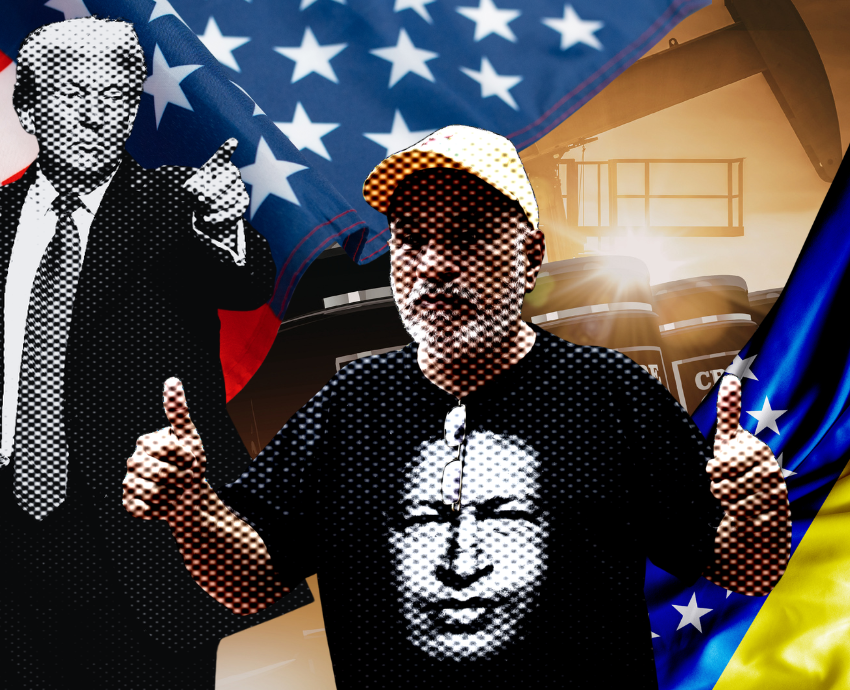
The January 3 United States military assault on Venezuela and kidnapping of then-President Nicolás Maduro and National Assembly deputy Cilia Flores, has been followed by some rapid changes in the country, most importantly the reform of the country’s oil law.
Green Left’s Federico Fuentes spoke to Malfred Gerig, a sociologist from the Universidad Central de Venezuela (Central University of Venezuela) and author of Venezuela’s Long Depression: Political economy of the rise and fall of the oil century, about the reform, the likelihood of resistance and solidarity with the Venezuelan people. Read part one here.
* * *
The Delcy Rodríguez government has taken steps to amend former socialist president Hugo Chávez’s hydrocarbons law. What is happening in terms of state sovereignty over oil?
What is happening is the dismantling of the foundations of Venezuelan oil nationalism, one of the great pillars of the construction of the Venezuelan state and nation throughout the 20th century.
Today, what we have is a “lease” imposed by force, in the sense that oil production is being handed over to private US companies for a specific period of time.
The proposed reform to the Hydrocarbons Law is Venezuela’s surrender as an oil-producing country, stepping backwards to the first half of the 20th century when it was a country that solely owned the resource.
Specifically, it is a radicalisation of what was already occurring, its formalisation.
What was already occurring? The anti-blockade law and so-called “Chevron model”, greatly celebrated by Maduro, based on Production Participation Contracts in which [Venezuelan oil company] PDVSA’s partners control everything, where there is absolute delegation on all operational matters.
What we will see is the Chevron model on steroids, since it also grants private US companies a monopoly over marketing, discretionary management of income, a monopoly over imports and so on.
Obviously, all of this goes against the constitution and the current Hydrocarbons Law. That is why they had to adapt the law to reflect current practices, which oil companies requested in their meeting with [Donald] Trump.
This reactionary reform to the Hydrocarbons Law, under the pretext of raising oil production, eliminates the country’s role as a producer and an owner.
Do you see any possible resistance against Trump’s recolonisation plans?
The future, in the short and medium term, is very difficult to predict, because I see all these agreements as highly unstable.
It is true that the Madurista political class offers the least resistance — to put it mildly — to implementing Trump’s foreign policy in Venezuela. It is no coincidence that the CIA reports on which Trump based his policies chose Madurismo to lead the transition to a protectorate.
And as we can see, it is achieving this without much fanfare, for now.
But there could be other sources of resistance and conflict: for example, internal conflicts within Madurismo could be a point of resistance that leads to this new normal collapsing at some point. Not for reasons of dignity, or over ethical or programmatic issues, but because of power struggles inherent to each faction, as well as attempts to settle scores between them.
But I do not foresee any major problem or resistance to establishing this protectorate coming from within the political class.
Nor do I expect the social base of Madurismo — what remains of it — to accuse Madurismo without Maduro of betraying Chávez’s legacy or the Bolivarian Revolution. That water passed under the bridge a long time ago.
But I do believe that nations possess moral and ethical reserves that allow them to persevere in their very being, a certain spirit of the homeland. The Venezuelan nation, in some way, will have to demonstrate a reservoir of dignity to reaffirm how it perseveres and asserts its right to self-governance.
We are perhaps entering the most important crossroads in our republican history, where we will see how the nation rebuilds itself and begins to demand its rights, primarily its right to decide its own destiny.
There will be no shortage of reactionaries who advocate for the Venezuelan nation to lose sovereignty over itself as penance for the catastrophic outcome of the political conflict.
But there will also be no shortage of republicans and Bolivarian supporters advocating for freedom, sovereignty, equality, virtue and the general and national-popular interest as a supreme value that we can give ourselves and that we deserve.
Do you think a return to democratic governance is possible in the short or medium term?
The transition to democracy, elections and so on, is not expected anytime soon by the US.
Why? Because Trump made a sound decision — in terms of his own interests — when he realised that Madurismo without Maduro could guarantee much better stability for the protectorate than a government led by María Corina Machado or [opposition presidential candidate] Edmundo González. They would have had to confront democratic, economic and popular demands that Madurismo has suppressed.
This is largely the reason for Trump’s decision to have Madurismo lead the initial stages of the protectorate, as it represents the point of least resistance to establish US interests in Venezuela. For Trump, the main thing is to make the protectorate irreversible or at least to make a lot of money, in Trump’s own words.
I believe that the Venezuelan nation’s perseverance at this moment hinges on reclaiming our right to self-governance, on establishing a government that defends our national interests. But we must also focus on strengthening the sources of national power, without which, realistically speaking, no nation is viable within the international system.
A nation that collapses militarily, as Venezuela did on January 3, is not viable within the international system. Nor is a nation viable when it has collapsed healthcare and education systems, political institutions lacking in any representation or legitimacy, and so on.
For Trump, Venezuelans will only be able to vote when they are no longer capable of choosing against the US’ interests — that is, when the protectorate is irreversible. But for the Venezuelan people, political participation and electoral expression based on their interests is a vital imperative.
What can the left do internationally to support the struggle of the Venezuelan people?
The first thing the left should understand is that its solidarity must be with the people of Venezuela, not with the government. This government ceased representing the deepest and most profound interests of the Venezuelan people a long time ago.
Not only does it fail to represent their interests, but, as we see, it has no qualms siding with those who seek to undermine the interests of the peoples of the world. Maduro’s son had no qualms stating that Venezuela should establish relations with Israel.
The Maduro government was a moral and strategic debacle for the left, not only in Latin America but globally.
When I say strategic, I mean Maduro was a champion of defeats who weakened the nation and annihilated the ethical and political strength of the movement he inherited. He reduced it to dust. When he had to put that movement in historic danger to defend his own power, he did so.
This attack by US imperialism does not prove that Maduro was right, that imperialism was plotting against him, and that imperialism was the cause of all this.
Rather, it proves that Maduro was utterly incompetent when it came to defending the Venezuelan nation against imperialism.
What Maduro did was precisely help imperialism do what it wanted to the nation: weaken it militarily, economically, culturally and institutionally, and above all, weaken its popular forces, the popular sovereignty upon which the nation and its social transformation rests.
We must ask ourselves: why did an attack like this, obviously against international law, obviously against international rights, give hope to the majority of the Venezuelan people, both inside and outside the country?
Furthermore, Trump found the perfect scapegoat to leverage his interventionist policy toward Latin America. A policy that, as we see, goes against President Gustavo Petro in Colombia, against President Claudia Sheinbaum in Mexico, but above all, against the national sovereignty of those sister Latin American nations.
What made this possible? It was the Maduro government.
The problem with much of the global left, especially in the Global North, is that they do not consider Venezuelans — neither the elite nor the people — to be subjects in this story, actors in their own story. For them in this whole story is imperialism. The complexities of reality matter little.
Even though it seems that we lack the capacity to decide our own destiny right now, I assure you that the Venezuelan nation will be reborn in some way, sooner rather than later, and we will take the reins of our future and our destiny.