
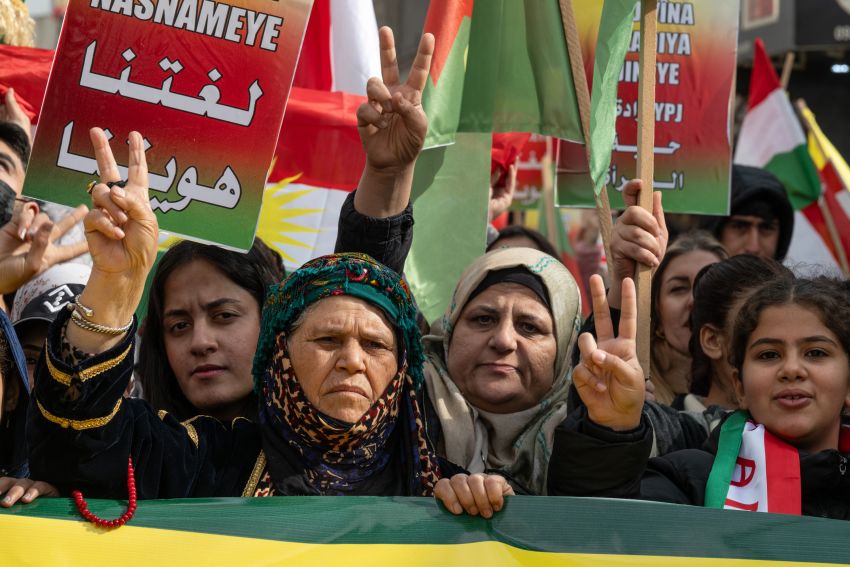
A ceasefire and integration agreement was signed on January 30 by the Syrian Transitional Government (STG) on one side and the Autonomous Administration of North and East Syria and the Administration’s Syrian Democratic Forces (SDF) on the other.
On paper, the agreement leaves the Autonomous Administration with a measure of local control in the Kurdish heartlands, to which they have retreated, and allows for specific SDF battalions in the Syrian army. How much of this will be allowed to survive in practice will depend on the interests and strengths of the many different powers operating in Syria, and whether international promises of support will develop into anything more than rhetoric.
The United States is preparing to pull out of Syria once they have evacuated the Islamic State (ISIS) prisoners. The Kurds have received a phone call from French President Emmanuel Macron and a visit by the French foreign minister, and my imagination keeps conjuring up a surreal vision of Macron, complete with sunglasses, telling gangs lusting for sectarian violence to put away their guns.
The January 30 agreement stipulates: withdrawal of military forces from both sides and exit of all military forces from towns and cities in Kurdish areas; integration into the Syrian army of a division, combining three SDF brigades, in Hasakah, and of one SDF brigade in Aleppo; retention of existing local security forces but under overall STG control; nomination by the SDF of a governor for Hasakah and a deputy minister of defence, and by the STG of a provincial security chief; taking over by the STG of oil fields, Qamishli airport and all civilian institutions, while retaining existing employees; STG’s ultimate control of border crossings and licensing of civil organisations; acceptance of Autonomous Administration school and university certificates and educational particularities for Kurdish areas; and the return of internally displaced persons (IDPs) to Afrîn, Serêkaniyê and Sheikh Maqsoud.
There has been nothing specifically published about the role of women, though the army brigades are said to include the Women’s Protection Units, and existing security and civil personnel will remain.
Even without formally breaking this agreement, as the STG has broken previous ones, there is a lot of scope for different interpretations and for creeping centralisation.
Kobanê under siege
Vitally, while the arrangements stipulated in the agreement have thus far been rolling out according to plan, with only minor attempts at disruption, no one can have faith in a shared future so long as the STG keeps the city of Kobanê under siege. Kobanê’s significance as the city that turned the tide on ISIS allows this siege to be understood as an attack on Kurdish self-worth and identity, as well as a brutal collective punishment of the city’s population and of the many IDPs who have been forced to take shelter there — hundreds of thousands of people in total.
Kobanê is still largely cut off from water, electricity, fuel and many other essentials, including food and medicines. Turkey is playing a part in this, too, refusing to allow truckloads of aid sent by the DEM Party to cross the Turkish border and enter Kobanê. This looming humanitarian disaster has been ignored by international media and politicians.
Although there has been much discussion about the SDF and the Autonomous Administration misjudging their situation during last year’s negotiations, it is difficult to envisage — given the weakness of their hand — what more they could have achieved.
How do you negotiate with people who treat every agreement as a delaying tactic to be broken at convenience, and who are backed by a Turkish government that is determined to eliminate your autonomy?
Once it was clear that the US had no more need for the Kurds — a position assured by the agreement between the STG and Israel, which gave Israel its zone of interest in Syria’s south and consolidated Syria’s break with Iran — the STG was free to carry out its long-planned attack. (The Israel agreement was made in Paris and mediated by the US, and Yeni Yaşam claims there was British involvement behind the scenes.)
Matt Broomfield, in a sober analysis for Jacobin, compares the position of the Syrian Kurds to that of Palestinians in the occupied West Bank. There are similarities in the isolated enclaves subjected to central control, but also very significant differences.
The Kurds lack even the recognition won by the Palestinians; however, the STG is hardly an established state apparatus. STG President Ahmed al-Sharaa has proved politically wily, but his army relies on gangs and warlords, and his administration relies on nepotism and his readiness to sell Syria’s assets to powerful foreign interests. Even without the looming threats of US-Israeli attacks on Iran or interference in neighbouring Iraq, the future of Syria looks very uncertain.
Öcalan behind the scenes
It has been claimed that imprisoned Kurdish leader Abdullah Öcalan played a significant role in securing an integration agreement that could be accepted, so avoiding the need for total resistance to the STG’s proposals for surrender and the accompanying risk of major inter-ethnic conflict. As part of this behind-the-scenes diplomacy, Öcalan made it clear that if Turkey refused to accept compromises on Rojava, he would withdraw from the “peace process” between the Turkish state and the PKK. For Öcalan, the red lines are the right to self-defence, local governance and the right to language and education.
The result appears to have satisfied Devlet Bahçeli, who, as leader of the far-right Nationalist Movement Party and Turkish President Recep Tayyip Erdoğan’s ally, took the first public steps in October 2024 in the ongoing “peace process”.
Bahçeli is still calling the YPG (the Kurdish component of the SDF) a “terrorist organisation”, but in his framing, as he told his party group meeting on February 3, the integration agreement amounts to their dissolution, and Öcalan has kept all his promises. Bahçeli called for “Anatolia to return to peace, Öcalan to [the Right to] Hope [for parole], [deposed mayor] Ahmet [Türk] to his post and [imprisoned HDP co-chair, Selahatin] Demirtaş to his home”.
None of these things have happened. Instead, Turkey has imprisoned Kurds and leftists, in a clear demonstration that democracy and freedom are not on the government’s agenda. Turkey has recently detained about 100 members of the Socialist Party of the Oppressed, a constituent part of the coalition that gave birth to the pro-Kurdish DEM Party. A large majority of these people have been arrested and held in prison.
Repression
Protests in Turkey against the attacks on Rojava were met with mass detentions, and young people reported police violence and bullying to force them into signing false statements. The clampdown has included women who have publicly braided their hair as a symbol of resistance to the misogynistic fighters of the STG, and who are being accused of making “terrorist propaganda”.
A student accused of lowering a Turkish flag was so badly beaten by the police he was briefly left for dead. In Diyarbakır, the Association of Lawyers for Freedom calculated that between January 1 and February 2 at least 842 people were detained, 118 people — including 25 minors — were arrested and 106 people suffered beatings and ill-treatment for taking part in peaceful protests.
Very little of all this makes its way into Western media or onto the agenda of European politicians, but there will be an emergency debate on Syria in the European Parliament on February 10.
In preparation, representatives of Syria’s different minorities met together in Brussels to share their experience of massacre and oppression and put forward their demands for the European Union to use its powers to protect them — including by making all help for Syria contingent on respect for fundamental rights and freedoms.
[Sarah Glynn is a writer and activist. Visit her website, where this article first appeared, and follow her on X and Bluesky.]