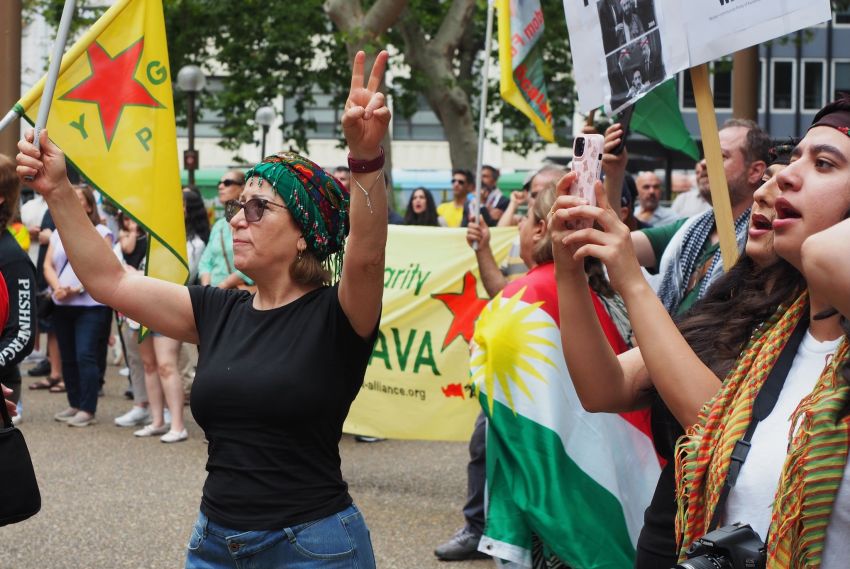
World Rojava Day on February 1 was marked by mass rallies by Kurds and their allies around the world defending the survival of the Kurdish-led revolutionary experiment in North and East Syria/Rojava in difficult new conditions.
An agreement was made, under pressure, on January 29 between Rojava’s Syrian Democratic Forces (SDF) and the United States-backed Syrian Transitional Government (STG) for a permanent ceasefire and integration of Rojava into the STG.
Ilham Ahmad, spokesperson of the Democratic Autonomous Administration of North and East Syria (DAANES), said it was signed “to stop bloodshed and limit acts of genocide against the Kurds”, after the SDF was forced to retreat to predominantly Kurdish areas around Qamishlo, Hesekê and Kobanê in January.
There are mounting reports of atrocities and reverses for women’s rights in the areas the SDF was forced to retreat from.
Fawza Yousef, Co-Chair of the Democratic Union Party, a leading party in the Rojava revolution, said the agreement “prevented ethnic cleansing, demographic change and civil war”.
She hoped it would be “a means to civil peace and guarantee the rights of the Kurds and all other communities”.
“Our regions will be protected by the Asayish [Rojava’s internal security] forces, which will be integrated into the [Syrian] Ministry of the Interior.
“The Kurdish regions will maintain their distinct security, cultural, administrative and institutional representation.
“We affirm that our efforts and struggle will continue to achieve constitutional guarantees of rights.”
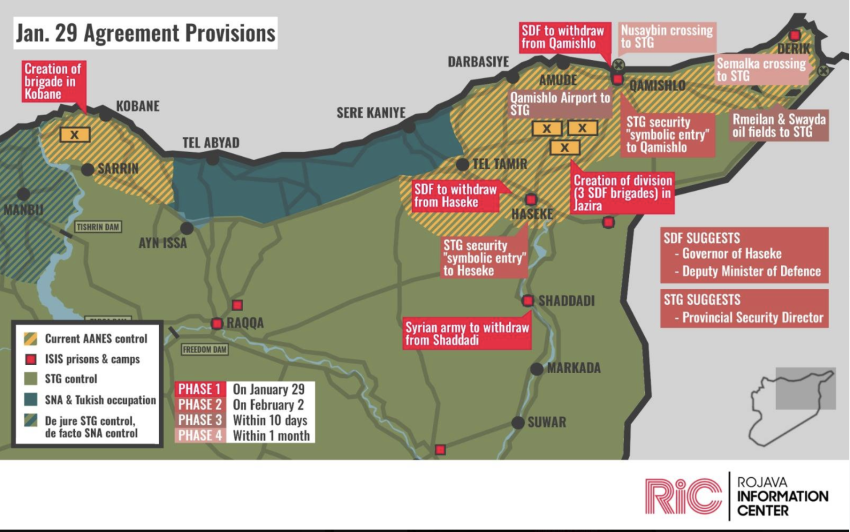
According to the SDF media centre, the agreement includes the withdrawal of military forces from contact lines, the entry of Internal Security Forces affiliated with the Ministry of Interior into Hesekê and Qamishlo and the start of the process of integrating security forces in the region.
This process began peacefully on February 2–3, when a small convoy of STG security officials entered Hesekê and Qamishlo.
The agreement provides for the formation of a new Syrian military division comprising three brigades from the SDF, in addition to the formation of a Kobanê brigade within another division affiliated with the Aleppo Governorate.
DAANES institutions will be integrated into Syrian state institutions, with their civilian employees keeping their positions.
Discussions on the constitution, elections and institutional coordination are to continue.
Under the agreement, the STG will also take over the border crossings with Iraq, the oilfields and the Qamishlo airport.
It guarantees the return of internally displaced people (estimated at nearly 160,000 in Rojava by the United Nations) to their home areas.
The Kurdistan National Congress (KNK), a coalition of Kurdish parties and organisations, explained that the agreement must be seen in the context of the military offensive initiated against Kurdish neighbourhoods in Aleppo on January 6.
“This was the violent culmination of a plan designed by the Turkish state and implemented by jihadist militias led by Ahmed al-Sharaa. Strategically, directed and logistically enabled by external state actors, the operation aimed not merely at territorial control but at the systematic dismantling of the SDF as an institutional entity and the forced liquidation of a decade of autonomous self-governance in the region.
“Through this attack, the perpetrators sought to extinguish a revolutionary project in which women are liberated, peoples coexist as equals and democracy breathes in everyday life. Yet they failed to account for one fundamental reality: this light is no longer only Rojava’s hope, it has become a source of inspiration for peoples across the world.”
However, this has come at great human cost — for which the states in the Global Coalition to Defeat ISIS “bear direct responsibility”, the KNK said.
“Hundreds of thousands of civilians have been forcibly displaced, hundreds killed, and the city of Kobanê now endures a new crippling siege, deliberately deprived of food, water, medicine and electricity. These acts — weaponising essential civilian infrastructure — constitute grave violations of international humanitarian law and amount to collective punishment.”
The KNK sees the agreement not as an endpoint, but “the beginning of a long and arduous struggle for genuine democratic integration”.
“It represents both an opportunity and a terrain of resistance to demonstrate that we will never accept the imposition of a one-size-fits-all model of life or the jihadist mentality forced upon our society.
“To protect and advance the achievements of the Rojava revolution, we must intensify our presence in the streets, strengthen our organisation, and maintain a resolute and unwavering stance.
“Silence in the face of this siege constitutes complicity. The Coalition now carries a heightened obligation to ensure the implementation of the agreement.
“Likewise, the international community must assume its role and guarantee constitutional protection for all political, social, democratic and linguistic rights of the Rojava administration, where diverse religious and ethnic communities have lived together in peace and dignity.”