
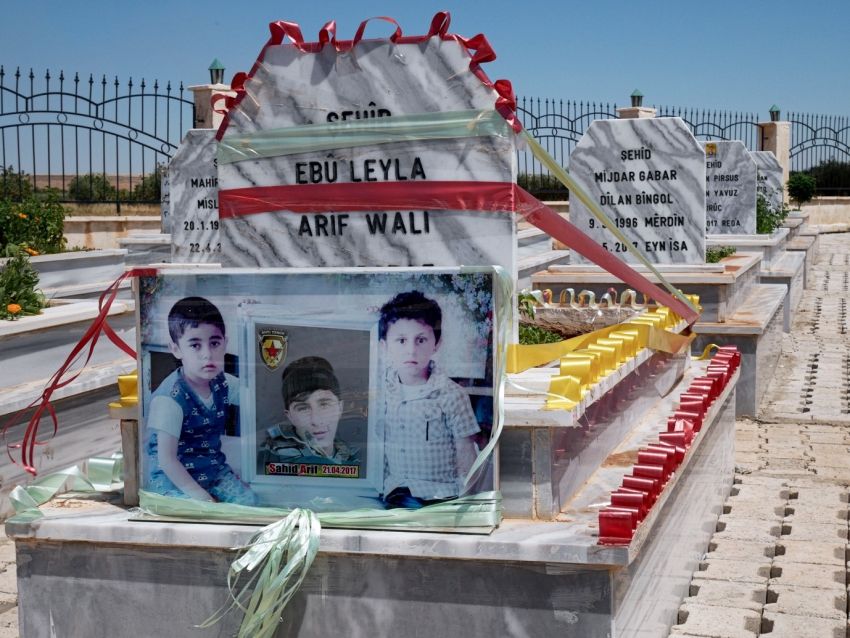
In 2014, the northeastern Syrian city of Kobanî was at the forefront of the battle against Islamic State (IS). IS had gained control of large swaths of territory across Syria and Iraq, including in the eastern Syrian governorates of Deir ez-Zor and Raqqa.
By September, it had turned its attention to the northeast, culminating in the battle of Kobanî. With the aid of United States airstrikes, a massive popular resistance headed by the Kurdish People’s Protection Units and the Women’s Protection Units successfully pushed IS back. They went on to unite with Arab units as the Syrian Democratic Forces (SDF) and become the Western coalition’s primary ally in the fight against IS.
This was a pivotal moment in the evolution of the Democratic Autonomous Administration of North and East Syria (DAANES), or what is popularly known as the Rojava Revolution. It is a grassroots movement organised around the principles of pluralism and democracy, women’s liberation and ecology and positioned in stark contrast to IS and the Bashar al-Assad-led Syrian regime.
DAANES’ territorial control expanded with its defeat of IS, spreading from the governorate of Hasakah to Raqqa and parts of Deir ez-Zor.
Today, Kobanî, and the broader northeast, is once again under threat, this time from the Syrian Transitional Government (STG) in Damascus and affiliated Turkish and Islamist militias, who now seek control over the entirety of Syria.
Contradicting earlier policy, this attack is at best enabled, and at worst actively supported, by the US and EU. The attack carries with it not only an extreme risk of IS resurgence, but an existential threat for northeastern Syria’s Kurdish population — and all those who stand for democracy.
Education gains
I first visited DAANES in early 2018 to research the education system established as part of the revolution, and I have returned since for political delegations. My research partner Adam Ronan and I spoke with more than 100 people who had experienced the new education system, both supporters of DAANES and those who preferred the Assad regime’s schools.
While not without faults, a dedication to protecting diversity, democratic values, gender equality and the environment was clear, along with a sense of hope among young people that is hard to come by in conflict settings.
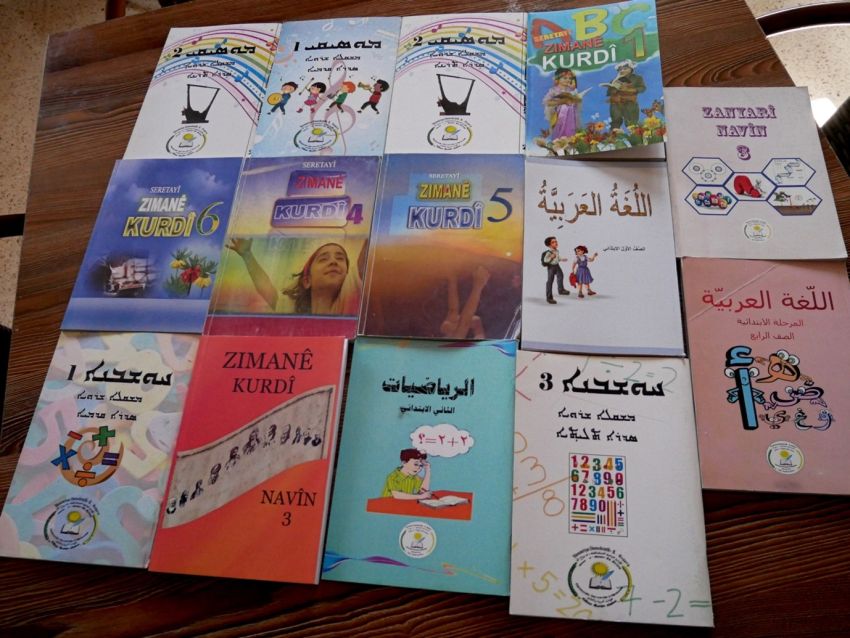
As a microcosm of the broader revolution, the education system is especially notable for the way it has challenged the erasure of minorities seen in the Assad regime’s system, with content and textbooks now tailored to each ethnic group and classes taught in multiple languages — Kurdish, Syriac and Arabic. A memorable middle school student told us, “We want to succeed because we see ourselves in it. We see our society and culture inside it.”
In my PhD, I went on to study the impact of IS on higher education in eastern Syria, and how those affected attempted to navigate the immense challenges they faced.
Demonstrating incredible resilience, for some educators in Raqqa this meant opening a new university, Al-Sharq, in the buildings that once housed IS’s finance department, with a lush garden growing above some of the group’s former tunnels. Like other DAANES universities, there is no official university curriculum, with staff free to create departments based on demand and students encouraged to do their own research.
Particularly for those who had been unable to safely or affordably leave Raqqa to continue their education at government universities, the university has provided hope — or “a second chance”, as one student described to me — to those who had their education disrupted by IS. These gains are now at risk.

New threats
After the fall of the Assad regime in December 2024 and the establishment of the STG, headed by former al-Qaeda and Hay’at Tahrir al-Sham member Al-Jolani (now known as Interim President Ahmed al-Sharaa), initial hopes gave way to fears amongst minorities. This was cemented by violence against the Druze people in Sweida and the Alawites on Syria’s coast.
While an agreement between al-Sharaa and SDF Commander in Chief Mazloum Abdi to work towards integration of DAANES into the Syrian state was reached in March last year, this came with great uncertainty over how it would be implemented in practice — and at what cost to the Kurds.
Recently, this uncertainty has come to a head, with al-Sharaa abandoning dialogue and opting for military force against DAANES. It has become clear that the STG are increasingly unlikely to grant any genuine autonomy to DAANES, favouring the complete centralisation of the Syrian state over other legitimate options. This includes the imperfect, but relatively stable, system of semi-autonomous governance in the neighbouring Kurdistan Region of Iraq.
Although alongside talk of unifying all Syrians, al-Sharaa issued a decree granting some rights to Kurds, including the right to teach the Kurdish language in schools, the decree is not a constitutional change and can be overturned. It discounts the very real, and far more radical, efforts that have been already made in education and governance to protect diversity and democracy in the northeast.
It must be acknowledged that there has been some popular resistance against DAANES, particularly in Deir ez-Zor and Raqqa, where its hold has always been tenuous. The STG’s recent takeover of those governorates will be welcome news for some. However, it must also be acknowledged that it has been a long time since the war in Syria could truly be characterised as a civil war, with any popular resistance against DAANES being stirred to some degree by invested foreign powers, including Turkey.
Violence
Videos have circulated of STG and allied militias committing acts of violence against Kurds, and local sources describe the release of IS members from prisons. On my recent visit to Al-Roj — one of the DAANES-controlled detention camps holding the families of IS members — I heard of how radicalised detainees had been emboldened by the new government in Damascus, hopeful that they would free them and IS would rise again.
In cities across Hasakah, thousands of fighters, students, artists, journalists and civil workers are currently mobilising in support of DAANES, with Kurds across Syria’s borders also rallying to join.
The SDF has called on its supporters in the international community to stand with it — essential for countering the international media’s complicity, and for a people all too aware that self-interest is the only consistent part of US foreign policy.
US senator Lindsey Graham has been a notable exception, emphasising that contrary to al-Sharaa’s military campaign, “You cannot unite Syria by the use of military force.” He acknowledged that it was the SDF who had been on the ground in the fight against IS in President Donald Trump’s first term, and “we owe them better”.
For all the criticisms that could be levelled at DAANES, after my eight years working as a researcher there, I can say with confidence that it is comprised of many people across all levels of society who are deeply and genuinely committed to democratic principles and self-reflexivity. That is more than we can say for many governments.
In the education system, I was moved by the hope many young people have in their futures despite, or perhaps because of, all the odds stacked against them. The scale at which DAANES has been able to succeed in its democratic project makes it a beacon for all those who believe in the possibility of a better world — one that will be a much darker place without it.
[Dr Elise Boyle Espinosa has an interdisciplinary background including in in international studies and global development, and prior to her time at the University of Aberdeen, she studied and researched at the Universities of Sydney, Cape Town, and Copenhagen.]