
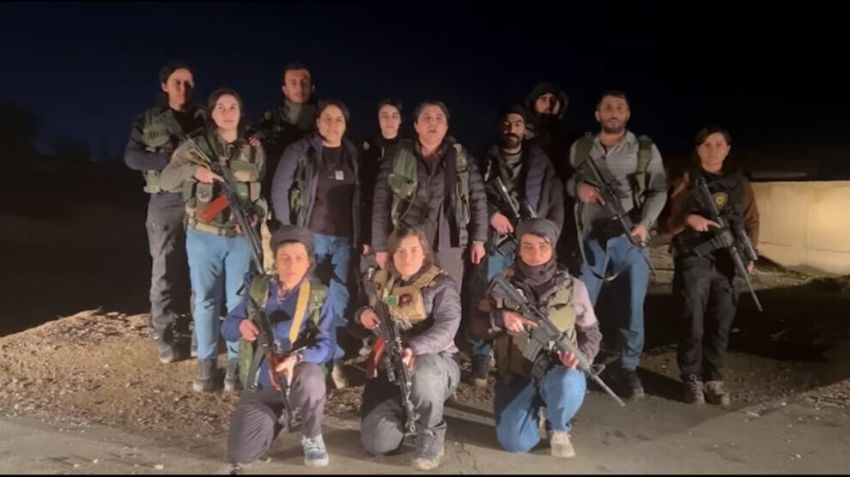
The one region in the Middle East that prioritised inter-ethnic peace, women’s rights and democracy is under existential threat.
The Syrian Transitional Government, which has been backed and legitimised by international powers, led by the US and Europe, is attempting to eradicate the Autonomous Administration of North and East Syria.
It has embarked on a new brutal civil war with the active backing of Turkey. The Syrian government has reneged on every agreement with the Autonomous Administration and broken every ceasefire. Its militias — already notorious for sadistic abuse — are posting videos of their atrocities. Prisons are being taken over and ISIS prisoners released in their thousands, while the US-led International Coalition to Defeat ISIS does nothing. Syrian government fighters now threaten the core Kurdish areas, and the city of Kobanê — famous for turning the tide against ISIS — has been cut off.
With the Syrian government offering only surrender, Kurds are mobilising against impending genocide.
To help clarify all that has been happening in Syria, I have put together a timeline of key events, followed by some more general comments, all of which is written in haste as events are changing rapidly.
Timeline
March 10, 2025: Mazloum Abdi, commander in chief of the Syrian Democratic Forces (SDF), and Ahmed al-Sharaa, interim president of Syria, sign an agreement to work towards integration of the Autonomous Administration of North and East Syria into the administration of the Syrian state. It is an outline framework within which executive committees are meant to agree on detailed implementation by the end of the year.
March 13, 2025: The Syrian Transitional Government (STG) adopts a new constitution that gives dictatorial powers to the president and is criticised as being in clear contradiction of the agreement it made with the SDF.
April 1, 2025: A further agreement is signed between the SDF and STG concerning the two autonomous predominantly Kurdish neighbourhoods of Aleppo — Sheikh Maqsoud and Ashrafiyeh.
These have a combined population of about half a million and are isolated from the rest of the Autonomous Administration. In line with this agreement, the SDF withdraws from the neighbourhoods, but they are left in control of their own internal affairs, with their own lightly armed internal security forces.
Although the March agreement includes a ceasefire throughout Syria, Turkey’s mercenary militias continue to attack the Autonomous Administration. These attacks lessen as the focus turns to the “peace process” in Turkey, but never stop.
Negotiations on the March 10 agreement are slow. Meetings are cancelled by Damascus. Verbal agreements are never put into writing. It is clear that Turkey is putting pressure on Damascus not to agree to any form of regional autonomy.
Meanwhile, Damascus restricts movement from the Autonomous Administration to government areas. This combines with the continued attacks to make daily life difficult.
At the end of the year, Turkey is blaming the SDF for failure to reach an integration agreement, threatening a military option and promising support to Damascus should it attack the Autonomous Administration.
January 4: A negotiation meeting between the SDF and STG seems to be nearing an agreement, but before an announcement can be made, it is abruptly terminated by the Syrian foreign minister, who is very close to Turkey.
January 6: Following a meeting in Paris, facilitated by the US, Syria and Israel announce that they have come to an agreement. This effectively removes Israel as a potential threat to Turkey’s plans for the north of Syria.
That same afternoon, STG forces — including the Turkish-backed militias, which have been incorporated into the Syrian army — attack the Kurdish neighbourhoods of Aleppo, breaking the April 1 agreement.
In scenes reminiscent of Gaza, they label residential areas military zones and bombard them; they target hospitals and they round up and abduct civilians claiming they are combatants.
The internal security forces are no match for the fighters ranged against them, who are equipped with Turkish tanks, drones and heavy weapons.
January 9: Ursula von de Leyen, president of the European Union Commission, promises al-Sharaa a political partnership and €620 million. At the same time as they meet in Damascus, Syrian government forces are pounding residential neighbourhoods in Aleppo.
January 11: The US mediates a ceasefire and the remaining security forces leave Aleppo. Dozens of civilians are dead, hundreds disappeared and 150,000 displaced. Many of the attacking fighters have been involved in atrocities committed against Alawites and Druze, and also the Kurds in Afrîn. There are videos of atrocities against captured Aleppo residents.
January 13: The Kurdistan Democratic Communities Union, the umbrella group that includes the PKK, put out a statement that describes the attacks as “a Sabotage to the Ceasefire and the ‘Peace and Democratic Society’ Process”.
The Syrian government, after massing its forces, declares two more SDF-controlled regions as “closed military zones” and targets for attack. These are areas that the SDF took over after the fall of Assad in an attempt to link up with the autonomous Aleppo regions.
January 16: Al-Sharaa signs a decree giving some rights to the Kurds, at the same time as increasing military bombardments against the SDF areas. This is a decree, not a constitutional change, and appears to be directed at appeasing Western criticism.
The same day, with attacks escalating, the US mediates another ceasefire, and the SDF agrees to retreat from the two areas under attack.
January 17: Before the retreat is fully completed, the STG breaks the ceasefire to ambush retreating troops. It then continues to attack further areas, for which there was no agreement for SDF retreat. The fighting is taking place on many fronts, and tribes once loyal to the SDF are changing sides.
Mazloum Abdi meets US ambassador to Turkey Tom Barrack and leaders of the Barzani’s Kurdistan Democratic Party in Erbil. There is no public statement.
January 18: The fighting intensifies and it becomes clear that any idea that the attacks would stop at the Euphrates was wishful thinking. The SDF is being forced to retreat to the Kurdish heartlands.
The physical attacks of the STG are combined with a mendacious propaganda war that attempts to destroy the reputation of the SDF.
In one example, the SDF are accused of murdering prisoners while, in fact, the prison in question had been emptied earlier as a precaution; the bodies shown are not those of prisoners and the STG actually filmed themselves ransacking the prison.
STG forces ISIS prisoners to be released in Raqqa.
A ceasefire and integration agreement is published by the STG following a telephone call with Abdi. This involves the end of almost all of the gains of the Autonomous Administration.
Where previous discussions had seemed to have accepted the idea of the SDF joining the Syrian army as self-contained brigades, this insists on SDF fighters being accepted only as individuals.
Barrack, who mediated the agreement, congratulates “two great Syrian leaders, driven by the shared vision of liberating their country and people from tyranny”. Abdi is scheduled to go to Damascus to discuss details in person the next day.
January 19: Despite the agreed ceasefire, attacks against the SDF continue to escalate.
STG forces capture Ain Issa and the Tishreen Dam, isolating Kobanê.
There are more mass releases of ISIS prisoners by STG forces. Dozens of SDF fighters lose their lives trying to defend the prisons, while the US and other forces that make up the International Coalition do nothing.
Fawza Yousef, a senior member of the Autonomous Administration, reports that the meeting between Abdi and al-Sharaa “did not produce positive results”.
Videos circulate of atrocities committed by STG fighters, including beheaded prisoners, humiliation and abuse of captured women. With the long record of abuse by the militias that make up the Syrian army, and the release of thousands of vengeful ISIS prisoners, we can expect to see many more such videos.
January 20: After the failure of the Damascus meeting between Syrian President Ahmed al-Sharaa and Syrian Democratic Forces (SDF) leader Mazloum Abdi, and with Turkish-backed Syrian government forces continuing their attacks, the General Command of the SDF called on all Kurds everywhere to unite behind the Democratic Autonomous Administration of North-East Syria/Rojava and join the resistance.
Al-Monitor sources claim that the failure of the meeting between al-Sharaa and Abdi was due to al-Sharaa’s insistence on adding new demands, while Rudaw sources claim that US ambassador to Turkey Tom Barrack had made promises to the SDF, which al-Sharaa refused to accept.
Kurds pour into the streets. International protests focus their anger on United States embassies.
The Syrian government’s Ministry of Endowments put out a call for mosques to celebrate conquests and victories against the Kurds. It opened with the same Quranic verse that was chosen by Saddam Hussein as the name for his genocidal campaign against the Kurds of Iraq.
Al Monitor sources claim that, in a telephone call with al-Sharaa, US President Donald Trump “secured a pledge from the Syrian leader to not enter al-Hasakeh”.
A planned operation
It is clear that this operation had been planned for a long time, while the STG and Turkey dragged out negotiations and waited for a propitious moment.
Although I have titled this account Turkish-backed treachery, this is the product of many international actors who see their interests lining up with Turkey, and for whom democracy, women’s rights and inter-ethnic peace are unimportant.
Britain and the US played especially key roles in enabling al-Sharaa’s rise to power and to international acceptance. The European Union promised him partnership and financial aid on the same day as his government was bombarding civilians in Aleppo. Qatar and Saudi Arabia have been supportive of al-Sharaa, and Israel appears to have traded zones of interest.
The US has once again used the Kurds and spat them out. The US was happy to see Kurds in the frontline against ISIS, and to encourage them to overstretch themselves in liberating Arab areas, but no US president gave them diplomatic recognition or protection against Turkish attacks.
US ambassadors have all been pro-Turkey. Trump’s ambassador Barrack is open about his disdain for democracy and should be remembered alongside Mark Sykes and François Georges-Picot for his arrogant destruction of Middle Eastern hopes.
While STG propaganda and its manufactured lies about the actions of the Autonomous Administration and SDF pour oil on the fire of anti-Kurdish hate, the perceived failure of the Rojava project has led some Kurds to reject the ideas behind it.
This may increase the influence of Iraq’s Kurdistan Regional Government leader Masoud Barzani and his conservative Kurdish nationalism, and will be encouraged by those who want to destroy any radical alternative or stoke inter-Kurdish division.
In particular, the defections of Arab tribes have led some Kurds to locate the cause of their situation in the idea of inter-ethnic brotherhood — a conclusion that is baseless, as well as dangerous.
Given the perceived interests of the different powers active in the region, the decision of these powers to back al-Sharaa, and Turkey’s ability to leverage its geopolitical position both with the West and (especially during the time of Bashar al-Assad) with Russia, it could be argued that the Autonomous Administration always existed on borrowed time.
But when it comes to the particular problems of tribal defections in the areas with the first Kurdish majority cantons, the problem is an old one. You cannot impose revolutionary change from the outside — it must come from the people themselves.
In the Kurdish cantons, Abdullah Öcalan’s ideas on democracy, women’s rights and inter-ethnic co-existence were already well rooted. In the other areas liberated from ISIS, these ideas were welcomed by a minority, especially women, but, in general, old tribal structures remained and participation in the Autonomous Administration was pragmatic.
When the balance of power changed, so did the pragmatic choice of allegiance.
The decision by Western powers to hitch their wagon to al-Sharaa has sounded a death knell to peace and hope.
[Sarah Glynn is a writer and activist. Visit her website and follow her on X or Bluesky.]