
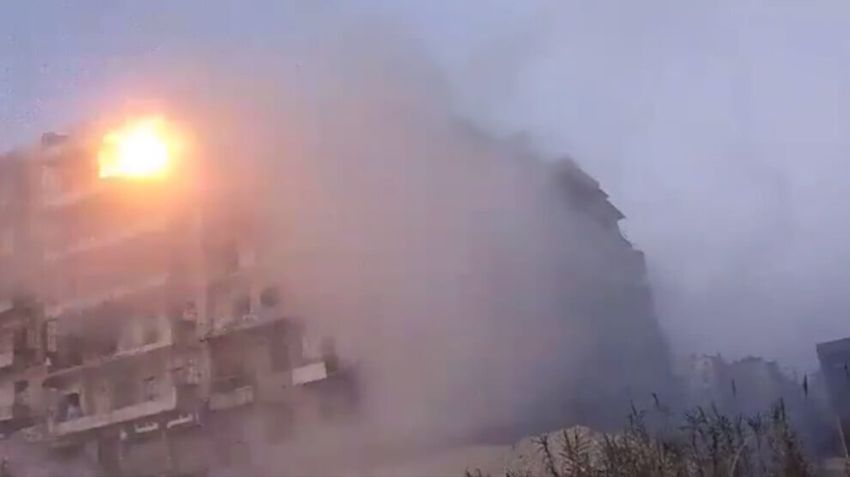
Ilham Ahmed, foreign affairs co-chair for the Autonomous Administration of North and East Syria, has denounced it as “a war of extermination against the Kurds”.
Syrian-government-backed forces’ small-scale attacks against the autonomous Kurdish-majority neighbourhoods of Aleppo took on a new and lethal dimension, on January 6.
This was just two days after the long-awaited meeting between leaders of the Autonomous Administration’s Syrian Democratic Forces (SDF) and the Syrian Transitional Government came up against a solid wall of government intransigence; and just hours after Syria signed an accord with Israel in Paris, where the Syrian foreign minister also met with the Turkish foreign minister.
Over the past year, fighters under the overall authority of the Syrian government have carried out brutal sectarian attacks against the country’s Alawites and Druze. Now, as long feared, it is the turn of the Kurds — specifically, of the inhabitants of the Aleppo neighbourhoods of Sheikh Maqsoud and Ashrafiyeh.
These neighbourhoods, home to half a million people, established their own autonomous structures during the Syrian civil war, but are isolated from the rest of the Autonomous Administration, and so are especially vulnerable. They suffered long blockades under the government of Bashar al-Assad, and now Syria’s new leadership, under pressure from Turkey, is putting them under even greater threat.
Last year
When, at the end of last year, years of international intervention enabled Ahmed al-Sharaa (al-Jolani) to oust Assad from Damascus, Turkish-backed militias took advantage of the power vacuum to attack the Autonomous Administration. Under Turkish tuition, they had long been persuaded that the real enemy was not Assad or ISIS, but the Kurds.
On that occasion, al-Sharaa, who had his eye on the main prize, deflected these anti-Kurdish groups away from Aleppo; and he was also able to use his more disciplined Hay’at Tahrir al-Sham (HTS) forces to temper some of the groups’ worst excesses in Tel Rifaat. However, he felt the need to keep these groups on side, and leaders notorious for their sadistic violence were given important roles in the new Syrian army.
Al-Sharaa and Mazloum Abdi, commander in chief of the SDF, signed an agreement in March that was supposed to provide a framework for talks on integrating the Autonomous Administration into a new Syria. Another agreement was signed the following month to secure the immediate future of Maqsoud and Ashrafiyeh.
This latter agreement was intended to allow practical integration of services with the rest of Aleppo, while leaving local control in local hands. The SDF withdrew, but left in place the local internal security forces, the Asayish. The agreement provided hope, not just in itself, but as an example of wider possibilities for the rest of the country.
Turkish/Kurdish ‘peace process’
Events in Syria were taking place in parallel with the tentative peace process in Turkey. Abdullah Öcalan’s public call for the dissolution of the Kurdistan Workers’ Party (PKK) was made at the end of February, and its dissolution was agreed by the PKK Congress in May. The desire to proceed with this dissolution process — as well as determined Kurdish resistance — brought an uneasy pause to Turkish aggression in Syria. Kurds began to dream that their century of oppression following the Treaty of Lausanne might finally be reaching an end.
In more recent months, there has been a repeated pattern of hopes lit up only to be extinguished, sometimes within a day. Now, this year has opened with an icy blast that would put out less persistent flames.
Within Turkey, the government has not made any concrete changes that could encourage the belief that they are aiming at anything more than the end of the PKK. Elected Kurdish politicians and thousands of other Kurdish activists are still in prison — where they have been joined by leading members of the main opposition Republican People’s Party. Ministers are insisting that the dissolution of the PKK also means dissolution of the SDF, which is a separate organisation and has never threatened Turkey.
Turkey in Syria
For the Turkish government, the March agreement between Syria and the SDF has become a tool for creating propaganda against the SDF and the Autonomous Administration. It has made sure to pressure Syria to block any sign of progress towards a detailed agreement, and then blamed the SDF for obstruction. In this way, it has set up its justification for military coercion. In mid-December, Turkish foreign minister Hakan Fidan claimed that Turkey didn’t want to resort to military means but its patience was running out.
The Autonomous Administration is determined to preserve the basic rights and freedoms for which 12,000 men and women gave their lives. It expects the Syrian government to engage with its concerns about democracy, multicultural coexistence, secularism and women’s rights, and will not relinquish its ability to defend itself in order to hand over control to a government that has overseen attacks on ethnic minorities. Reaching agreement was never going to be easy, however, it is Turkey’s intervention that has made it impossible.
Alongside influencing Syrian politicians, Turkey continued to encourage its militias — now officially part of the Syrian army — to carry out low level attacks on North and East Syria with a view to making it ungovernable, and so reducing support for the Autonomous Administration. They also hoped to goad the SDF into a reaction that it could portray as SDF aggression.
Under Turkish pressure, the Syrian government restricted movement between the Autonomous Administration and the rest of Syria, and, like Assad, it put a blockade on Sheikh Maqsoud and Ashrafiyeh. This has been in place for more than six months. It has been blocking electricity supplies and diesel for generators.
Even before the intensified attack that began on January 6, Turkish-backed groups carried out lethal attacks on the autonomous neighbourhoods, and attempted provocations. On New Year’s Eve, Turkey’s defence ministry stated: “If the Syrian government decides to take an initiative for unity and integrity, Turkey will support it.”
The Syrian government’s actions against the Kurds have tended to take place soon after meetings with Turkish leaders. In addition, Syria’s recent agreement with Israel may have given Turkey and Damascus confidence that Israel would not stand in the way of their attack on the Kurds.
January 6–7
In the latest actions, Turkish-backed groups were soon joined by groups from (the now dissolved) HTS, and even — as spotted in videos aired by Al Jazeera — by fighters proudly sporting ISIS patches. Many of the groups are the same that took part in the massacres of Alawites and Druze, including groups sanctioned for their extreme violence by the United States and Britain.
On the afternoon of January 6, these forces attacked the autonomous neighbourhoods with heavy weapons and tried to enter with tanks and armoured vehicles. They forced the Syriac Christian population of an adjacent area to vacate their homes so that this could become a base from which to attack.
The Syrian army announced that after 3pm on January 7 the two neighbourhoods would be considered a military zone, calling on all inhabitants to leave. Thousands decided to escape the impending attacks, but many more remain. There have been reports that some of those who left were abducted, and even used as human shields in the attacks. By the end of the day, the two neighbourhoods had counted eight dead civilians, including two children, and 55 wounded.
SDF commander Sipan Hemo observed, “The people of these neighbourhoods have stood firm against every kind of attack and siege for more than fifteen years ... Sheikh Maqsoud and Ashrafieh will remain as impregnable fortresses of resistance, unbowed and unbreakable.”
The West’s short-sighted support for the HTS takeover of Syria may have left these Aleppo residents with few options, but there are very real fears that Syria could be heading for a further phase of brutal civil war.
International response
The scale of the attacks and the dangers they present have brought them to world attention, but many reports adopt a “both side-ism” in place of analysis, failing to call out the absurdity of Syrian government claims, or to ask the question: Who gains from this conflict? It isn’t the Kurds. Calls like that of the United Nations for all parties to de-escalate only serve to whitewash the aggressor.
We have learnt not to expect any moral leadership from our governments, but we cannot stop applying pressure for change, and that begins by analysing what is really happening.
[Sarah Glynn is a writer and activist — visit her website and follow her on X or Bluesky.]