
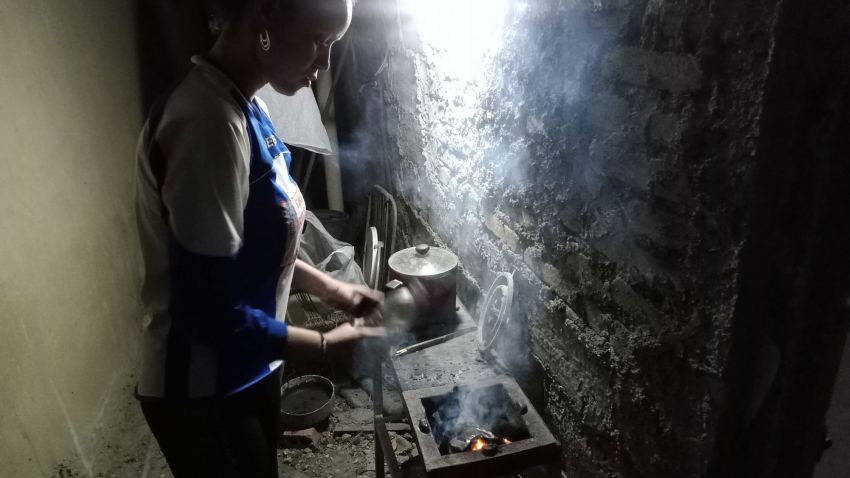
Cuban women cooking dinner in the dark with charcoal. Images of these scenes have become representative of the especially harsh period the country is going through at the moment, but they also highlight resourcefulness and resilience.
“Blackouts are lasting more than 24 hours. Sometimes we get three hours of electricity, but that’s not enough time for things to cool down in the refrigerator. You have to cook what you’re going to eat that day because it will spoil. And how do you do that when you work and have to go to the city, eight kilometres away, to buy what you need?” says Caridad Curbelo Crespo.
With the United States stopping other countries from selling oil to Cuba, there’s no fuel for the transport to cover those eight kilometres.
US President Donald Trump signed an executive order on January 29, declaring a national emergency regarding Cuba and establishing a system of tariffs on products from countries that supply, directly or indirectly, oil to the Caribbean nation. Since then, everything has become more difficult, Curbelo says.
Two weeks after the executive order, Cuba is experiencing a critical fuel shortage. At the start of February, the Financial Post reported the country had only 15–20 days’ worth of oil remaining. As a result, gasoline is being rationed and most transport services have been suspended, which in turn affects distribution of food and other goods. Patients can’t get to hospitals due to lack of transportation.
Cuba now produces about 1000 megawatts of electricity — 38% of its daytime output — from solar panels. For the rest, it counts on oil. Cuba does produce some oil itself, but the amount is minimal. The lack of power has led to long daily blackouts, with cooking, refrigeration and food production harshly impacted. Water pumps and communications are severely affected, and school and work hours have been reduced.
The Trump administration’s stated goal is to pressure the Cuban government. The real effect, as documented by the testimonies of those who live on the island, is the collective punishment of a population already worn down by six decades of US sanctions.
This type of mass “punishment is a crime”, said Carlos Fernández de Cossío, the Cuban foreign affairs minister, on X, referring to collective penalties and methods of intimidation that are prohibited under international law in the Fourth Geneva Convention.
Curbelo is 80 and lives with her brother on the road to Viñales, Pinar del Rio, in the west of the country. She is retired, but she continues to work. “We have both wanted to stay active, and our health has allowed us to do so,” Curbelo explains to Truthdig, speaking of herself and her brother. “Plus, we need that money to make ends meet, because the pension isn’t enough to live on, especially with this crisis.”
Curbelo works in an office of the Credit and Services Cooperative, an agricultural production organisation in Cuba, several kilometres from her home. Her brother is a guard at a medicinal plant cooperative. When she talks about the current difficulties, she doesn’t separate work and domestic struggles: They are one and the same, she insists.
“Women feel it twice as much, because in addition to working outside the home, we also have to worry about household chores. I, for example, am the one in charge of everything: cooking, washing, cleaning, even the shopping. In my house, it was always like that, and now that we’re old, things haven’t changed.”
The blackouts, Curbelo says, have added to her burden. She normally cooks with electricity because cooking gas is rationed. “Sometimes I can only buy one gas canister a year,” she says. Now, she’s had to return to using charcoal.
“It’s more work, but it’s not new to me. My mother always had her charcoal stove. The thing is, a sack of charcoal is very expensive now; 1500 pesos [US$58, A$82] is the cheapest option,” she says.
Suffocation as a strategy
The energy crisis is not an isolated phenomenon. It compounds already existing problems — inflation, currency shortages, deteriorating infrastructure — and increases the impact of financial and commercial restrictions by the US that already make importing fuel, as well as basic supplies and medicines, expensive and difficult.
“The tightening of the US blockade against Cuba is part of the Trump administration’s strategy of territorial control over the American continent,” Pável Alemán Benítez tells Truthdig. He is a professor and researcher at the University of Havana and an analyst on international affairs.
“They saw a window of opportunity in the weakening of international institutions, especially if we take into account what has happened in Gaza, where they have literally flouted the United Nations. They have tried to replicate that model of action in the Americas.”
With the January 29 executive order, they are aiming for the collapse of Cuban society, a breakdown of its social fabric based on the population’s exhaustion from all the restrictions that the lack of energy imposes on daily life, Alemán says. “It makes life very uncomfortable for the ordinary citizen. In any country, this tends to be reflected in an increase in social protest, and that is what they are seeking in order to destabilise the government,” he said.
In his view, Trump’s actions stem from “an old longing to get rid of one of its longest-standing adversaries, located just off the coast of the United States. Put simply: to get rid of the bad example of Cuba.”
“The Trump administration applies pressure with tariffs on all countries in the international community, but particularly on those with greater dependence on the US market. That places them in a privileged position to impose conditions,” Alemán says.
“The blockade has deeply affected the Cuban economy. Having to import from distant markets has increased the freight and maritime costs. Many people are unwilling to trade with Cuba because of the risks involved with the sanctions. Financial institutions know this perfectly well: Banks from all countries, including European ones, have received multimillion-dollar fines,” he says.
Referring to the centrality of Venezuela in this crisis — following the kidnapping of President Nicolás Maduro on January 3 in a US military attack on Caracas — Alemán points out that “they started with Venezuela for several reasons”. To secure oil in case of a major global crisis, but also to kill two birds with one stone: weaken a government allied with Cuba and cut off the petroleum that Venezuela supplied to Cuba for 25 years in exchange for Cuban medical services, he says.
“Cuba at one point imported up to 110,000 barrels of oil per day from Venezuela, which covered all of its import needs. That figure has been declining, and with this abrupt cutoff … things here have gotten much worse,” Alemán says.
Mexico was the second-largest supplier of oil to Cuba in 2025. But it “is being pressured by the US over the possibility of tariffs if it exports oil to Cuba. Mexico has a strong economic relationship with the US. This would not be a minor issue. It calls into question the ability of states to make sovereign decisions,” he adds.
Last Thursday [February 12], Mexico sent more than 800 tons of humanitarian aid on two ships, and President Claudia Sheinbaum said her country is open to receiving aid from other countries to send on to Cuba. But they have not sent oil.
Hence Alemán believes the Cuban government “must make quick and assertive decisions, concentrating resources to guarantee basic services for the population”, including “increasing domestic oil production to cover the deficit. Energy consumption will be reduced, and ordinary people living in residential areas will be most impacted,” Alemán says. Adding to the difficulties, he says, are the frequent breakdowns of the country’s thermoelectric plants due to ageing equipment that isn’t easy to replace given the blockade.
The Cuban government has recognised the seriousness of the situation. President Miguel Díaz-Canel Bermúdez announced, on February 5, measures to face what he called an “energy blockade”, and denounced the US’ strangulation strategy: “What right does one nation have to prevent another country from receiving fuel?” he said.
The government has since detailed various measures, including speeding up the delivery of solar power systems to homes, shortening office hours to Monday through Thursday, reorganising the education and the health systems, suspending public transit services and limiting national train operations to one departure every eight days.
Energy and Mines Minister Vicente de la O Levy announced that fuel sales in national currency are being postponed while sales in US dollars are being limited to 20 litres (5.2 gallons) per customer per purchase, with purchase days allocated by an app. Fuel supplies for aeroplanes leaving the country have also been suspended for a month.
“What is taking place is an exercise in domination, not hegemony. The US had a key instrument for generating hegemony: USAID [US Agency for International Development], which carried out development aid projects. Trump eliminated USAID. That reveals they are not interested in influence, but rather are banking on the use of hard power: military and coercive measures with tariffs,” says Alemán.
Unequal weight of the siege
Vicente Infante Martínez, 73, a retiree, lives in the Celso Maragoto neighbourhood of Pinar del Rio. He considers himself “privileged”.
“I live in an area where they respect the planned schedules: 6×6 during the day and 4×4 at night. In other areas, blackouts can last more than 24 hours and you never know when they’ll cut the power,” Infante says. The term “6×6” is shorthand for six hours with electricity and six hours without. This relative predictability allows him to organise when to cook and when to store water. But some things are beyond his control.
“They supply water every 30 days. That leaves me without reserves. I can’t pay for a water truck to provide more water because they charge more than 4000 Cuban pesos, my entire pension. And they don’t even come to my home because of the poor condition of the streets. I live alone, and this is a huge complication, because I can’t carry water from the aqueduct 500 metres from my house. I’ve been without water for weeks on more than one occasion,” says Infante.
Inflation is devouring the pensions of retired Cubans living in an ageing country. Cuba ended 2024 with 25.7% of its population 60 or older, one of the highest percentages in Latin America and the Caribbean.
“Retirees are among those suffering the most from this crisis. The medications prescribed for my high blood pressure and heart condition — I have to buy them monthly on the informal market because they’re not available in pharmacies. The cost is almost double my pension. So how do I buy food?” says Infante.
His children help cover his expenses. “I’m aware that these days, an older person without family support can’t cover their basic needs,” says Infante.
Arletis Arronte Quintana, 30, lives in the same neighbourhood as Infante. Until a few months ago, she worked as a cashier at a private restaurant. Then she gave birth and has been on maternity leave. Maternity leave in Cuba is available until the baby is 15 months old and provides for a payment of 60% of the parent’s average monthly salary.
In addition to the elderly, economic difficulties also affect women more acutely. María del Carmen Zabala Argüelles, a doctor in psychological sciences and coordinator of the Social Inequalities and Equity Policies department of the Latin American Faculty of Social Sciences, FLACSO-Cuba, has documented how economic deterioration reduces female participation in formal employment and increases informal survival strategies. Similarly, sociologist Mayra Espina Prieto has explained that structural inequalities — of gender, age and territory — do not disappear in crisis scenarios. They are instead reconfigured and, often, deepened.
In practice, this can mean more hours of unpaid domestic work for many women, more care-giving, and more physical and emotional stress when basic services are lacking. It is often women who have to cook with charcoal or fetch water in buckets. Caring for sick people without the use of fans or adequate refrigeration in tropical Cuba can be challenging.
“I earned a good salary, and that allowed me to easily cover the basic needs of my mum, my grandmother and myself. They are retired, they get a pension, but it’s not enough these days. I’ve always been the one supporting the household,” Arronte says.
“I’m worried about our economic situation. Basic supplies, medicines … they keep getting more expensive. With older people [her mother and grandmother] and now a baby at home, that’s always a greater expense that you have to prioritise.”
Arronte says she used some of her savings to buy a small power station, to be able to run fans and plug in the fridge. She is now using charcoal for cooking, though. “I remember my mum cooking with charcoal during the 1990s. I never thought I would have to experience the same thing in this same house,” she says.
She acknowledges that she’s not among those worst off. “But this crisis affects all of us in some way. I made a lot of personal sacrifices — of my time, my health, my energy — to have some savings, to be able to travel, to get ahead. And I see how [those savings] lose value by the day, how they’re disappearing just to guarantee survival. There’s no clear horizon for improvement,” she says.
Health impact
According to a report Cuba presented to the United Nations in May last year, the US blockade caused damages totalling $7.56 billion [A$10.65 billion] between March 2024 and February last year, an increase of 49% from the previous period. Accumulated over more than six decades, blockade damages amount to over $170 billion [A$240 billion] at current prices. In the health sector, losses exceeded $288 million [A$406 million] during that period. There were 364 medications in short supply. At the time of the report, some 94,000 patients were on a waiting list for surgery, including nearly 10,000 children.
Cuba’s National Institute of Oncology and Radiobiology (INOR) reported that the US blockade is leading to shortages of chemotherapy drugs and forcing health institutions to modify protocols and adjust dosages. In paediatric oncology, medications such as lomustine and methotrexate have had to be replaced with second- and third-line drugs that are less effective. Survival rates for some childhood cancers have dropped from 75% to 60%.
“We have to reinvent ourselves every day,” Dr Mariuska Forteza Sáez, head of INOR’s paediatric oncology service, told Granma, in response to Trump’s latest measure. It means even more uncertainty regarding medical supplies and electricity in hospitals, which is a serious concern for life-support services in intensive care units.
Work brought to a halt
Estrella Acosta, a homemaker and seamstress, lives in Old Havana. The capital is not immune to the blackouts either. She says that at the moment, the water supply is also a source of stress. Her area already depends on water purchased from trucks. “Due to the fuel shortage, the [delivery] cycles have become more spaced out,” she tells Truthdig.
She uses her sewing machine to earn an income, “But it’s already hard for me to sit down. The number of hours of electricity is barely enough to survive, to cover the basic tasks,” she says, let alone use her machine and work.
Other workers are also affected by the tightening of the blockade. D’Madera Habana, a furniture design, manufacturing and restoration business, marked its second anniversary this month. The owners posted on social media that they were celebrating their anniversary and still operating. But, they noted, in January, they lost 76 work hours due to the energy crisis, “a 39.5% drop in our productive capacity and an equal reduction in our income”. To cover the worsening electricity situation, they are working weekends and at night.
Low productivity reduces income, which causes the workforce to migrate to other sectors less dependent on energy.
In the town of Falla, a rural area in the municipality of Chambas in Ciego de Ávila, more than 400 kilometres from Havana, the Mary Fe, Love and Life project, founded by Maylie Sánchez Jiménez, makes and distributes textile breast prostheses for women who have had mastectomies, for free. The project was developed after Sánchez’s mother’s breast cancer experience, and now her mother plays an essential role in the work.
But in Falla, there are now barely one or two hours a day of electricity. That “time that must be distributed precisely between income-generating production and the [unpaid] creation of prostheses,” Sánchez tells Truthdig. Even so, the workshop remains a space for employment and growth for women in vulnerable situations.
In Britain, more than 100 parliamentarians, union leaders, academics and cultural figures signed an Urgent Appeal for Peace and Sovereignty launched by the Cuba Solidarity Campaign. Former Labour leader Jeremy Corbyn, economist Yanis Varoufakis and 25 union general secretaries were among those who signed and demanded the British government and the European Union “unequivocally oppose any threat or use of military force against Cuba”. And on February 12, UN experts issued a joint statement condemning Trump’s executive order as a “grave violation of international law”.
Meanwhile, here in Cuba, daily life reveals the reality of the siege: that of life organised day by day, hour by hour, amid blackouts, shortages and the will to carry on.
[Reposted with permission from Truthdig.]