
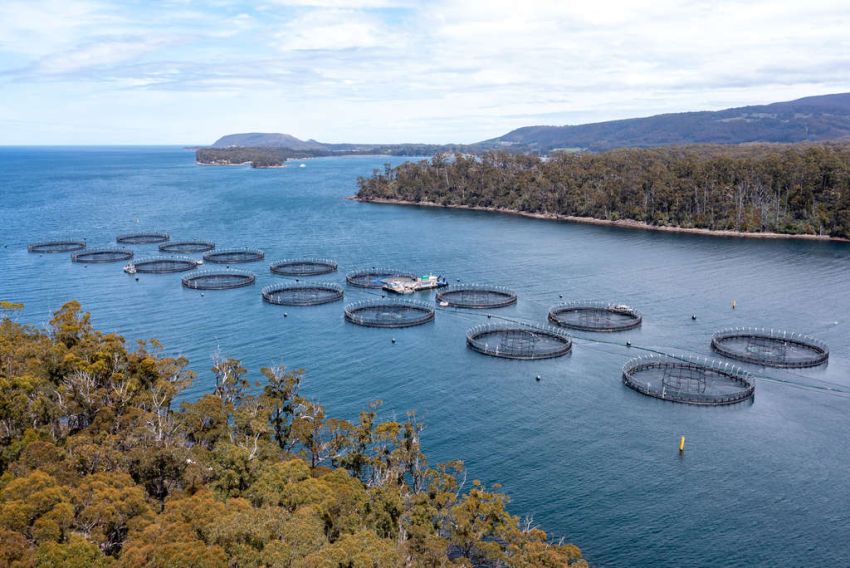
Permission for salmon companies to use the antibiotic florfenicol in south-east Lutruwita/Tasmania may be suspended by the federal regulator only four months after approval was granted, as traces of the drug have been detected in wild species well outside the assumed impact zone.
Florfenicol, manufactured by Abbey Laboratories, is used to treat the bacterial disease Piscirickettsia salmonis, which was identified as the immediate cause of a mass die-off in 2024. Fish fragments washed up on beaches and 15,000 tonnes of dead fish had to be disposed of.
Warming coastal waters and the density of vertical salmon pens combine to produce ideal conditions for the bacteria, which is now being treated as an epidemic.
A document released last October, following a freedom of information application by the Tasmanian Inquirer, found the mortality rate at a Huon Aquaculture site on the D’Entrecasteaux Channel had quadrupled in one year, with tests identifying Piscirickettsia salmonis in 60% of cases.
Last November, Abbey Laboratories applied to the Australian Pesticides and Veterinary Medicine Authority (APVMA) to start using florfenicol; it was a pre-emptive measure aimed at avoiding a similar mass die-off.
Once granted, the public and other commercial fisheries were warned against catching fish and other animals within three kilometres of the salmon pens to avoid trace contamination of florfenicol.
All fish species, except Atlantic salmon, must be trace-free to meet local and international criteria for sale. Even fishing vessels passing through waters affected by florfenicol are likely to become contaminated, as most rinse catches using the surrounding sea water.
The Tasmanian Department of Natural Resources and Environment advised that traces of the antibiotic can remain seven days after its use. Since last November, florfenicol has been used at 16 sites across the south-east.
The ABC reported on February 19 that studies by the Institute for Marine and Antarctic Studies had found traces of florfenicol more than 10 kilometres from the closest salmon pen dispensing the antibiotic.
Since then, community groups, commercial fisheries and the Greens have protested its use, prompting the APVMA to consider suspending Abbey Laboratory’s license to continue using florfenicol after March 2.
While the Liberal government has maintained that the antibiotic levels detected do not pose a direct threat to humans, an antibacterial resistance expert from the University of Queensland, Professor Mark Blaskovich, told the ABC that the situation is “ideal for generating resistance”.
“It’s a sub-lethal concentration of an antibiotic where bacteria that are exposed to it are able to develop tolerance to it because it’s a level where it’s not rapidly killing them.” He said “it’s highly likely that that can make its way through the chain and potentially make its way in bacteria that can infect humans”.
Meanwhile, the World Health Organisation declared in November 2023 that anti-microbial resistance through the overuse and misuse of antibiotics is “one of the top global public health and development threats” the world faces.