
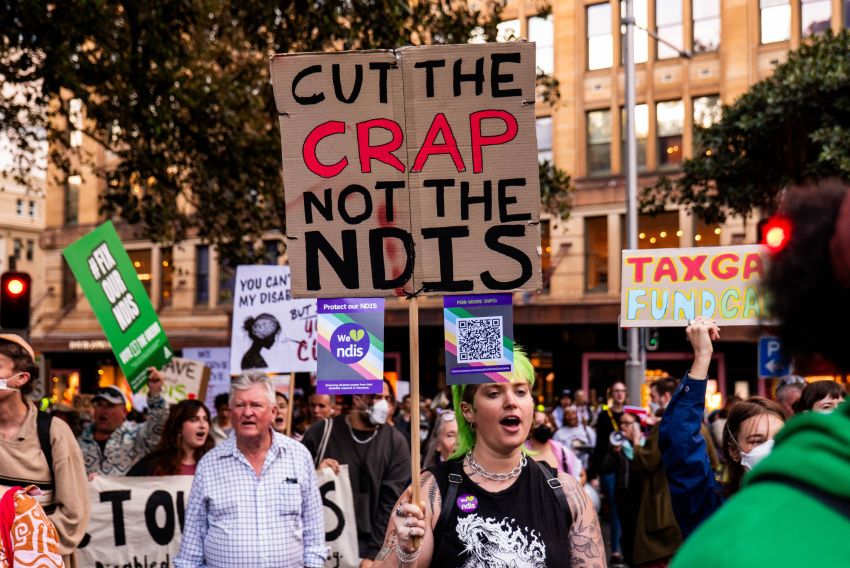
Federal Labor cut $37 billion from the projected cost of NDIS to 2030. Much of the “savings”, concentrated in the final two years, will throw 160,000 existing participants off the scheme and deny access to a further projected 140,000.
New applicants will have to show that they have exhausted all available mainstream treatments (that might otherwise mitigate their impairment being permanent).
These cruel cuts are aimed squarely at persons with psychosocial disability. The “value for money” approach is focused on budgetary considerations, not the humans.
Robo-planning will start from January 1, 2028 with standardised assessments to determine eligibility to be done by an NDIS officer who does not have to be a skilled professional (such as an occupational therapist).
The new approach to NDIS participants’ support budget is going to be determined by a calculation of functional capacity — the lowest common denominator, with any whiff of individual consideration removed.
Children under nine will be diverted to the Thriving Kids program, which will have a much lower level of support and will be run by the states.
Those who NDIS excludes will be diverted to “foundational supports” (whatever they prove to be). The federal government foreshadows spending $5 billion over 5 years, for this, with additional $5 billion expected from state governments.
NSW Premier Chris Minns has already said that Foundational Supports will not be like-for-like with NDIS. He means that they will be threadbare.
There will also be cuts to community supports and capacity building, although exactly how much will be cut has not been said.
These cuts will divert the NDIS away from self-directed supports, enabling community interaction, to simply providing basic in-home support to sustain life is an enormous change to the scheme.
Neoliberal correction
This is how My Aged Care has evolved — another marketised support system that provides graded assistance for the elderly on a means-tested basis.
The limitations of such a system are self evident. There are now waiting lists of around one year for people to receive in-home supports get into an aged acre facility. Reports have surfaced that some elderly people have not been able to afford support to have a regular shower.
I am not suggesting that this is exactly where NDIS will end. This is because it caters for a more diverse range of participants and, potentially, a more activated community which has historically fought for the kinds of choice and control that made up NDIS.
But the aged care cuts could be a harbinger of how far government might go with NDIS.
It is also important to note that many of the aspects of this NDIS plan mirror those that the federal Coalition government under Scott Morrison floated five to six years ago. Back then Labor opposed the robo planning changes.
Alliances needed to resist
It is critical that those with capacity campaign against these cuts. If the government succeeds with this round, it will push for more cuts next time.
The ruling class wants the government to go further. According to its chief mouthpiece, the Australian Financial Review, it wants NDIS means testing to be introduced and access limited to 65 and under (already the case for eligibility). They want to throw participants onto the aged care system when they turn 65.
Only broad alliances will be successful in defeating such attacks.
Currently there are 760,000 NDIS participants, around 2.7% of the population of 27.7 million. Cutting the number of participants to 600,000, would reduce that to around 2.2%. Many people with disability are not easily able to take to the streets, so if we are to have a chance in turning these attacks around, people with disability need allies.
First among these are those who provide support, many of whom only receive low wages and do the work out of an enduring social commitment.
Another potential ally are new migrants, given that many are support workers, some on visas with reduced rights themselves. This cohort are also under attack, particularly by Pauline Hanson’s One Nation and the Coalition, the latter proposing to deny NDIS to all non-citizens.
First Nations peoples are another possible ally. While their rights are continually under attack and they make up less than 4% of the population, they know how to successfully forge alliances.
Finally, we need to win over working people who are being sold the lie that the NDIS is “out of control” and that NDIS participants have special access to schemes at their expense.
We have to patiently explain that our access to assistance does not give us anything that able-bodied people do not already have. In fact, the assistance provided by NDIS means that we (at least, some of us) are able to join the workforce. For others, it allows our family — particularly the women — to be able to work and participate fully in society.
Build back better
The Socialist Alliance (SA) does not think that it is enough to simply say that NDIS needs to be defended. We say the cuts need to be reversed and that the attacks need to stop. But we think we could do better.
Australia is a wealthy country and budgets are a political choice. The government did not have to attack NDIS to reduce the deficit: this was its neoliberal decision to attack those least likely to effectively fight back. NDIS participants are an easy target to claw back billions of dollars for an already underfunded budget, particularly after a sustained demonisation campaign with claims of rorts, speculation about over-charging and fraud committed by “unregistered”
providers.
It is not the first time that we’ve come under attack: the Coalition and Labor have a history of scapegoating the disadvantaged and cutting, or severely restricting, social programs, rather than taxing capital and wealth fairly.
Students, the unemployed, single parents, migrants and refugees have all been targeted by the major parties. Now it’s the turn of people with disabilities.
Labor has other options to reduce its budget deficit. It could reduce military spending. AUKUS will cost $368 billion for a bunch of second-hand, clapped-out submarines that may never actually arrive but means that Australia can play a bigger role in encircling and intimidating China.
Labor could have imposed a 25% tax on gas exports or nationalised the fossil fuel industry and used the funds to rapidly transition to renewables.
The Australia Institute suggested a 2% tax on the wealthy with assets of more than $5 million — the wealthiest 1% — would raise over $41 billion a year.
It is important to go beyond the actually existing for-profit and privatised NDIS system to take profit out of the equation. Taking a leaf from the Indigenous rights movement, SA campaigns for disability control of disability affairs. Rather than vesting NDIS to over-paid bureaucrats, it should be people with disability themselves and their families who lead it.
Currently, NDIS millionaires enjoy profits of between 20–40%, paid for by the public purse. SA believes that the NDIS should transition to a community-run, not-for-profit system, which retains the best elements of the choice and control, but moves away from the exorbitant costs, which are largely determined by private providers needing to maximise their profit.
This is the real rort being perpetrated, not some confected idea that micro businesses are ripping off the public purse.
Calling for the nationalisation of the NDIS is an empty slogan. Those who have spent time in the neoliberal public hospital system know that the impersonal, bureaucratic underfunded and unaccountable way it operates is enough to save a life, but it is certainly no way to live.
NDIS is a frustrating, inadequate and unpredictable scheme, with a limited system of supports. However, SA acknowledges that it is better than the inconsistent and bureaucratic systems run by the states which preceded it.
[Graham Matthews is the disability spokesperson for the Socialist Alliance.]